
Virginia parents and students are all too familiar with SOLs, the commonwealth’s Standards of Learning exam administered annually to the vast majority of students used to measure student, district, and state educational achievement.
NAEP – an exam administered to a representative sample of American students – is also familiar nomenclature, though generally less-well understood by parents, students, and even some educational professionals.
Both exams receive extensive media coverage.
The 2026 SOL results were released in August and had an air of mostly good news. In broad strokes, math and reading scores were up marginally, with a few districts realizing notable gains.
The recently released “statewide assessment results reflect progress in our classrooms, with combined math and reading scores of students in grades 3–8 rising slightly across the state,” said Secretary of Education Dr. Jeffery Smith.
NAEP exams are administered every two years. Often called “The Nation’s Report Card,” the results are frequently referenced as a check on state scores. Under Gov. Glenn Youngkin – the last governorship for which we have NAEP data – Virginia was faulted for an “honesty gap.” That is, SOL scores showed more students were performing at a “proficient” level than NAEP scores showed.
Which is the better record of academic performance? It depends on who is asked. Educators will point to the SOL exams, because they are geared toward the state curriculum. In short, the questions students receive are based on material they covered in class. It’s the most clear test of what students are learning.
Critics, pointing to shifting cut scores and changing tests, will point to NAEP as a better measure – a check on the test, if one will. NAEP questions are not geared toward any state’s standards, but rather are set by the National Center for Education Statistics and the National Assessment Governing Board. It is a more-steady yardstick, but not without its challenges. (See Tom Loveless’ dated, but still valuable, “The NAEP Proficiency Myth”)
Few parents, however, are familiar with an exam that serves as a check on the checks.
The Tower of PISA
Since 2000, an exam has measured academic performance around the globe. Administered every three to four years, this representative sample test is known as the Programme for International Student Assessment, or PISA.
“PISA is the world’s largest international comparative survey of 15-year-old students,” according to its website, “assessing the extent to which they have acquired key knowledge and skills essential for full participation in social and economic life. The survey’s core domains are mathematics, reading and science, and the focal core domain rotates with each PISA cycle. Additionally, each cycle includes an innovative domain.”
Last week, the most-recent PISA results were released, and the results offer important insights for those evaluating how America’s students are performing.
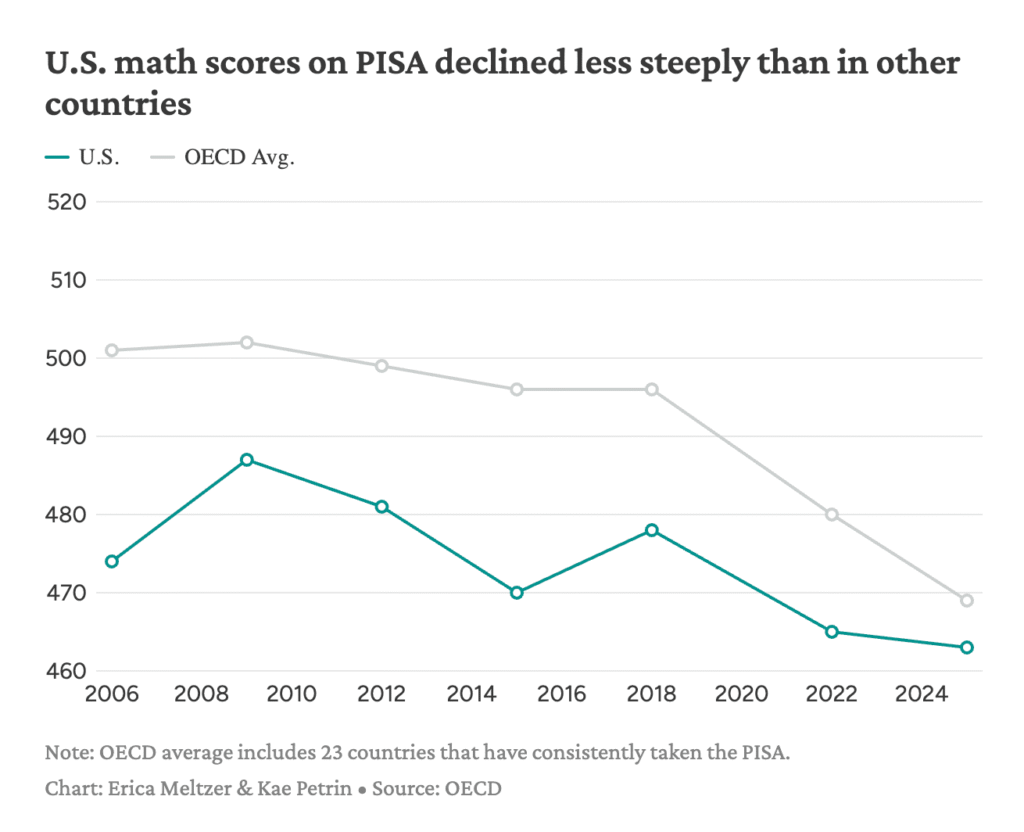
Reaching for the Basement In Both Reading and Math – The United States has struggled to compete internationally in the foundational subjects of reading and math, and the 2025 PISA results show that students are at historically low levels. As reported by the Center for Education Reform, “OECD’s triennial PISA measures student proficiency of 15-year-olds in Science, Reading, and Math in 91 countries. Compared to 2022, this year’s results for the United States show an increase of 3 points in Science (still back to even with 2009), a decrease of 14 points in Reading, and a decrease of 2 points in Math (still 24 points down from 2009!).”
The U.S. Is Far from Alone – More concerning than the poor performance of U.S. students, however, is the falling-off-the-table-top performance of students across the globe. Continuing a decline that began in 2012, students in the 38 industrialized Organisation for Economic Co-operation and Development (OECD) nations industrialized countries have seen their scores plummet.
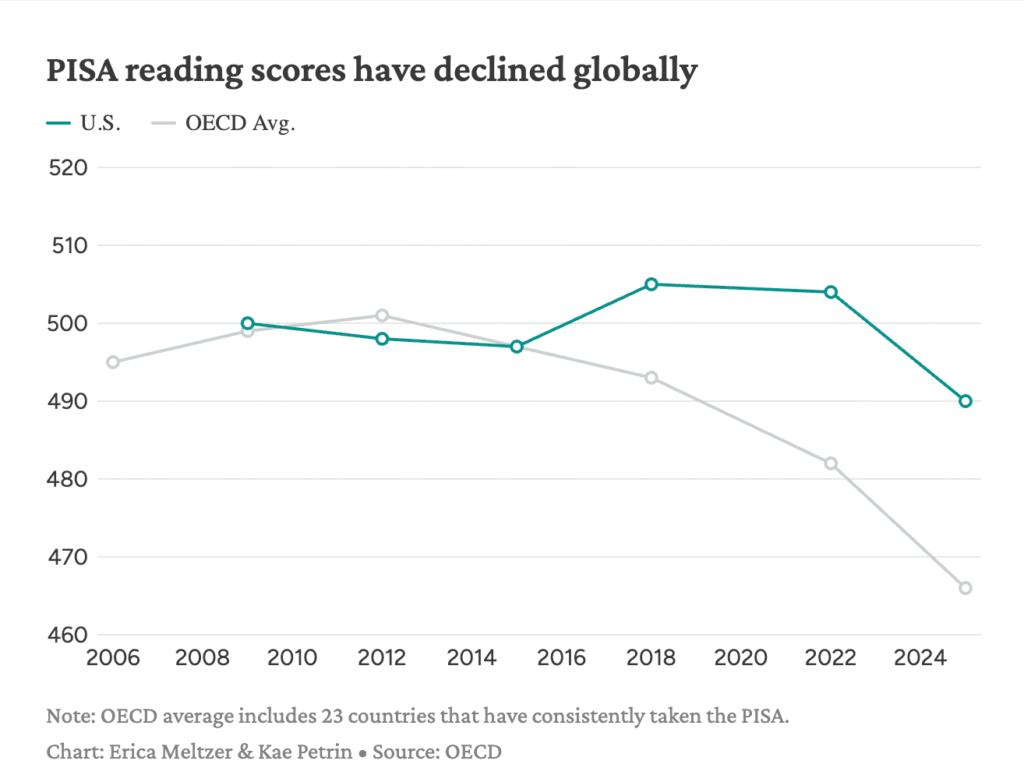
Blame … ? – Technology is frequently pointed to as the cause for this decline, and it’s likely a factor. But how is technology affecting student performance? Part of the answer may lie in shortening attention spans. The PISA report found that “The proportion of accurate and fluent readers declined by about seven percentage points between 2018 and 2025. The proportion of hasty readers – those who gave fast and incorrect responses – increased by about five percentage points, on average, from almost 7% in 2018 to 11% in 2025.”
The PISA report goes on to say that “PISA 2025 students, who were born in around 2009, grew up during a period of rapid change and diffusion of personal electronic devices, which may have altered reading habits, favouring shorter, fragmented digital engagement over sustained reading.” Such “fragmented digital engagement” may lead to habits that detract from sustained reading, which is “strongly associated with the development of reading comprehension.”
Harbinger or Bellwether?
While the overall numbers for U.S. students are poor, they do not show the rapid decline evidenced in other OECD countries. The question is whether the OECD collapse is a harbinger of steeper declines to come in the U.S., or if efforts to strengthen reading and math skills in the U.S. since COVID – if not reversing the slide in achievement – are a bellwether pointing to better performance in the future.
It is too early to make that judgment, but there is space in thinking through that question to explore the proper role that artificial intelligence can play in that process.
Andreas Schleicher, the OECD director of education skills, pointed to the pronounced score gaps between Western and Eastern nations to show that the challenge with AI isn’t whether to use it or ignore it, but how best to use it.
In Western countries, he said, schools tend to use the technology to “make things easier for kids.” In Asian countries, by contrast, teachers tend to use it “to make students think harder, work harder.”
Teaching Matters
American government leaders over the past 25 years have been consumed with controlling the classroom. Standardized tests geared to rigid state standards leave teachers little room to go deep on important subjects, review material students are struggling with, or deviate from the subject matter when class interest merits it.
Further, political fights over content – especially in history and English – are stymying teachers, concerned about stepping on a landmine that could cost them their job should they say the wrong thing to the wrong student.
The pressure is having a negative impact on the profession. Teachers are increasingly pessimistic about the future of the profession, overly stressed in the classroom, and feeling unsupported by parents who too infrequently engage in their child’s learning.
The answer to seeing the improvements that everyone wants to see is to begin trusting the people most directly responsible for academic achievement. The teachers.
Schleicher notes that understanding the gulf between student performance in the West and in Asia likely owes a great deal to putting great people in the classroom.
“In the U.S. if you make a choice between a better teacher and a smaller class, you typically choose a smaller class,” he told The Hill. “In [Asian] countries, they save on the class size, but they get the best people to become teachers.”