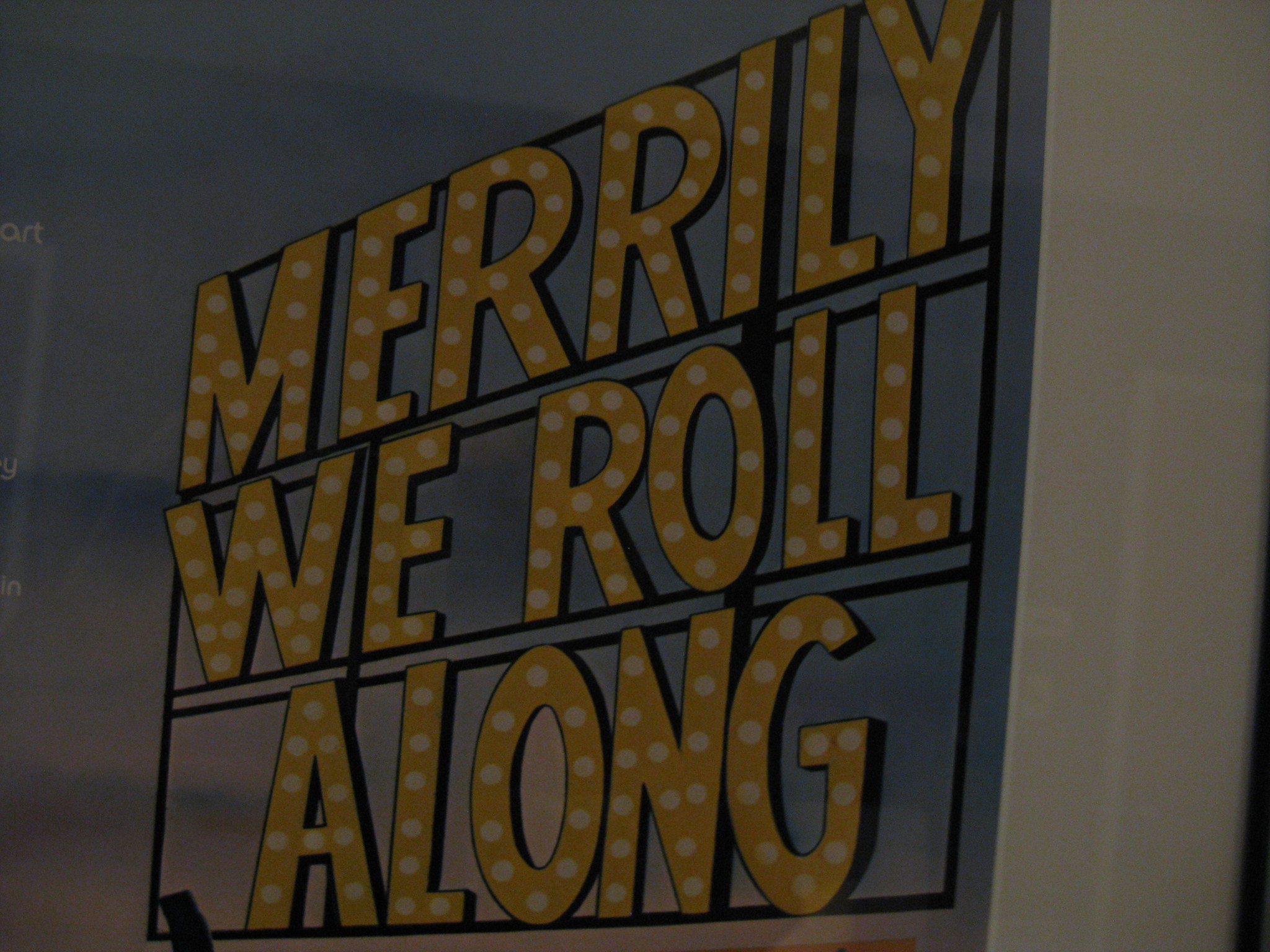
Merrily We Roll Along is a cross between a logical mystery without a murder and a gorgeous jigsaw puzzle, except you need to know that the death is a death of a friendship. The murderers are the friends who gradually chop away at their relationship while counting on the same relationship to survive. It takes almost twenty years for it to occur and the story unravels backwards, taking us past the various crime scenes.
You do get everything you need to know to put it together, but there are myriad ways you could fit it together. The original 1981 production was a legendary flop, but the score lives on in countless revivals and tribute shows. The main themes are the rhythm of a train with a staccato, chugging beginning that leads to a smooth melodic ride through time. The repeated musical question is “How did it happen?” The answers take about 150 minutes with an intermission.
This is, in so many ways, a play for grownups and not for the usual “language and nudity” reasons. Each person has a hand in the friendship’s demise, each person is to blame, and as the friends experience the outside world it erodes a little more of their easy innocence away. The more they satisfy the needs they feel as young artists, the less satisfied they are with what they have.
Add into it one of the most gorgeously intricate scores in musical theatre history. The whole thing is driven by a Stephen Sondheim score that is varied; by turns heartfelt, joyous, sarcastic, satirical, reflective, and occasionally joyously Broadway. Each moment is well-positioned in the score. Several revisions have been implemented since the 1981 productions that only strengthened the effect of the show. Jon Kalbfleisch (Musical Director) steers through the piece and leads his performers to the best vocal and instrumental work I think I’ve ever heard with these songs.
It’s a love story, or several love stories combined and intertwined. In the story, though, romance is what gets you into trouble.
Frank is hungry for success but is constantly reinventing what “success” means. Mostly with him it’s personal: first a love of music which leaves him broke. Then a desire to change the world (that makes him broke) through topical satire. Then a love of success which gets him the money. Then a need to keep the money coming by courting empty fame. Now a celebrity, famous and successful for being famous and successful.
Mary’s friendship has always been pinned on Frank, first on helping him succeed as a musical sketch artist, then as the also-ran in the race for him as a romantic partner. She grows to depend on her memories of her feelings for him, replacing those with more and more physical dependencies, food, and alcohol. She worships Frank, and her confessional is her writing. She lives her life at the edges of Frank’s glowing success. Frank needs her to remind him of just why he’s chasing success. She keeps reminding him of his humanity. She’s about to quit that job, and at the end of the first (last?) scene it seems like she might be able to do it.
We don’t meet Charlie right away, mainly because in the church of Frank he’s a heretic. In a very public (and incredibly well-written musical accusation) he vents every frustration he’s ever had with Frank live on camera on NBC. Frank will never forgive him for that. Charlie loved Frank for his tenacity, his unique drive, and his devotion to his art. Charlie is also married and a family man, while Frank almost single-mindedly mangles every personal relationship he’s ever had.
None of the three are exactly guilt free in the crime of friendship abuse and murder.
This is not really a nostalgia piece by any means, the easy sentiment and easy ironic joking are very limited. Your reaction is a growing sense of connection as the whole audience recognizes the mostly personal hits, runs, and errors they share with the characters. Boomers and Gen-Xers will probably smile as they recognize situations but that’s not the point of the memory structure. The play is an examination of personal reactions instead of social issues. While “Bobby and Jackie and Jack” is both funny and a little eerie, easy ironies and impersonal social commentary are not what Sondheim and Furth are into.
Signature Theatre delivers an amazing production which well supports the backwards timeline. Costuming and hair shows the passage of time, the set is spare and populated more by humans than furniture.
Scenes flow well, introduced by recurring themes and motifs but the stage is really dominated by a revolving central platform, which is used effectively. The central focus on the stage is Frank’s piano, which stands unused in the beginning of the performance, being used mainly as a seating area and a platform. It literally turns around at a major transition point and seems to come to life while it becomes a major part of the action. Props and small furniture dress the stage, with all the major items to be used on the various scene changes arranged as a kind of backdrop to the rest of the action from the beginning: the furniture of the memories is placed in context of the present.
Vocally, this production is lovely and instrumentally it is dead on. The orchestra is visible but out of real sightlines (like every lamp that will be placed onstage). This gives a (sorry to say) Brechtian distancing to the experience, constantly reminding us that we’re watching a show. The chorus and ensemble are just as important in the leads and they show the same commitment and presence as featured characters. The sound support for both has a great balance that never seemed to overwhelm either the vocals or instruments.
Lighting ran hot and cool: scenes flowed from chill blues and purples to red tinged ambers, and shifted shades from emotionally motivated character cues. The precision of lighting, actor placement, and cuing is quick, clean and accurate.
The costuming expresses most of the set dressing and shows details of time, place and action. Fashion for each era is accurate and reflects the characters well.
Performances were uniformly strong. The three leads, Franklin (Jason Gotay); Charley (Jake Loewenthal); and Mary (Sarah Anne Sillers, understudying Melanie Field) were strong throughout. Frank is not a very likeable character, Charley and Mary are more approachable but also more passive.
Sometimes the direction took a non-conventional twist that was a little off-putting: having Frank take a dominant position on the stage only to strike a statuesque power pose and hold it. I found myself wondering what he had been going to do up there, and did he forget to do it? However, for the most part Director/Choreographer Matthew Gardiner found exactly the right balance of movement to reflect the action. In particular the number “The Blob” that satirizes cultural snobbery was just slimy enough.
Merrily We Roll Along is worth the trip to Signature Theatre in Shirlington.
Take It In
Merrily We Roll Along
Music and Lyrics by Stephen Sondheim
Book by George Furth
Original production directed by Hal Prince
Runs August 25 – November 1, 2026
Signature Theatre
Dennis Wemm is a retired professor of theatre and communication, having taught and led both departments at Glenville State College for 34 years. In his off time he was president and sometimes Executive Director of the West Virginia Theatre Conference, secretary and president of the Southeastern Theatre Conference, and generally enjoyed a life in theatre.