
Democratic Gov. Abigail Spanberger on Thursday released an energy plan for Virginia that she claims proves the state can end the use of hydrocarbon fuels for electricity in 20 years or so and still meet the exploding demand for power in the new digital economy.
The 192-page plan, with a 22-page executive summary that’s easier to navigate, reads much like the complex integrated resource plans that are required every few years of the two large investor-owned utilities, Dominion Energy Virginia and Appalachian Power Company. It was developed using some of the same modeling software they use to evaluate power generation options.
Its depth, detail, and focus are a stark contrast to the 35-page energy plan produced about four years ago by former Republican Gov. Glenn Youngkin. Youngkin’s plan all but abandoned the goals of the 2020 Virginia Clean Economy Act (VCEA) and rejected the Regional Greenhouse Gas Initiative (RGGI). Spanberger embraces both.
Spanberger’s defense of both the VCEA and RGGI is largely based on assumptions about a social cost to the general economy from environmental damage and weather blamed on carbon dioxide emissions, plus assumed worsened health outcomes for many Virginians.
“Importantly, the Energy Plan also models the cost of walking away from our clean energy commitments,” she wrote in her introduction. “While some might question whether abandoning Virginia’s Clean Economy Act or once again exiting the Regional Greenhouse Gas Initiative could produce cost savings, the model quantitatively disputes this notion. Not only would taking these actions nearly double carbon emissions over the next two decades, doing so would also cost Virginians an estimated $145 billion in health impacts.”
She continued: “In producing this Energy Plan, we have clearly demonstrated that there are multiple paths forward that would allow Virginia to meet our clean energy goals, strengthen our energy mix, and power growth, investment and innovation.”
The five energy development scenarios included one that assumes the repeal of VCEA and RGGI, which led the modeling software to recommend a very heavy investment in new natural gas generation.
There were three scenarios offered that proposed no additional gas generation or very little. In response to a reporter’s question, Spanberger said she preferred and would be promoting those three.
Virginia would remain a major electricity importer under all five proposals.
Two of the three scenarios she endorsed would accommodate only one or maybe two additional major gas plants, probably the one Dominion has already proposed for Cumberland County. The third would end gas development after the 944-megawatt Chesterfield County plant Dominion is about to start building.
Spanberger’s three preferred plans involve heavy expansion of solar capacity, from 1.2 to 1.8 gigawatts per year for more than 20 years. They assume far more offshore wind than the 2.6-gigawatt facility Dominion is about to complete off Virginia Beach. They assume additional nuclear generation, the use of natural gas fuel cells, and massive battery installations.
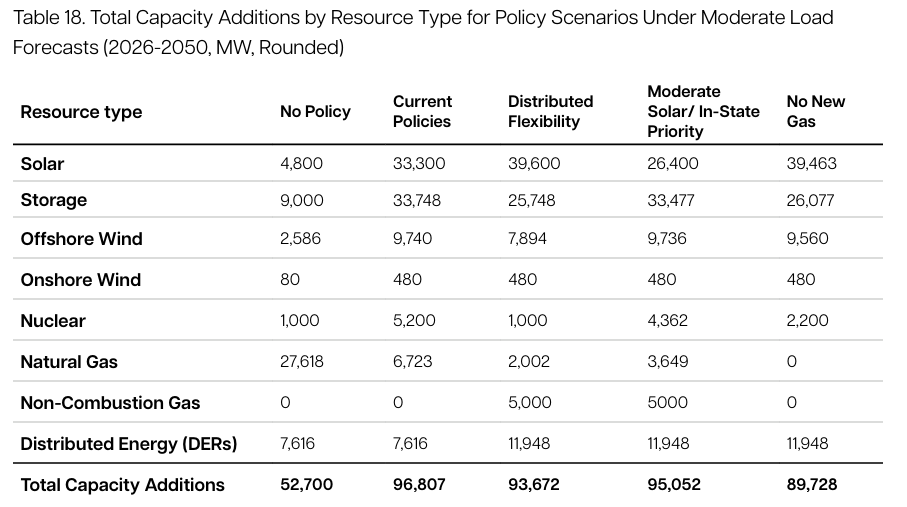 Two options projected the need for more than 39 gigawatts of solar capacity beyond what exists now, which could require hundreds of square miles of land. Spanberger said the state could blunt that impact by stressing distributed solar at homes and buildings, and by using previous energy sites such as abandoned mines.
That no-gas option also projected another 9.6 megawatts of offshore wind capacity, almost quadruple the size of the existing Coastal Virginia Offshore Wind project.
Just like the long-range plans produced by the utilities, none of this is guaranteed to come to pass. New power plants built by utilities or by independent generators must clear the State Corporation Commission. The plan openly lists many of the cost and efficiency assumptions used in the models, but all of those would be under heavy examination in a real SCC case.
Spanberger also is planning a legislative push to help steer those future SCC decisions and wants the state itself to start recruiting renewable energy projects with a state-managed request for proposals process.
Senate Majority Leader Scott Surovell (D-34) told the Virginia Free Press that “It’s nice to have a Virginia governor who actually beleives climate change is a problem and is willing to tackle our energy problems in a climate-conscious, cost-effective, practical manner rather than sticking their head in the sand.”
The Republican House of Delegates leader focused on the plan’s assumed “social cost of carbon” of more than $260 per ton of emissions, and its claims about direct health costs to individuals. Based on capital costs alone, the gas-heavy plan is the least expensive, but Spanberger added on those other costs and claimed it was the most expensive plan.
“Today’s energy plan is the strongest argument we’ve seen yet for repealing the Virginia Clean Economy Act and getting Virginia out of RGGI,” noted Republican Minority Leader Terry Kilgore, R-Scott County.
“Virginians need to tell Governor Spanberger: we’ve had enough,” was a response from Senator Mark Obenshain, R-Harrisonburg. “We need affordable, reliable power—and relief from mandates that sentence our families and businesses to decades more of rising energy costs.”
This document meshes with the regulatory scheme for the data center industry that Spanberger released two weeks ago. She noted again that the state will push data centers to produce their own power to reduce strain on the grid, but that only so much new natural gas will be allowed. The demand projections behind the plan assume the industry continues to grow here rapidly.
Some of the modeling plans assumed the data center industry would accept up to a 10 percent reduction in overall electricity use when the grid was under stress. Data centers with larger power plants of their own using hydrocarbons would need to purchase RGGI allowances, another disincentive.
This is an electricity plan more than an energy plan. It branched out into transportation briefly, with several strategies proposed to promote the use of electric vehicles or other no-emissions options. It did not focus on all the other ways that energy is used by Virginians in their homes and businesses, each with their own challenges and cost issues.