On Tuesday, the predictions, TV ads, and apocalyptic worrying come to a grinding halt as the final voters cast their ballots and winners are announced. It should bring a few months of calm as people adjust to the leadership changes to come, incoming officeholders prepare to transition to power in January, and those leaving the political arena by choice or because they lost an election begin preparing for life outside the bubble.
It won’t.
The presidential election of 2028 is already ramping up; Virginia — which holds elections every year — will see General Assembly elections kick into high gear; and political oddsmakers will start priming the media pump with early polls.
This campaign cycle is both relentless, and relentlessly negative. According to campaign managers and candidates I’ve interviewed over two-plus-decades covering politics, this is the nature of politics today because they believe negativity works.
A story in the New York Times about Pennsylvania’s contested 10th congressional district seat, however, shows that far from working, the negativity is forcing people to tune out of politics and, in some cases, stop voting.
Speaking with voters in a two-block area in York, Pennsylvania, the Times found that people are tuning out because of the negativity. And they are increasingly tuning out the news outlets that were once a primary vehicle of political information.
“Mr. James, a 72-year-old retired furniture maker” who spoke with the Times, “said he has kept the election at arm’s length this year, wanting to ‘steer clear of the negativity.’ That sentiment was shared by many of his neighbors.”
Another person interviewed was more blunt — “’I don’t watch too much news anymore,’ said Bryce Kline, 64, who lives around the corner from the James’s. ‘The Democratic stations, they pick and choose what they want to say. They’re liars.’”
Alex and Mindy Bond are much younger and newcomers to the community. They get their information about candidates mostly from candidates’ literature. With most of that focused on undercutting opponents, the Bonds said they found the information “off-putting,” and consequently “they quickly end up in the trash.”
While true that early voter turnout this midterm has been running at historic levels, stories like these shouldn’t be ignored. Voters, especially those below the age of 45, are tired of the destructive tone of campaigns and re-examining the value of being engaged.
The question at hand — How do we change it?
Politics Is a Good Thing
The candidates in Pennsylvania’s 10th district are asking the same question, because the traditional methods of reaching people like those interviewed by the Times are no longer effective. When people no longer see the value in politics, their willingness to be reached declines.
Part of the issue is how people receive news.
Mainline news is out. The range of media filling the void is falling short. And increasingly, people quit looking to others to help make sense of the political world and begin trusting only their own judgment.
That’s the point surfaced by a Pew Research finding in February.
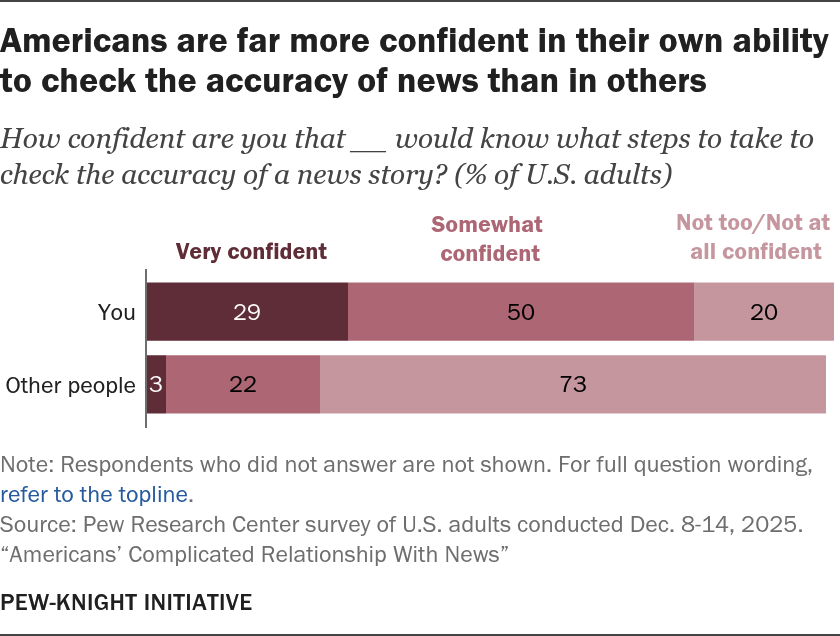
Sorting out fact from fiction, however, in any arena is almost never done effectively in isolation.
Policy issues in particular are enormously complex, far beyond the ability of the average person to spend the necessary time to grasp the full scope of the material and make informed decisions.
We require a level of trust in experts across a wide range of fields to help us navigate our complex society.
That begins with accepting that most people in the political sphere are not themselves corrupt.
Such is the long-standing argument of the University of Virginia’s Center for Politics founder Larry Sabato, who is known for his expression: “Politics is a good thing!”
The loss of that ideal is what makes the New York Times piece particularly noteworthy. Yes, the negativity of campaigns is wearing voters out. But the frustration with the negativity goes far beyond frustration with candidates. People are also questioning the value of the mediums through which they obtain political information, and they are coming to believe that most of those in politics are corrupt.
Writing in the Virginia Free Press about the federal charges recently filed against Sen. Louise Lucas, Shaun Kenney — who recently worked for Attorney General Jason Miyares and regularly worked with the Virginia press corps — stated flatly that this is incorrect.
“The good news,” he wrote, “is that the vast majority of our public servants really are good, whether they are elected officials or public bureaucrats. Most of them want to serve the public, respond well to criticism and encouragement, and are simply asking for the tools they need to do the job.”
How do we restore voters’ faith in those people?
It begins with leaders standing up to misdeeds within their own party, as Paul Goldman recently did, also in the pages of the Virginia Free Press.
The morning before the New York Times broke the story about the ballot shenanigans in Alaska, former chairman of the Democratic Party in Virginia Paul Goldman argued in the pages of the Virginia Free Press that unscrupulous deeds were at play in Alaska with two Dan Sullivans on the ballot. In an update to that piece Thursday morning, Goldman observed the following:
If this Times report is true, then the Democratic nominee should drop out of the race. If we want to keep our democratic election process, we can’t permit this to go on. This plays right into Donald Trump‘s hands and it couldn’t possibly have happened at the worst time in the 2026 cycle for Democrats. Trump will use this to taint the 2026 election process, which is the last thing we need in our country right now.
You Be That Person
Negativity is leading voters to tune out, but we must remember that in a democracy, the government we get is the government we elect. Deflecting the problem onto politicians and negativity gets the sequencing of the problem wrong.
We have negativity because too many of us would rather celebrate problems than solutions. Not because leaders are driving us toward negativity.
That has become clear in presidential approval ratings. As I reported earlier this month, the “10-year run from 2016 to 2026, in which the sitting president has been below 50 percent approval for the vast majority of their administrations, has no parallel in post-World War II American presidential history.”
It represents, according to retired professor emeritus of political science at the University of Mary Washington, Stephen Farnsworth, who recently told the Virginia Free Press in a phone interview that what we are witnessing is “the real growth of negative partisanship. People feel much more negatively about the other party” then they feel positively about their own.
That trend will only change when voters decide to again trust those who can help us understand complex issues, and begin to vote again for problem-solvers, not problem-celebrators.
To realize that shift requires understanding who we are and what we value.
Noted historian Tim Snyder made this very point in 2024 after Trump won re-election. Concern over the return of a president who is driven by retribution and thrives on chaos and denigration of those who disagree with him was already energizing people to create change. But change must be more than a reaction to some policy or someone.
“Freedom means you decide who you are,” he told Ari Velshi, “and when things change around you, you continue to be that person.”
A decade defined by negative partisanship has taken the place of understanding who we are and moving to address problems, not revel in them.
Rediscovering who we are, and returning to addressing hard problems, is the key to ending the negativity in campaigning. It’s also the key to getting citizens to once again tune in to poliitcs.
Politics, after all, is a good thing. But only when we choose to make it so.