
A little over 30 years ago, the commonwealth launched the Virginia Economic Development Partnership (VEDP) to attract businesses and investments to Virginia.
“It was a unique model,” Keith Boswell told business, political, and economic development leaders from across Virginia who were in Williamsburg on Tuesday for RVA757 Connects‘ Convergence conference. “No one in the whole United States was doing what we were doing.”
Times have changed, however, and Boswell said that other states have caught on and caught up. “Other states have learned from our success,” he said. The challenge now is giving the tools to VEDP so that Virginia can be more competitive again.
Getting It Right, Rising to the Need
Virginia sits at the intersection of a new era in economic development. Across the commonwealth, leaders are balancing a shifting economy and public concerns with the need to address longstanding issues related to infrastructure and develop new areas of growth.
Balancing these challenges will require a new approach said Christopher Lloyd of MacGuire Woods Consulting. “The old ways of solving problems,” he said “are not going to be the way to be the way that we need to do them going forward.”
Regional economic development groups across Virginia are cutting that path.
Boswell, for example, leads Virginia’s Gateway Region. Nestled in southern Virginia, VGR includes Emporia, Hopewell, and Petersburg, as well as Brunswick and Dinwiddie counties among others.
The area is “very rural, very distressed,” Boswell said, but there is a lot happening. As a transportation corridor, “we make things and move things.” It’s also a region that is leaning into data centers. “While everybody else is tired of data centers around the commonwealth, we’re welcoming them.”
Jennifer Wakefield of the Greater Richmond Partnership said that their goal is building on the region’s urban strengths to attract “targeted industries” to the region.
That is accomplished in large part by working with the roughly 200 site location consultants working in the U.S. and selling them on the benefits of the region. Her organization has made significant strides in this over the past five years.
“About five years ago, 20 percent of site location consultants had previously considered Richmond as a place to expand or relocate,” Wakefield said. “That number jumped up to 92 percent last year.”
If there’s one thing that everyone agrees Virginia needs to get right, it’s energy.
Mark Christie, who heads William & Mary’s Center for Energy Law & Policy, put a point on the issue by opening the panel on Virginia’s energy landscape noting that “energy may be only 6 percent of GDP, but it’s the first 6 percent because everything else flows from that.”
Emil Avram of Dominion Energy framed the challenge succinctly. Dominion is looking at having the generate an additional 40 gigawatts of energy, or about 2 gigawatts of new generation a year through 2045. The two top concerns in delivering this are reliability — it needs to be up 99.99 percent — and affordability.
Reaching that goal is going to require a diverse base of energy production sources and the infrastructure to support it. Not only is Dominion having the generate more power, it has to build out the delivery system. “In just the next five years,” Avram said, “we plan to spend about $65 billion in capital infrastructure.”
One source of that new energy is natural gas. Avram said about 25 percent of the needed energy generation will come from that industry, which faces its own infrastructure challenges.
On the upside, said Shannon Pierce of Virginia Natural Gas, the United States has plenty natural gas. “We have a hundred-year supply of natural gas.” What we don’t have is “the pipeline infrastructure to get the gas to us in Virginia.” In addition, she said, storage is critical. That will have to be built as well.
We have to get it right, said Jennifer Montague from Columbia Gas of Virginia. “In order to have great economic development, you really need to have strong utilities who are able to provide that power … to those companies coming in.
Headwinds
“I am an eternal optimist,” said Chris Lloyd who, along with Todd Haymore of Hunton Andrews Kurth lead the conference’s first panel discussion. “I believe in the value proposition of Virginia … and I think we’ve got some great things going on in Virginia.”
Equating the economic development community to family, he added, however, that sometimes families have to have hard conversations. “Facts are stubborn things,” he said quoting John Adams. And there are some concerning blinking lights that are challenging Virginia’s economic development.
The challenges are not new, Lloyd said. Both he and Haymore realize that the challenges facing the commonwealth are “decades in the making,” and as such are neither “partisan” nor “political.”
Understanding them, however, is the first step to solving them.
The challenges begin with population. Relative to the Southeastern states Virginia typically competes against, the commonwealth is lagging both in population growth and in growing people in the 25-34 age group.
Just 0.7 of Virginia’s 1,000 new residents migrating in for the year ending July 1, 2025, were from other states. South Carolina, by comparison is +12 and North Carolina +7.6.
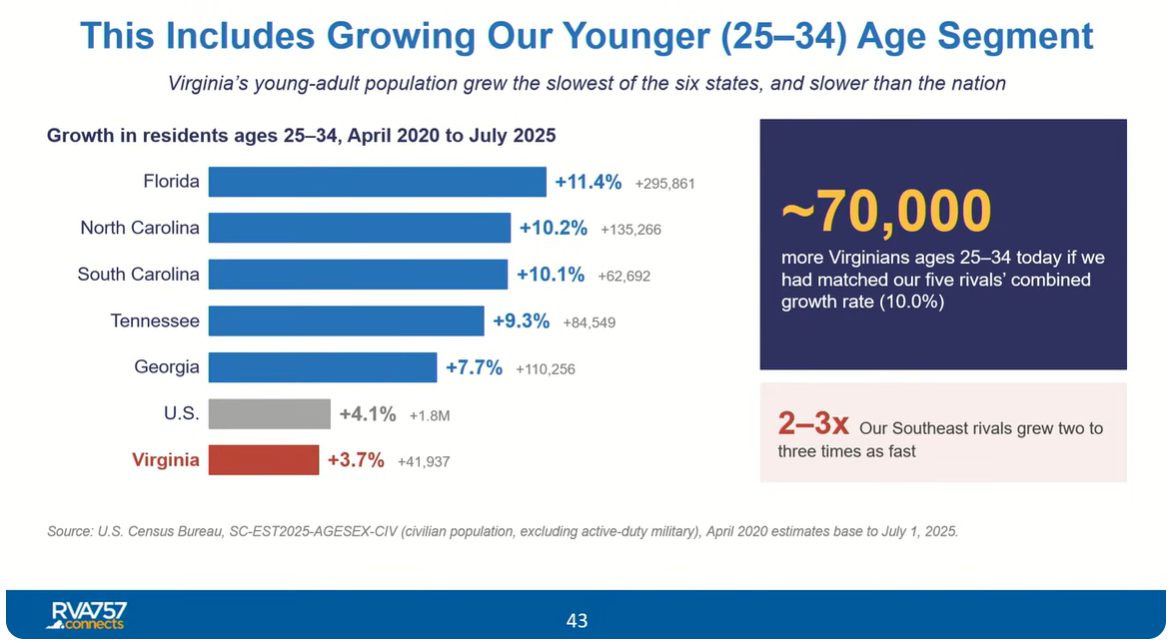
More telling is that for people aged 25-34, Virginia’s growth was lower than that of Florida, Georgia, North Carolina, South Carolina, or Tennessee. It’s also below the U.S. average. These workers, Lloyd said, represent those in the “prime working years of their life.”
Virginia is also losing jobs, Lloyd said. Cuts in federal workforce are partly responsible, but the commonwealth is also losing jobs in manufacturing and professional services.
Another troubling indicator is that Virginia’s Gross Domestic Product is not growing fast enough. This is true despite the news about businesses coming to Virginia in the first months of the Spanberger administration and the final months of the Glenn Youngkin administration.
Not only is it not growing fast enough relative to its Southeastern competitions, it’s not even keeping pace with the national GDP. The nation’s GDP for Q2 2026 was 2.2 percent. Virginia’s was 1 percent.
Lloyd shared a slide that put the commonwealth’s positioning in these all of these areas relative to our southeastern competitors in perspective.
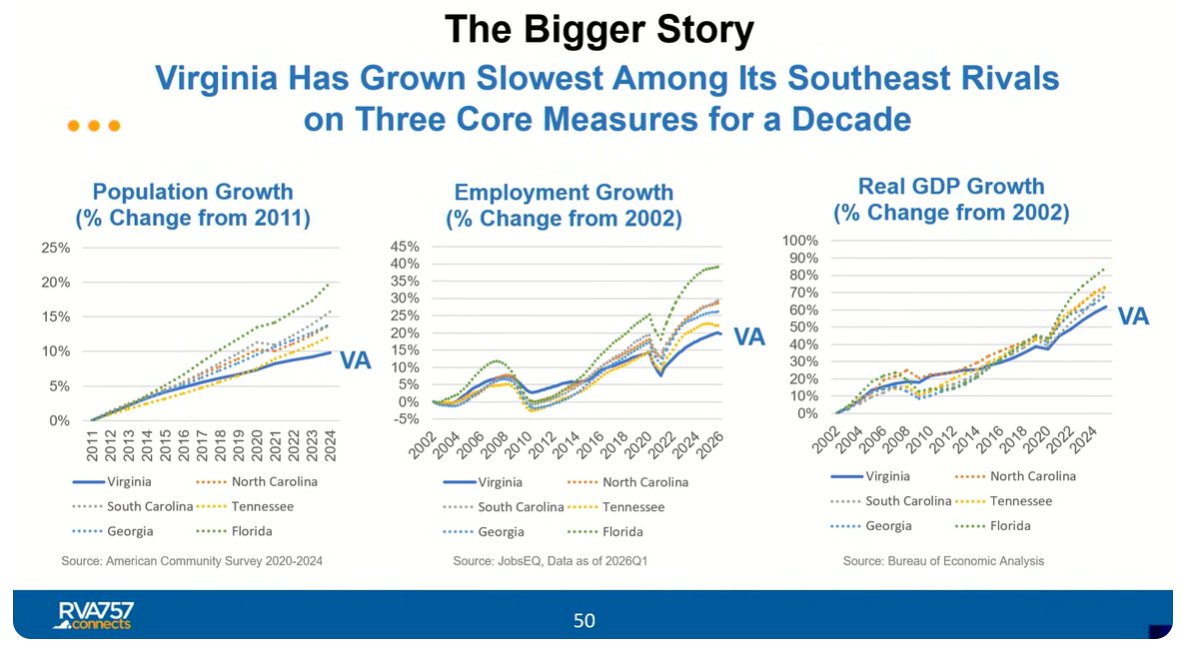
In population growth, employment growth, and real GDP growth, Virginia is below our five closest competing states — Florida, Georgia, North Carolina, South Carolina, and Tennessee.
In terms of dollars, Lloyd noted that if Virginia’s GDP had grown at the same rate as the Southeastern average, the commonwealth’s GDP would be about $56 billion larger in 2025.
Why is this happening? Lloyd points to several factors.
First is the commonwealth’s over-reliance on federal employment. Fully 24 percent of Virginia’s economy is tied to federal spending.
Another challenge is relatively poor spending for economic development marketing. In 2024, Virginia spent $2.7 million. North Carolina that same year spent $20 million.
Investment in site readiness is another challenge. Noting that when he first got into economic development he sometimes had a year or more to work on some projects, today, Lloyd said, “I’m lucky if I have 30 to 45 days sometimes to make a decision with a client.”
Due to the speed with which things are moving, it’s critical that infrastructure and zoning already be in place when businesses approach Lloyd. Too often in Virginia, that is not the case, putting the commonwealth at a competitive disadvantage.
And then there is the state’s tax structure, which “is built for the 19th century,” Lloyd said. He points to the Tax Foundation which ranks Virginia 30th on its State Tax Competitiveness Index. Well below neighboring North Carolina (13th), Tennessee (8th), and competitor Florida (5th).
Data Centers and the Economy
A significant challenge ahead concerns where Virginia is headed with data centers. Haymore covered this in his portion of the presentation with Lloyd.
On the plus side, Haymore said that “84 percent of our economic … investments have been tied to data centers” between 2022 and 2024. “Now, that’s really good news,” he said.
And the investment made in data centers is generating considerably new investment in the supply chain — also good news for Virginia.
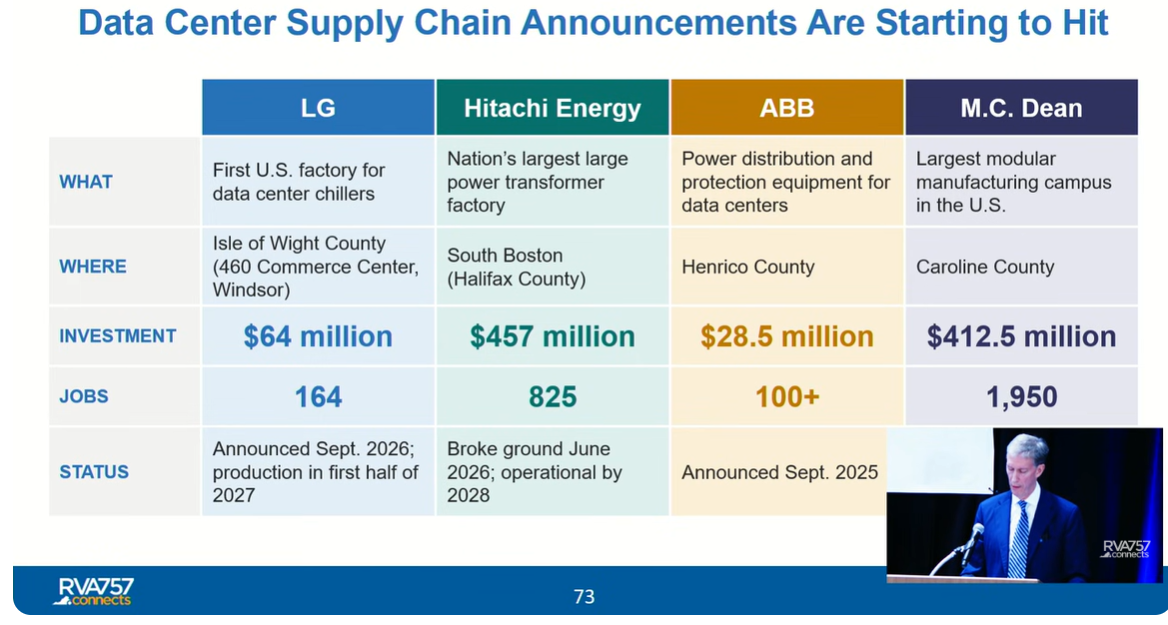
However, the growing movement against data centers can potentially impede this growth.
The challenge comes in “some of the things that are taking place at the local and state” level that are “adding new levels of uncertainty,” Haymore said.
In particular is Spanberger’s Executive Order 22, and some of the moves being taken at the local level to put the brakes on development. More concerning is the coming legislative session. There is one effort to introduce a three-year freeze on data center approvals.
Virginia’s competitors are noticing.
Haymore concluded his presentation with a series of quotes gathered from people in other states watching what is happening in the commonwealth.
One in particular stood out as it relates to the industry that has powered Virginia’s economic growth in recent years — data centers.
“This might be one of the best examples ever of a state killing its golden goose while it’s laying golden eggs all over the place.”
Though a challenging time, Virginia is doing a lot of things right. What matters now is helping people understand that “worker protections and investments are not mutually exclusive,” Lloyd said in the Q&A period.
Learn More
Videos for each of the sessions in the Convergence Conference are available on RVA757 Connects’ YouTube page.
Learn more about RVA757 Connects