

Virginia’s current and most-recent governors stand on separate sides of the political aisle, but they share a common concern; strengthening the commonwealth’s teacher labor force.
By one metric, Virginia is on the right track. “Since 2023,” reports the Virginia Department of Education, “teacher vacancies have dropped by 35.9%, while substantial increases to teacher salaries have been made across the state with historic investments by Governor Glenn Youngkin, the General Assembly, and local school divisions.” Gov. Spanberger has built on that momentum in her first term, signing legislation to enter Virginia into the Interstate Teacher Mobility Compact, which would allow teachers to carry their credentials to participating states. This could help alleviate longstanding teacher-vacancy issues, which is a persistent problem in southeast Virginia.
2024-2025 Teacher Vacancy Rates by Region
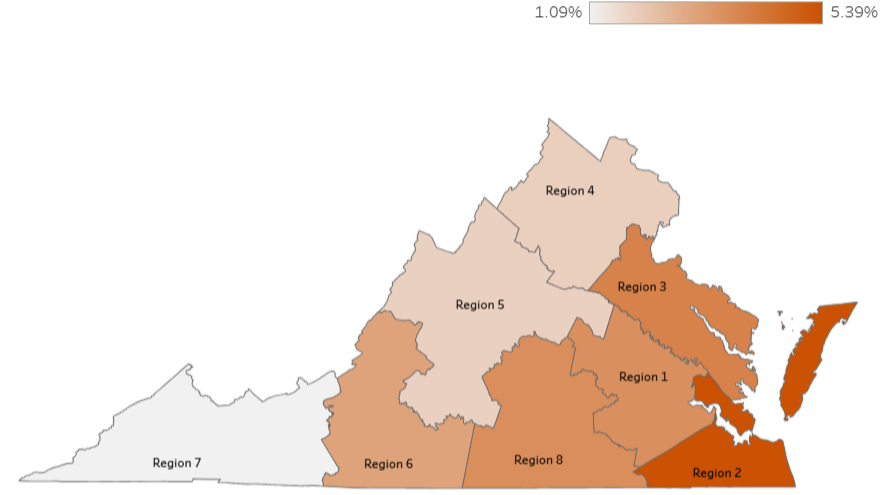
Virginia’s progress in reducing vacancies and hiring teachers, however, isn’t the full story. New research by Matt Barnum at ChalkBeat suggests that between the final school year before the pandemic (2019-2020) and the 2024-2025 school year, Virginia – like most of the other 21 states from which Barnum could find data – experienced a sharp rise in teacher turnover.
“Compared with 2019,” he wrote in his report published Thursday, “fewer teachers left the profession in the summer of 2020 when the economy was at a standstill due to the pandemic. But then teacher attrition began to rise sharply. Rates peaked in 2022 but typically remained elevated for the next couple years.” That pattern held in Virginia.
Virginia Teacher Turnover Rates: 2019 – 2025
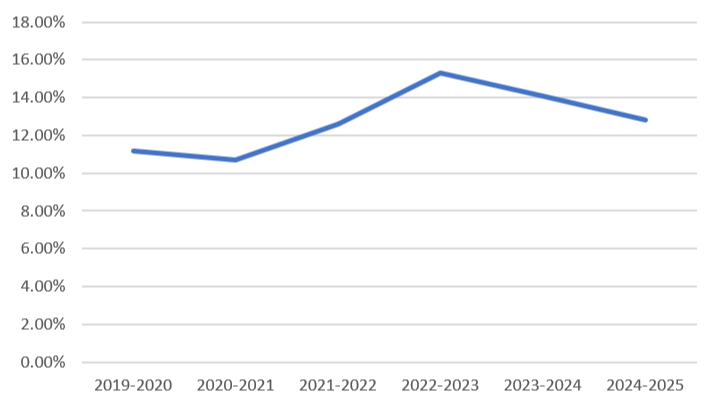
Source: Virginia Department of Education via records request from ChalkBeat.
In the year before the pandemic, 11.2% of teachers left teaching. The year following, 10.7% left. And then the percentage climbed, reaching 15.3% in 2022-2023 before beginning to fall.
In an online call with media on Thursday, Barnum said that his concern is that “we may have seen more of our top teachers leave because they’re best equipped to find jobs outside of teaching, or move to administration within schools. I worry they’re being replaced with less effective teachers.”
While Barnum said his research doesn’t prove that is the case – it isn’t clear which teachers are leaving – he does suggest that this is a hypothesis researchers should look at.
“Even though turnover finally appears to be trending down,” Barnum wrote in ChalkBeat, “the consequences persist. Research has linked teacher churn to declines in test scores. At a moment when policymakers are seeking to understand America’s sluggish learning recovery, the loss of teachers and instability in schools deserves to be on the list of plausible contributors.”
Out of Line with Other Professions?
Turnover in the teaching profession is a long-standing concern, as are worries about teacher shortages. Replacing teachers is not easy. To take over a classroom requires an appropriate educational background, training, and certifications that take time to earn. Spikes in turnover like Barnum has identified, therefore, are worth a closer look.
But is teaching different from other professions when it comes to turnover?
That’s the question that Chad Aldeman and Samuel Yi recently explored in an article for Education Next, “Are Teachers Abandoning Teaching.”
Aldeman and Yi used data from the Current Population Survey administered by the U.S. Census Bureau to compare turnover rates for teachers over approximately 40 years to nurses, social workers, and accountants.
Their study showed that about “7.6 percent of teachers leave the profession in a given year. This rate has remained relatively stable over time, and teachers continue to leave their profession at about the same rate as nurses.”
In the early 1990s, accountants and teachers were leaving their careers at about the same rate. Since about 2000, however, the turnover rate for accountants has been slowly but steadily declining.
Aldeman and Yi did see a spike in teacher turnover similar to what Barnum at ChalkBeat found, but note that the spike was “temporary” and turnover rates are back to pre-pandemic levels.
In an email exchange with the Virginia Free Press, Aldeman said that “The rates have all come down since their highs in 2022. Virginia’s trend line looks particularly promising.”
He also noted that “the absolute turnover rate [that Barnum references] is not that high. In Virginia in 2025-26, the turnover rate was 11.8 percent. That rate just isn’t very high compared to most other fields or sectors.” In short, he concluded, “teacher turnover rates look comparable to turnover rates for college graduates in other fields.”
Don’t Hit the Panic Button
Despite the difference in how the pieces in ChalkBeat and EducationNext interpret the post-pandemic spike, both acknowledge that the question is more complex than simply looking at numbers of teachers leaving the profession.
Barnum noted that high-poverty schools in South Carolina have been more affected by teacher churn than non-high-poverty schools.
In 2019, for example there was a 3.1 percentage point gap between turnover rates in high-poverty schools vs. other schools. In 2024 that gap had surged to 4.7 percent.
Aldeman concurs, writing in Education Next that “teacher turnover is indeed much higher in some schools and districts that serve high-need, low-income students.”
Understanding why turnover in high-poverty schools is outpacing turnover in other schools deserves policymakers’ attention.
Both also agree that teacher turnover is not necessarily a bad thing, especially when people discover they aren’t particularly well-suited to the profession, or they are struggling to do the job well.
There are also positive indicators. Aldeman and Yi, for example, found that when looking at teachers in their “30s and 40s, who make up the bulk of the teacher labor force. … the behavior of today’s teachers has changed remarkably little compared to their peers in the 1990s and early 2000s. Middle-aged teachers are not leaving the profession in large numbers.”
The takeaway about teacher turnover – regardless of the data one looks to – should be the same. Don’t hit the panic button just yet.
Rather, it’s important to look deeper into the problem and understand precisely what is driving the change, and what policy choices can improve the situation.
It’s also important to remember that this isn’t only the challenge schools face in elevating academic performance.
Rick Hess at the American Enterprise Institute in an email to the Virginia Free Press wrote that “while teacher turnover may be a contributing factor, it sure seems like there are a number of more obvious culprits, including extraordinary rates of chronic absenteeism, school disorder, the distractions of phone and screen culture, a decline in academic expectations, and grade inflation.”