
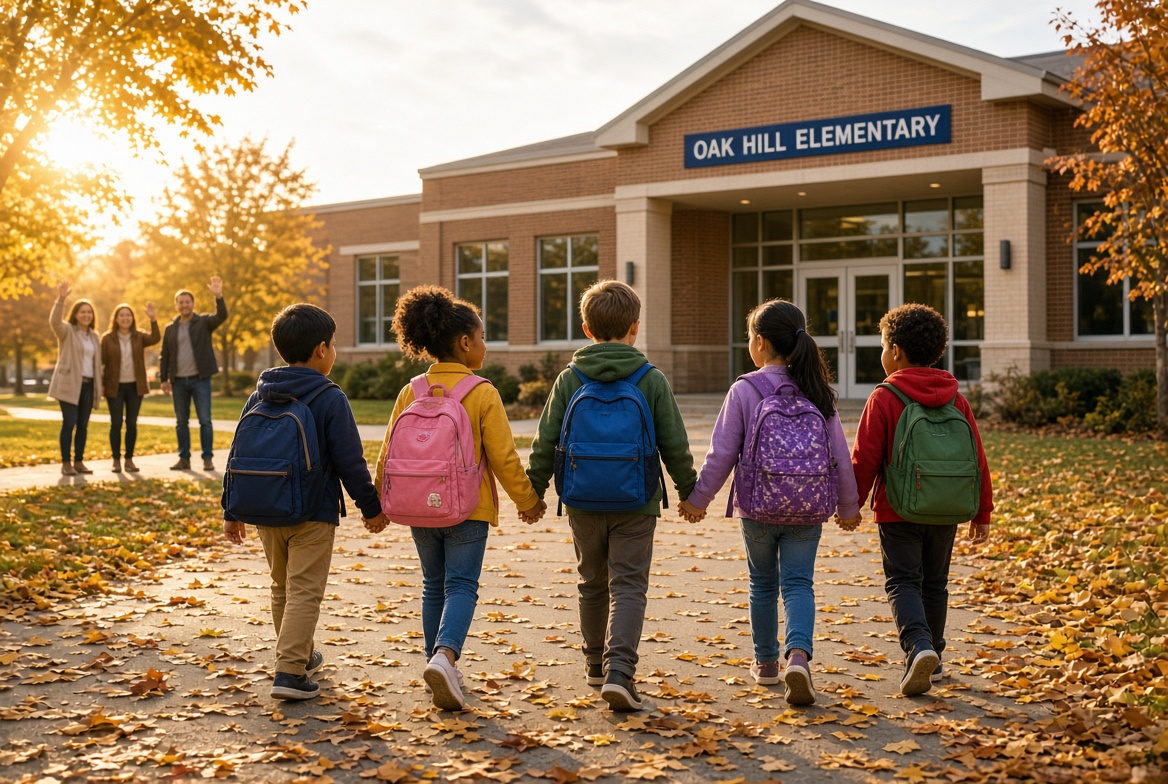
Over the course of the past two years, national media outlets have covered the intensified policing of immigrant communities by Immigration and Customs Enforcement (ICE), including the revocation of the sensitive locations policy that previously prevented ICE actions in or around schools. This policy is resulting in numerous incidents in or near schools across the country, increasing fears among families sending their children to school.
When these federal actions first started, media outlets frequently showed video footage of the violent apprehension of immigrant families and the aftermath of the cruelty of family separation. While we no longer hear as much reporting on these stories, the violence against immigrant communities continues and our schools must be prepared.
What Does This Mean for Virginia’s Public Schools?
Virginia is a diverse state with roughly 191,000 students in Virginia who are receiving or have previously received English learner (EL) services, consisting of nearly 20% of all public-school students, speaking over 280 languages and representing countries and cultures from all parts of the world.
In recent years, Virginia has ranked in the top ten states in the U.S. for fastest absolute growth of recently arrived children to the U.S. or some districts, such as Chesterfield and Henrico, the number of ELs has more than doubled in the past ten years. In Frederick County, Fauquier, and Spotsylvania, the total EL students have almost tripled. Districts like Alexandria City have 55% of their students as ELs.
Being an English learner does not mean that the student is undocumented. Yet such indicators increase the likelihood of interaction with federal immigration enforcement, which is harmful to learning. In fact, there is evidence that disruption caused by immigration enforcement harms learning for all students, not just those with immigrant backgrounds.
Policy Response by Virginia General Assembly
In response, House Bill 836 and Senate Bill 491were both approved and signed by Governor Abigail Spanberger (D-VA) to protect against discrimination based on the presumption of one’s immigration status, codifying the landmark Plyer v. Doe (1982) Supreme Court case that ruled that states could not deny public education to children based on documentation status as a violation of the Equal Protection Clause of the Fourteenth Amendment. The bill additionally requires the Virginia Department of Education and the Office of the Attorney General to develop guidance for school divisions and develop of a set of local policies and best practices . The legislation also requires training for all principals and school administrators to learn the new policies adopted by their division. Policies must be in place by December 31, 2026 and all training must be completed by the start of the 2027-28 academic year.
By contrast, the Heritage Foundation argues that providing an education to potentially undocumented students places an unfair financial burden on states and local school districts and calls for an end to Plyer v. Doe on grounds that it encourages violations of the rule of law by incentivizing unlawful border crossing. Furthermore, it rests on a false assumption that undocumented families “take” benefits paid for by citizens rather than recognizing that undocumented families pay taxes without full access to most public services. Beyond the fiscal implications, leaders in the Republican party refer to immigrants as “invaders” whether they enter legally or not – criminalizing the mere existence of immigrants in our country. This language is used to make certain groups “underserving” of public goods such as an education.
What Does This Mean in Practice?
While concerns for the rule of law and the cost of accommodating immigrant communities are serious concerns, advocates for the new legislation contrast that with education outcomes for students, preserving the best environment for education, and ensuring that the legal and constitutional rights of students are not violated in the pursuit of such concerns.
However, there is much more work to do at the local and school level to make sure that students and their families do not feel the pressure of federal politics. In previous academic years, divisions such as Fairfax County have made an explicit commitment to protect students and staff, with the superintendent advising principals of the expectations to uphold those expectations in the school building.
Such moves inside the classroom are positive. Yet despite this, there remains the real concern as to how to accommodate students who come home to discover a parent or relative has been detained by federal law enforcement. The reality is that the aftermath of a family detention will impact schools when a student becomes chronically absent, experiences anxiety or depression that impacts learning, or presents other challenges due to economic pressures from losing a family member.
As immigration enforcement continues to rattle both children and families, it is important that schools remain a safe place for all students, regardless of their immigration status or that of their family.
We must not let these issues go silent or become normalized. With the beginning of the school year quickly approaching, divisions must be ready to protect their students and to implement HB836/SB491. The legislation establishes clear protections of Plyer v. Doe in case it is overturned in the courts by ensuring that public education remains a common good for all students regardless of their background and provides additional protections against federal overreach of immigration enforcement in schools. In doing so, Virginia is declaring its belief that education is a common good to defend for all children and that it will uphold the importance of education above the current politics of immigration enforcement.
BETH DAVIS is a Postdoctoral Fellow at EdPolicyForward: The Center for Education Policy at George Mason University.