

Now fully six years in Virginians’ rearview mirrors, the outward signs of COVID — masking, social distancing, and virtual work life — are fading into memory. But the inflation that was ignited during COVID is not fading. In some cases it is accelerating.
The rising costs of housing, fuels, and energy routinely garner attention when inflation is the topic. These are unavoidable expenses and closely watched by the Bureau of Labor Statistics and the Federal Reserve Bank.
But the prices of automobiles, schools lunches, and credit cards also touch most consumers, and their upward march reveals how broad the inflationary pressures are on Virginia families.
Automobiles
Prior to COVID, new-car inflation had been remarkably, historically, low. After a 20-plus-year span when new car inflation rose every year from 1974 to 1997 — the peak was 1975 when new-car inflation was 8.57 percent — it barely budged, save for the Great Recession period.
With the arrival of COVID, however, and the chip shortage, prices soared. The inflation rate in 2022 was the highest recorded since records began being kept in 1947 — 11.07 percent.
It’s not just the price of new cars, however, that are crimping customer’s pockets, it’s the overall cost of ownership.
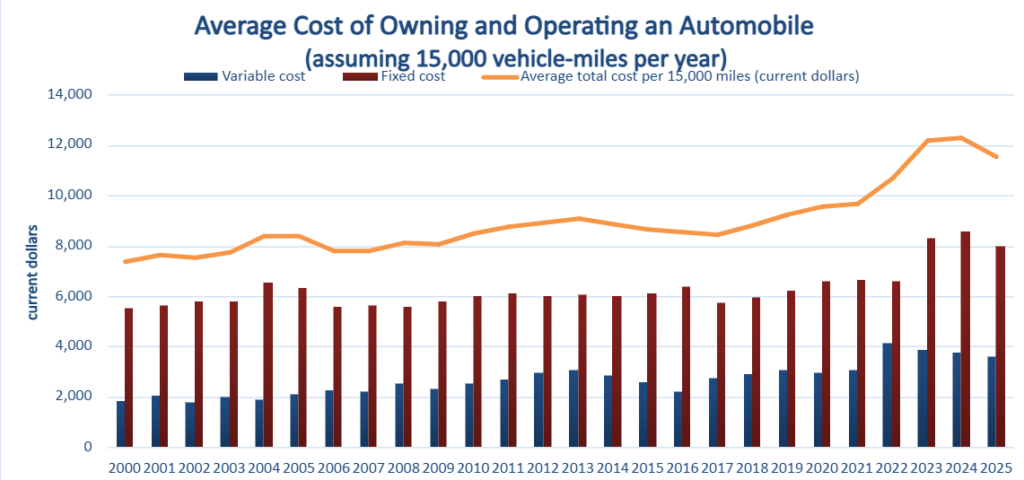
The Bureau of Transportation Statistics has tracked the average cost of ownership since 2000, considering variable and fixed costs. As with inflation, cost of ownership remained relatively steady up to the start of COVID, when costs began to climb. The increase was slow at first, but then jumped in 2023 owing to several factors, including fewer cars on the market and the growing technological sophistication of cars which drives up repair costs.
Virginia is a particularly expensive state in which to own a car. An analysis by MotiveGrid reports that the 5-year cost to own a car in Virginia is $61,429 over five years. That makes Virginia the 16th most-expensive state in the U.S. to own and maintain a car.
These rising costs are also partly responsible for people holding on to cars longer. In 2000, people held onto passenger cars an average of 8.9 years before moving on to another vehicle. Today, that average is up to 13.6 years.
Cost isn’t the only factor, however, as the dependability of cars has also improved significantly since 2000. Still, repair costs, as noted above, are considerably higher today.
School Lunches
For empty-nesters, the costs of school lunches are a distant memory, but for young families already straining to make ends meet, these lunches can prove burdensome if they don’t qualify for free and reduced price meals.
The Bureau of Labor Statistics last week released the Consumer Price Index for select school lunch items between 2006 and 2026. As with the price of cars, there’s a substantial spike that sets in with the COVID pandemic.
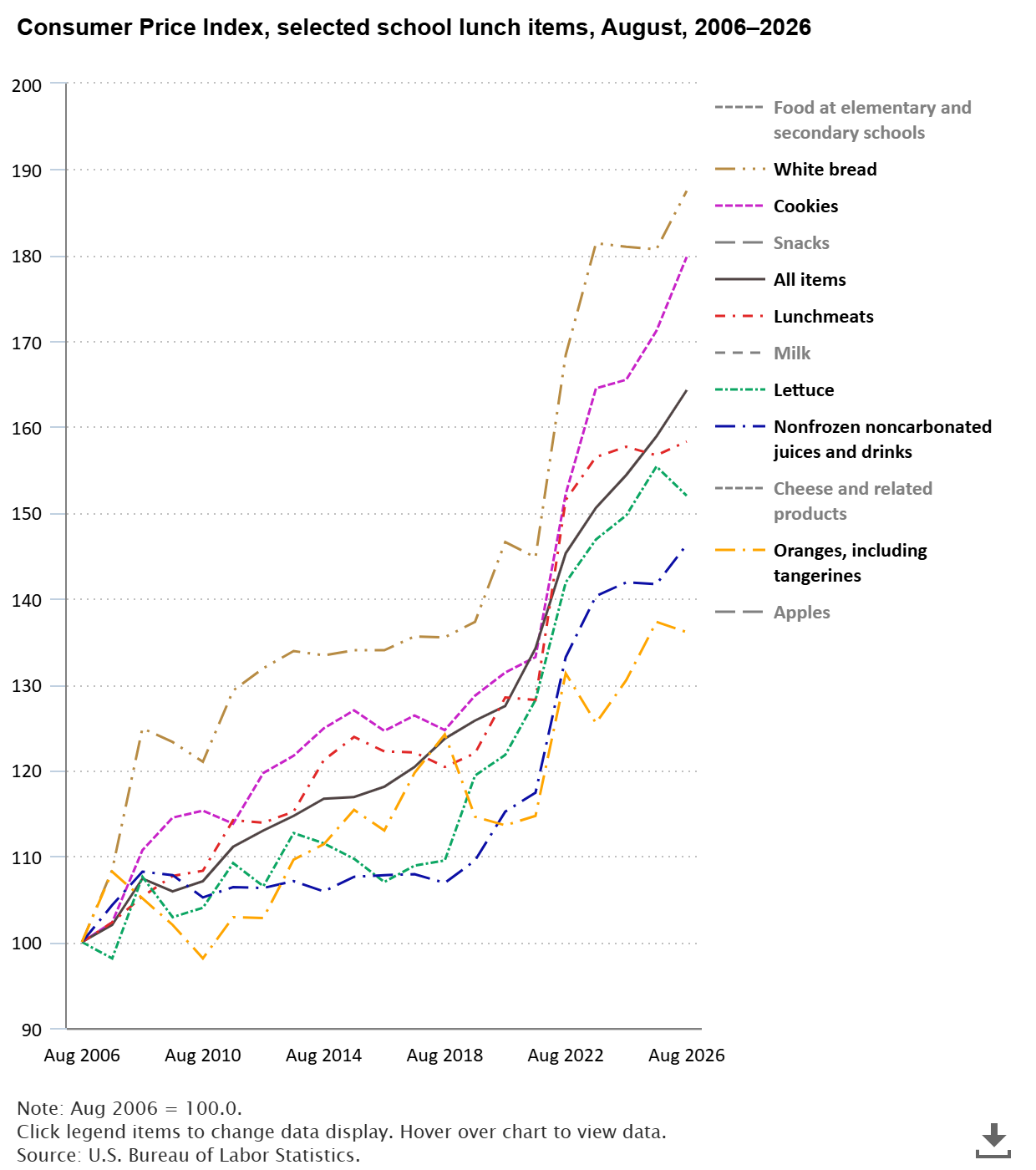
Because the items tracked are also items that many consumers purchase for themselves, the rise gives some insight into the costs of food items shoppers have experienced over the past six years.
Deloitte also keeps track of school lunch prices and has noted the correlation between rising school prices and the prices of groceries writ large. In its most-recent report on school lunches, Deloitte found that: “Whether their kids eat the cafeteria’s daily special or from a lunch box (and what goes into that box) is inherently an economic call for many parents, especially when the cost of groceries is 26% higher than it was five years ago across major US cities [italics added for emphasis], according to US Bureau of Labor Statistics data.”
For students purchasing lunch at school cafeterias, Deloitte reports that average price in 2026 is $3.15, up just 2 percent year-over-year.
But there are worrying signs here, as well. “[E]ven though data from our school lunch index … shows only a moderate upswing,” the report’s authors wrote, “that trend may not hold through the year. Over the next few months, production pressures such as higher diesel and fertilizer costs may work their way through the supply chain to consumers.”
Credit Cards
The sudden inflationary spikes noted in automobiles and school lunches are also hitting consumer debt.
Beginning in 2021, the amount of debt that consumers began taking on accelerated. Today’s combined credit card debt nationwide in Q2 2026 was $1.263 trillion. While that’s down from Q4 2025’s $1.277 trillion — the highest recorded since the New York Fed began tracking the data in 1999, it’s 60% higher than the total from just five years ago.
Further, Virginia is in the top third of states with average credit card debt — $8,298, according to Lending Tree, up 2.1 percent from a year ago.
And that debt is pinching harder. Because credit cards are unsecured debt, there will always be a premium associated with using them. But as economies become more trying, credit card interest rates are going to reflect those challenges with higher rates.
“Credit card interest rates are significantly higher than those of other major loan or bond products,” wrote Itamar Drechsler in the New York Fed blog Liberty Street Economics. “While high default losses contribute, they do not fully explain the magnitude of card interest rates.”
Instead, she points to two factors. “[H]igh rates reflect compensation for default risk that cannot be diversified away, either within the credit card market or across other lending markets in downturns,” and “credit card banks have significant pricing power, which they achieve by incurring large operating expenses.”
It’s Not Just Energy
The recent Consumer Price Index was pushed upward principally on the back of energy costs. But the inflation that has hit Virginians goes far beyond the month-over-month and year-over-year numbers that get the spotlight with monthly reports from the Bureau of Labor Statistics.
In many areas that touch on families, costs have been accelerating since COVID.
The reasons are not straight-forward, nor are they the fault of any one political party. Rather, like all economic issues, the range of reasons vary by region and product and circumstances.
New-car inflation, for example, is rising both because of tariffs and overseas wars, but also because cars have become technologically more sophisticated, spiking the ownership costs. Further, people are holding on to cars longer, which places strains on the used-car market, typically the place where more-affordable purchase options are available.
As affordability grows as an issue, solutions that go beyond fuel prices are necessary to address the broad-based challenges confronting households.