The Blue Wave certainly materialized on Tuesday night, and it was a big one – a tsunami. Or maybe we should mix our metaphors and call it a Blue Bloodbath?
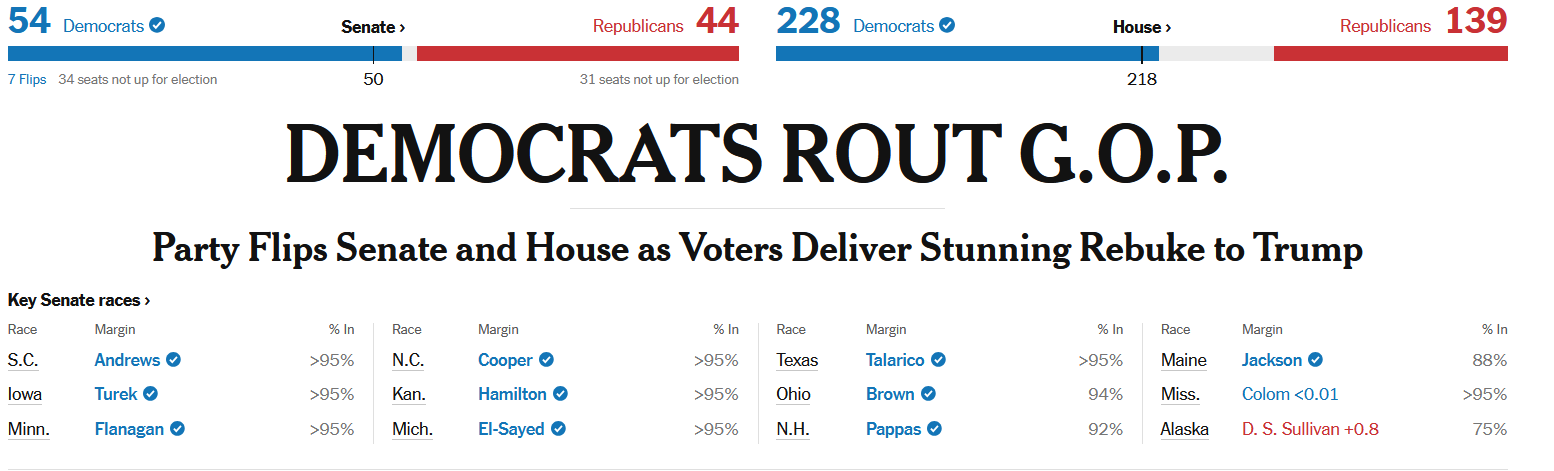
Nationally, the Democrats easily took control of both houses of Congress. Not only did they win a majority in the Senate, but flipped just about every seat they were contesting. As of early Wednesday morning, Dems have 54 Senate seats, with shots at adding Alaska, Maine and Mississippi (!?!?!). Add in historic wins for Governor in states like Georgia and Texas, and you can understand why the New York Times called it a “rout.”
This election was clearly about President Donald Trump. He told his supporters, “pretend I’m on the ballot.” This wasn’t the best idea, considering his historically low approval ratings and general unpopularity. Voters were mad, and they sent a message. We’ll see how that message is heard, by both parties, over the next year or two.
Here’s a few takeaways from the results in Virginia.
VA Congressional Races
Again, we already knew there would be a Blue Wave; the question was how big. The answer seems to be gigantic, but as I told radio listeners last night on VPM News (shoutout to the amazing VPM News team and their Election Night Pizza!), the tsunami didn’t hit Virginia with quite its full force.
By the time we reached this past week, it was pretty clear Jen Kiggans was toast in the 2nd district. That district was too purple to begin with, and the electorate had shifted too far towards the Democrats. A 2025 electorate (which seems to be what we got, with similar turnout to last year) was going to put Elaine Luria in office. The same logic claimed Rob Wittman’s political career as well, as Shannon Taylor seems to have won in the 1st. (The AP hasn’t called this race as of this writing, but VPAP has.)
For a while there it looked like John McGuire was actually going to lose the 5th! But while I thought he might have taken his race for granted earlier this election season, he rallied. His campaign seems to have gotten enough of his supporters out to eke out a narrow win in what was a VERY red district. Late last night, his opponent Tom Perriello suggested there might be a way to make up any difference with provisional ballots. (Virginia allows same-day registration, so an unregistered voter can go to the polls and vote past the registration deadline and even on Election Day; but those ballots are provisional and may take time to count.) But despite what looked like huge turnout in the college towns of Charlottesville and Lynchburg, it looks like there just aren’t going to be enough of those to change the result.
Democrats have to be happy with flipping two seats, although there’s probably a little regret that they didn’t get that third. Still, I don’t know what else they could have done; the fact that the 5th was even in play shows how bad a year this was for Republicans overall.
Constitutional Amendments: Reversal of Fortune
The three statewide ballot questions brought some interesting wrinkles — and some significant policy issues — to this year’s election in Virginia. All three sailed through, led by Question 1 on reproductive rights, which passed by an eye-popping +25 margin.
What I find most interesting about these amendments is how they reversed the normal order of things in politics. This time around, the Democrats had clear, resonant messages like “Support abortion rights” and “Everyone has the right to vote.” Republicans and other opponents were often forced into arguing against the amendments on technical grounds. So opponents warned that the language of the abortion amendment “impacts the General Assembly’s ability to regulate!” Boy, what a rallying cry.
Similarly, critics pointed out the voting rights amendment doesn’t take into account probation periods or restitution, doesn’t distinguish between violent and non-violent felonies, and didn’t have as big effects due to recent litigation. I know this was a complicated amendment. Ballotpedia actually rates the reading levels of ballot initiatives, and rated this one at a 42nd (!?!?!?!?!) grade level.
But the arguments against got even more complicated, and it made opponents sound like Democrats! How often have we heard establishment Dems complaining that easily explained policies like Medicare for All should actually be Medicare for Some if They Are Means-Tested and a Certain Percentage of Income is Allocated to Healthcare As Measured by Three Consecutive Tax Years Argle Bargle Argle Bargle? This time the Republicans were complicating things (if they weighed in at all), and the Democrats had the easy to understand message. The old saying applies here: if you’re explaining, you’re losing. Republicans lost.
Two more things about the amendments. First, I’ll be interested to see the turnout numbers by Congressional district. (VPAP I expect your visualization posthaste.) Did anyone come out to vote just for abortion, and did that have any effect on the Congressional races? This was the original intent in some ways for the amendments. Because of the Blue Wave that materialized against Trump nationally, Virginia Dems didn’t exactly need a turnout boost. But the amendment issues still could have made a difference in, say, the results in the 1st district if reluctant Taylor voters came out because abortion was on the ballot. I wonder what lessons the parties will take from this year’s amendments – and whether constitutional politics will be a more regular feature of Virginia elections.
Second, I had expected that the first two amendments would be fairly close in vote totals, with the third voting rights amendment dragging behind as a more technical issue. It turns out that the massive effort for Vote Yes on reproductive rights had significant effect, as Ballot Q1 did 5 points better than relatively equal results for both the marriage equality and voting amendments. (There was some effort and fundraising for the voting rights amendment as well, but the more complicated and technical nature of that amendment might have blunted the effect.) It turns out that if you mount a campaign for a salient policy issue, you often get results. Who knew?
Schools Tax Referenda
There were a record 47 localities with a sales tax referendum on the ballot, thanks to a new state law. As a reminder, the question before voters was to allow their county board or city council to pass a one cent sales tax, with proceeds to fund school maintenance and construction.
It looks like this question was NOT popular with voters, as over 30 of those localities voted against the question. Most of these were rural counties. Advocates argued that these counties will find it hard to raise money for new schools by any other means; still, it’s clear that asking for ANY kind of tax increase in this “affordability crisis” environment was a tall order. The Yes vote didn’t align well with the anti-Trump sentiment that drove these election results. Cities like Richmond and Fairfax, plus progressive leaning counties like Chesterfield and Albermarle, were more likely to vote yes.
Advocates for this state law, and schools funding in general, thought that this sales tax opportunity was a really good thing for all local governments. I was told that the dozens of localities that didn’t offer a referendum this year would likely do it next year. I wonder if that’s still true, or if rural county governments will think twice before asking voters for a tax hike, even if it’s for a worthy cause.
Recounts? (Please God let this be over)
As I usually do around Election Night, I’ve been looking at the rules for recounts in Virginia! Our state code allows for a recount if any election results in a less than 1% difference in total votes between the candidates. Sort of. If the margin is less than 1%, the losing candidate can request the recount, and may have to pay for it (although the fees aren’t astronomical). If the difference is even smaller, less than 1/2 percent, then the state triggers a free and automatic recount. It looks like none of the Congressional races will fall within the 1% threshold, although we’ll have to wait and see how provisional ballots are counted.
However, right now the sales tax referendum results in a couple of localities look like it might be within recount range. Chesterfield is within the 1% currently, and in Martinsville “yes” is leading by only 5 votes!!!! There’s no candidate here to ask for a recount if they are within the .5-1% window. But if 50 voters organize themselves, together they can ask for (and pay for) a recount.
One Final Warning?
Joe Morrissey is back in elected office. (If you know, you know.) Set your news alerts.
RICH MEAGHER is a professor, analyst, and podcast host who knows all things Virginia politics. (Well, most things.)