
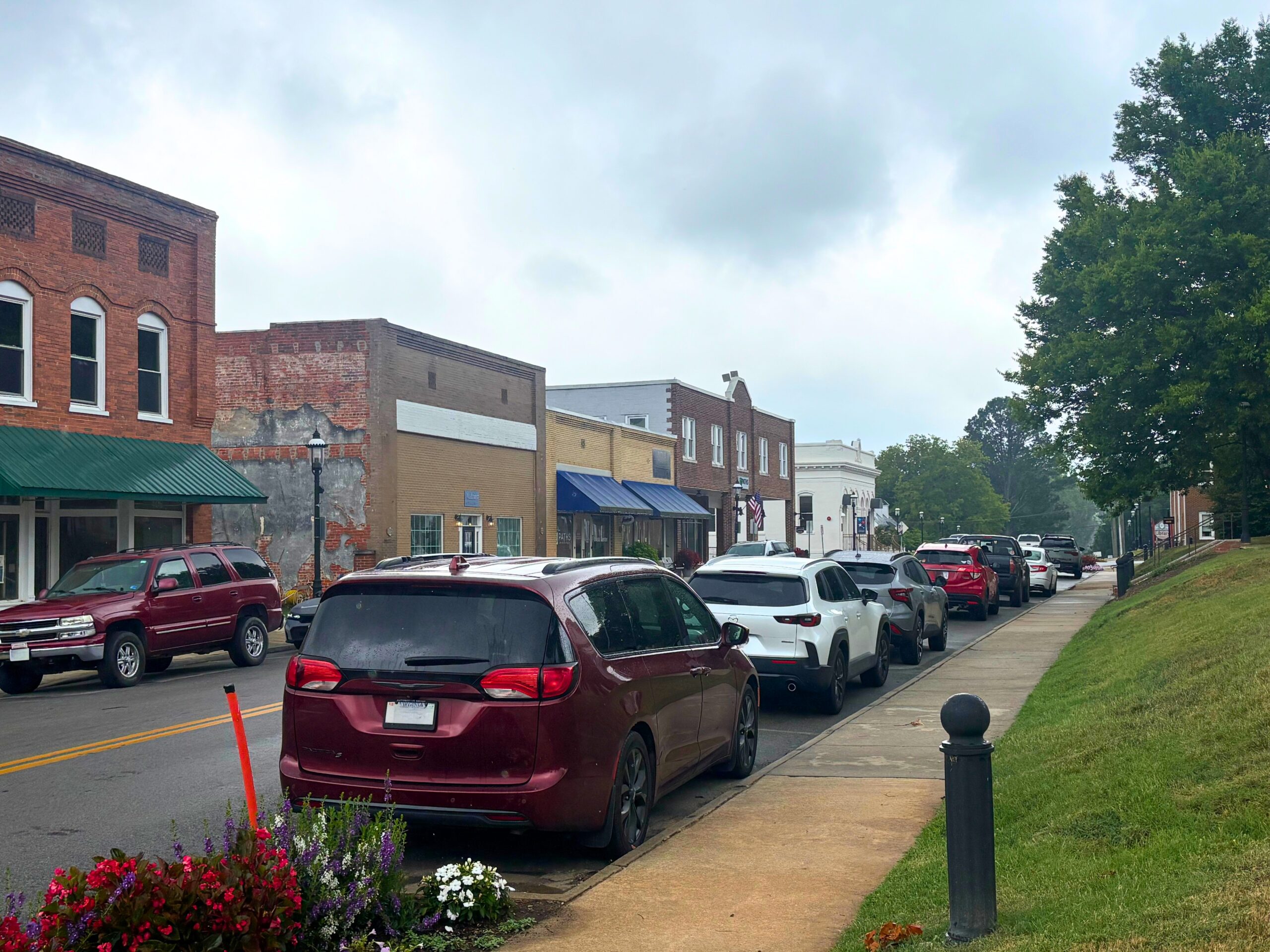
Rose’s Restaurant fills at lunch time with Boydton locals who are drawn by appetizing Italian food at reasonable prices, and the lively banter that fills the dining room.
It’s the kind of warm, welcoming small business people envision when they think about rural America. Only about 300 people live in this Mecklenburg County seat. Places like Rose’s Restaurant are the upside of small-town life that glossy lifestyle magazines rightfully celebrate.
Picture-perfect small towns can become eyesores, however, when economic hard times land. And economic collapse fell hard on Mecklenburg County and Boydton at the turn of the millennium.
For much of the second half of the 20th century, tobacco and manufacturing underpinned the county’s economy.
Most of that is all gone now.
In the 1990s, Big Tobacco saw its domestic market drop sharply as concerns about its products’ health effects led to litigation and settlements that resulted in a sharp decline in demand for locally grown tobacco. In 2001, the Russell Stover candy factory closed, costing the county 750 jobs. Then in 2002, textile manufacturer Burlington Industries shuttered, taking roughly 2,200 jobs out of the county’s employment pool.
Another blow came in 2008 when the global financial crisis all but stopped the growth in building vacation homes along Kerr Lake, a major recreation and tourism site.
“We had shed thousands of jobs,” in the last decade of the 20th century and the first decade of the 21st ,”said Mecklenburg County Administrator Alex Gottschalk, “and a lot of the key pillars of our economy” that had sustained three generations of citizens.
A new industry came calling in the early 2010s, however, that has revived Boydton and Mecklenburg, created new opportunities for its citizens as well as those in surrounding counties, without stripping the area of its small-town culture that its residents love and vacationers are attracted to.
Making Digital Benefits Tangible: The Data Center Dividend
While the turn of the millennium was tough on Mecklenburg, the region wasn’t without assets.
“We had seven industrial parks that were site-ready,” Mecklenburg’s Director of Economic Development Angie Kellett told the Virginia Free press (VFP). “At one point, we were the county in the state with the most available sites.”
The hope was to bring traditional heavy manufacturing to the Boydton site. Instead, Microsoft came with a plan to build a data center on one of those site-ready plots – 170 acres along Highway 58, which bisects the county east and west.
Kellett called Microsoft’s arrival “ironic,” because, she continued, “it was so far from what we imagined going there.”
It was the first in a string of expansions and new developments. Gottschalk points to the period from 2019 to 2022 as the tipping point, as Microsoft made a number of subsequent purchases of site-ready plots. “That’s when we began reaping revenue growth,” Gottschalk said. “We had multiple campuses and buildings coming online and were taxable at the same time.”
As revenue began to ramp up, county leaders began looking for ways to show citizens how their cost of living was being positively affected by the new revenues. The first was altering the financing for the joint middle- and high-school that opened in 2022.
In fiscal year 2016-2017, the personal property tax rate was raised by 10 cents from $3.26 to $3.36 to pay for the debt service on the new school complex. For the 2025-2026 budget year, the county reduced that rate back to $3.26. As Gottschalk explained in the budget, this could be done because data center revenue allowed the county to “assume the remaining debt costs within the new baseline of the Budget without the need for the extra revenue generated from the prior tax increase.”
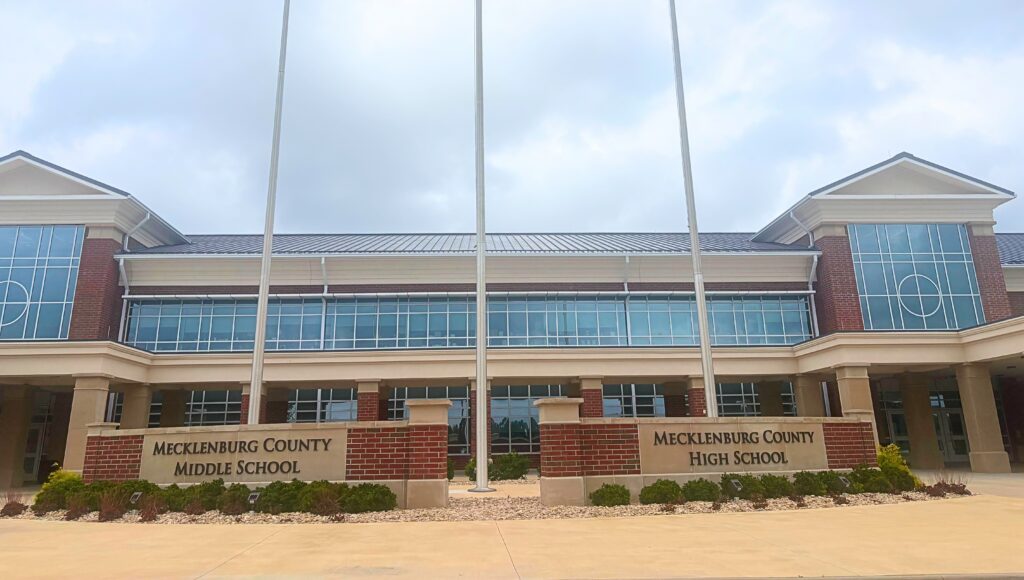
For fiscal year 2027, the county cut deeper, lowering the rate on personal vehicles to $2.46. The $3.26 rate remains in place for other categories of personal property.
The county developed a shortened nomenclature to explain the connection between rising data center revenues, increased capital projects, and lower tax rates: the “Data Center Dividend.”
Each year, the county targets different areas for this benefit.
In addition to the reduction in the personal property rate in 2025, two additional savings were realized. The county eliminated the vehicle registration decal fee and the Consumer Utility tax.
Gottschalk said that in real terms, that’s nearly a $100 a year the average household no longer has to shoulder.
The dividend shows up in other ways as well.
Over the past six years, the county has reduced the real-estate tax rate from 42 cents to the recently approved 31 cents.
The dividend is also being used to broaden the county’s economic base. This year, $400,000 in matching funds is being given to help “build a broader based and more sustainable long-term economy,” according to the budget. The funds include four $50,000 awards for businesses with 10-50 jobs to help fuel their growth, as well as two $15,000 awards to help home businesses move into commercial spaces.
Tourism is also getting a $1.5 million boost to help bring new businesses to the county’s newly established tourism zone.
Where the Backlash Isn’t
While public outcry against data centers is accelerating across much of Virginia, one sees relatively little of it in Mecklenburg.
“No Data Center” signs that are common in some parts of the state don’t appear to be part of Mecklenburg’s landscape.
Even though the number of data centers is continuing to grow in Mecklenburg – there are a dozen campuses and some two dozen data centers – resistance appears to be minimal.
In 2024 the Sierra Club held a joint meeting with a local environmental group, but little organized opposition appears to have followed. At the most recent meeting to approve a new center, a couple of people spoke against the project, but there was little other evidence of widespread distaste for it.
Understanding why this is the case has no simple answer.
The county’s clearly explaining what the data center revenues are supporting likely helps.
Further, not only are tax rates falling, but infrastructure projects are being supported that are being fully funded by the data centers.
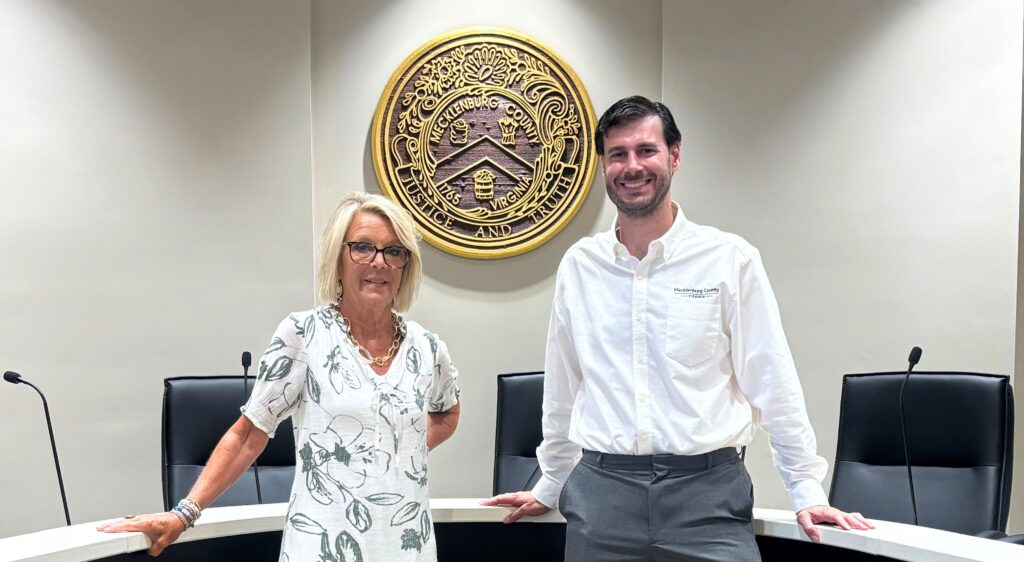
Gottschalk points to the expansion and rehabilitation of the water treatment plant as one example. The $25 million project doubled capacity, and introduced new technologies that “allow for more efficient and automated water production and supply operations,” he said. Because the industry covered the cost, ratepayers avoid the burden of a generational upgrade entirely – the kind of expense that typically drives water rates up. And despite the doubled capacity, the county’s actual water use remains far below permitted levels.
The data center industry has also become a jobs engine for the community. The largest employer in Mecklenburg at the moment is VCU Hospital. Second is the data center industry. The gap between the two, Gottschalk said, is “a couple hundred and closing.”
These factors alone, however, don’t explain why the vocal backlash to data centers has not so far come to Mecklenburg. Other localities in Virginia like Prince William and Loudoun have realized these same benefits, but they are seeing anti-data-center sentiment rise.
The answer may rest with how people understand where the county’s economy is headed.
Training a Workforce, Not Simply Filling Jobs
Microsoft’s tax revenue makes up a substantial portion of Mecklenburg’s county budget. The company alone accounts for some 45 percent of the county’s real estate tax base. This doesn’t include the taxes generated on peripherals.
The company has also become a trainer of next-generation employees. This training creates pathways to Microsoft in Mecklenburg, to be sure, but to other industries inside and outside the region as well.
The best example of this is the Data Center Academy. The first such program of its kind, the academy launched in 2018 through a partnership with Southside Virginia Community College (SVCC).
Up to that point, SVCC had been offering degree programs that could lead to careers in the data center industry. Then, said Chad Patton, SVCC dean of career and occupational technology, “Microsoft came to us and said we want to work with you.”
It began with a review of the school’s curriculum, which Microsoft recommended strengthening by adding a number of required credentials. It also helped the school transition this training from degree programs to “shorter training programs,” Patton said.
As of now, well over 500 people have passed through the training programs coming from counties across southern Virginia.
They learn in a mock data center that Microsoft built and paid for, contributing racks, servers, and all the tools one would expect to find inside a data center.
When the program launched, there was scholarship funding to pay for the training which was in place so long as the student “was passing the tests and continuing,” Patton said.
A significant portion of this training is in the critical environment lab. According to a press release issued by Microsoft when the program launched, the lab focuses on electrical, mechanical, and HVAC systems, along with other industrial systems meant to prepare students for work in critical environments.
A benefit of the program is that students are employable after the first semester or two. If they want to work at Microsoft, attending this training improves their chances of getting an interview.
But Microsoft isn’t the only path forward.
Kellett told VFP that “the Critical Environment Lab provides skills that can make you attractive to many industrial facility jobs – not just at Microsoft”
And Gottschalk added that local companies are benefiting, hiring graduates experienced in welding, HVAC, and other technical areas.
The academy now offers a “Hiring Our Heroes,” which provides training in information technology and critical environment operations.
“Microsoft does not charge participants, nor are they asked to use any of the GI benefits,” Patton said. Once accepted into the program, students are “offered the opportunity to come to us and have the training paid for in the last 6 months of their active military service if their commanding officer approves,” Patton said. “The active military students are still getting paid by the military.”
The last cohort through the program had a 100% placement rate, a not unusual result according to Patton.
There are more than numbers for Patton. Before transitioning into education, he was a police officer in Clarksville, also in Mecklenburg County, a job he very much loved. “It’s the noblest of professions,” he said. However, in that job he “saw the socioeconomic effect on the economy, on crime, quality of life, so many things.”
Now standing on the other side and working in education, he gets to see “all the quality of life improvements Microsoft” and other major employers have brought to the region. And that, Patton said, brings “great fulfillment”
What Mecklenburg’s Experience Offers
Mecklenburg is among the few places in Virginia that now have a long track record with data centers as community partners and economic engines. Only Loudoun County arguably has more experience.
What has emerged in this quiet southside community is worth factoring into the debates about data centers in the Commonwealth.
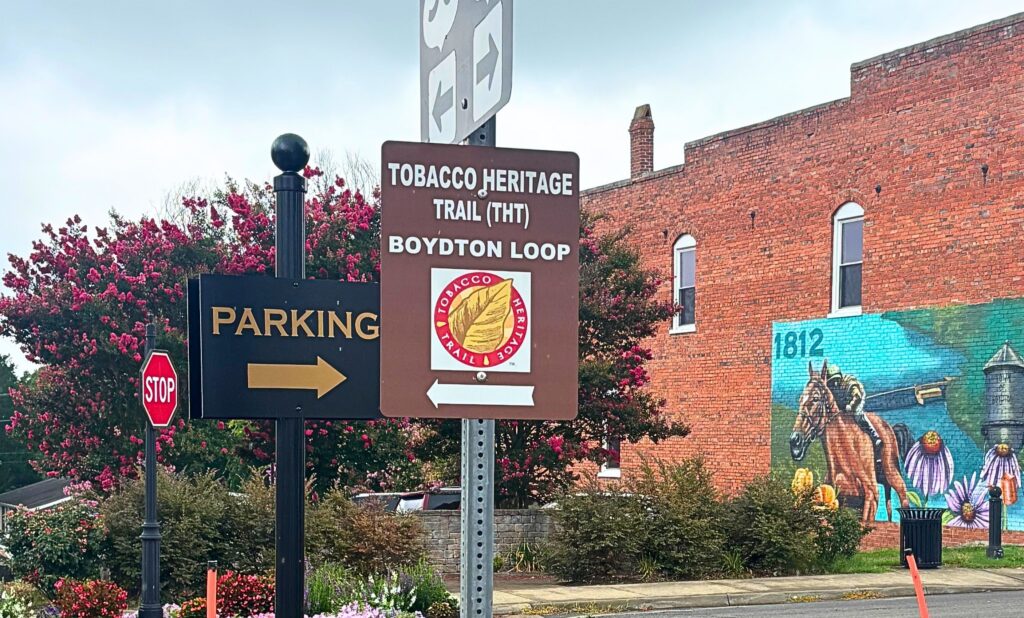
While data centers have shored up the county’s finances, and contributed significantly to the community’s education programs, it is also bringing a generational shift for the county’s residents.
Opportunities to succeed in the new economy being created by data centers go beyond direct operational jobs created. They include new funding for local businesses to help strengthen the small towns that dot Mecklenburg, new infrastructure to carry the county into the future and potentially attract new businesses, and training that is valuable well beyond the walls of a data center facility.
And it’s happened without changing the small-town fabric that makes places like Rose’s Restaurant feel the way local restaurants have long felt in Boydton – like home.