
The Virginia Department of Environmental Quality Wednesday released the final version of the amended Regional Greenhouse Gas Initiative (RGGI) regulation for 2027 and beyond, which shrinks the number of Virginia carbon allowances from 27 million next year to fewer than 10 million a decade later.
The 2026 General Assembly exempted the return to RGGI from the Administrative Process Act, so no public input was sought, no public hearings were held, no economic analysis done, and the Air Pollution Control Board didn’t even get to vote on this text. The only final step is formal publication later this month.
There are substantial changes from the regulatory program Virginia participated in from 2021 through 2023. The number of available allowances, which electricity generators need to buy and retire to run coal or natural gas plants, will decline far more rapidly and reach a lower level than under previous rules.
The new regulation does not, however, seek to impose the RGGI allowance requirement on Virginia data centers that use on-site diesel or natural gas to generate for their own use. Gov. Abigail Spanberger (D) mentioned that idea as part of her package of data center regulations last month, but no details have emerged and it may require legislation.
The 11-state RGGI compact’s rules went through a redesign while Virginia was not participating, and Virginia’s energy system was not part of any of the modeling done. The other states later did agree to increase the overall number of allowances to accommodate Virginia, but with the same steep downward curve they had imposed on themselves.
The RGGI system has always included both base allowances and an additional amount known as a “cost containment reserve,” or CCR, which is only available when the price hits a certain level. This new regulatory setup includes two sets of CCR allowances. With RGGI prices now crowding $40 per allowance, everybody expects the trigger prices will be exceeded, and every CCR alowance will be used in 2027 and beyond.
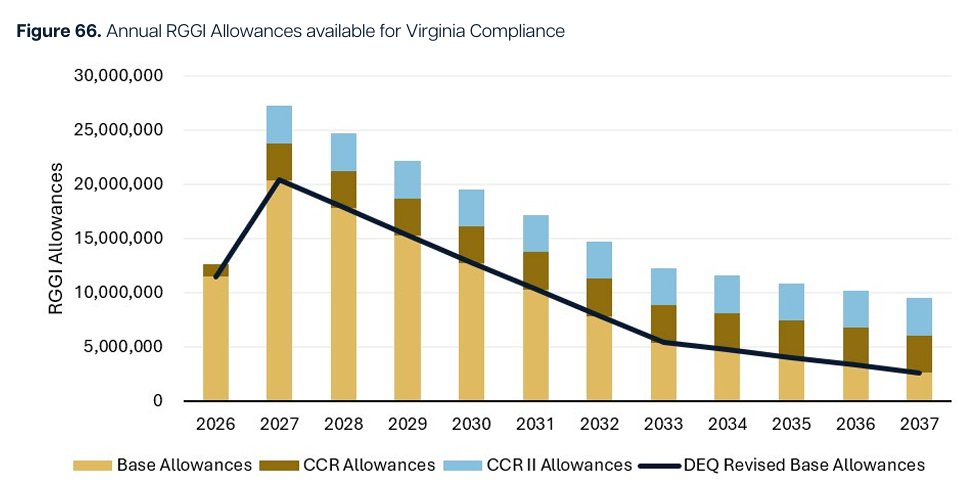
The table below is from the recent Virginia Energy Plan, and it shows Virginia’s allocation of RGGI allowances, with both tranches of cost containment reserve. Slightly more than 27 million allowance can be sold by Virginia in 2027, which reduces to 19.6 million by 2030 and 9.5 million in 2036. The 2036 allocation is just 35% of the amount for 2027. By then the CCR amount is larger than the base allocation of allowances.
Does that mean Virginia’s major energy producers, particularly the largest, Dominion Energy Virginia, will be shutting down their coal or natural gas facilities? Not according to that same Energy Plan released last week by Gov. Spanberger. As the table below shows, it assumes the hydrocarbon plants all stay open, and a few may be added. None close before the Virginia Clean Economy Act deadline of 2045 (when you can see the need for imported power jumps).
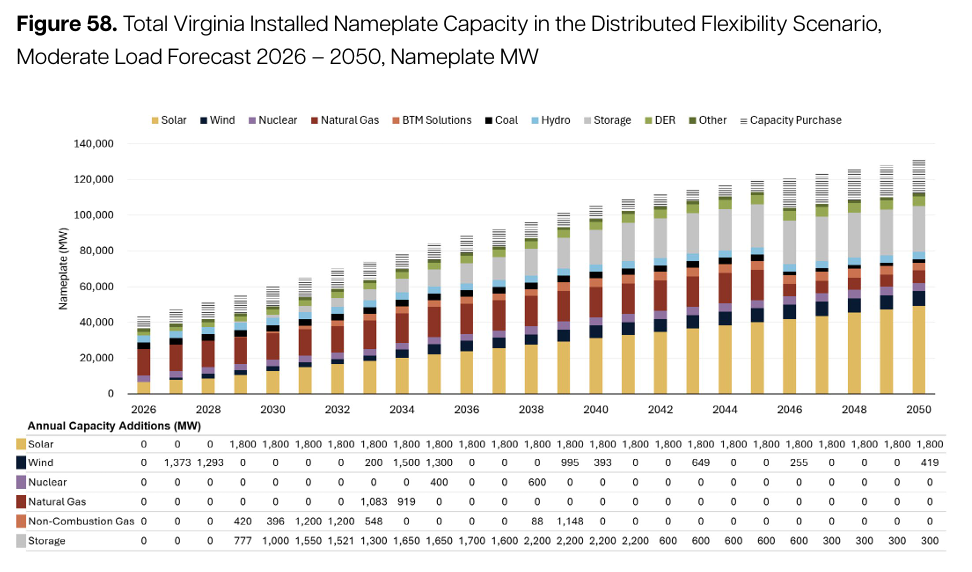
Even if they run only half the time, the remaining hydrocarbon plants will likely emit up to 32 million metric tons of carbon dioxide and thus need 32 million RGGI allowances. A decade from now the companies will be buying most of their allowances, 20 million or more, from other states within the RGGI compact, or from speculators who buy and sell allowances in a secondary market.
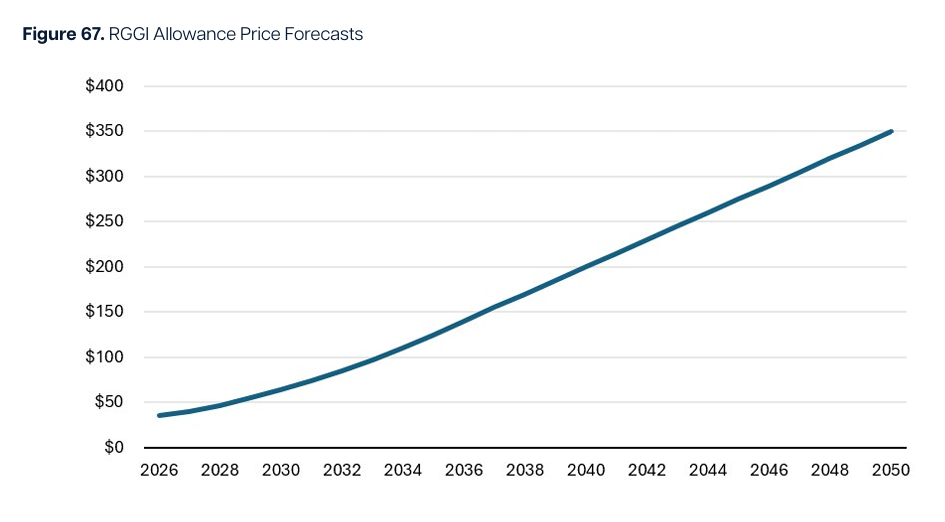
The governor’s Energy Plan noted the impact of that disconnect between supply and demand on the future price of RGGI allowances. Here is a third illustration from that document, which shows the RGGI auction prices rising from just under $40 per ton now to about $150 per ton a decade from now and $200 a ton in 2040. Before the 2045 VCEA deadline, the Spanberger Administration sees allowance prices exceeding $250 per ton.
If (when, really) Virginia is a net buyer of allowances, needing more than it has, the additional money will not be paid to Virginia. It will be paid to other entities selling RGGI allowances – any RGGI state that has a surplus or any speculator willing to sell. The cost being passed on to customers will cover payments made to those non-Virginia sellers.
The recent political promises to rebate RGGI revenue to residential customers only cover the money collected by Virginia. Within a decade, that could be no more than one-third of what the utilities are paying and passing on to customers for RGGI. There is no plan to rebate any of the RGGI costs to commercial or industrial customers.
The regulatory State Corporation Commission is currently reviewing Dominion’s request for a 7 percent rate increase to cover the cost of RGGI ($13 per 1,000 kilowatt hours). Nothing in the record indicates anybody is asking about what happens in future years when Dominion and others are buying many and eventually most of their allowances from outside the state.