
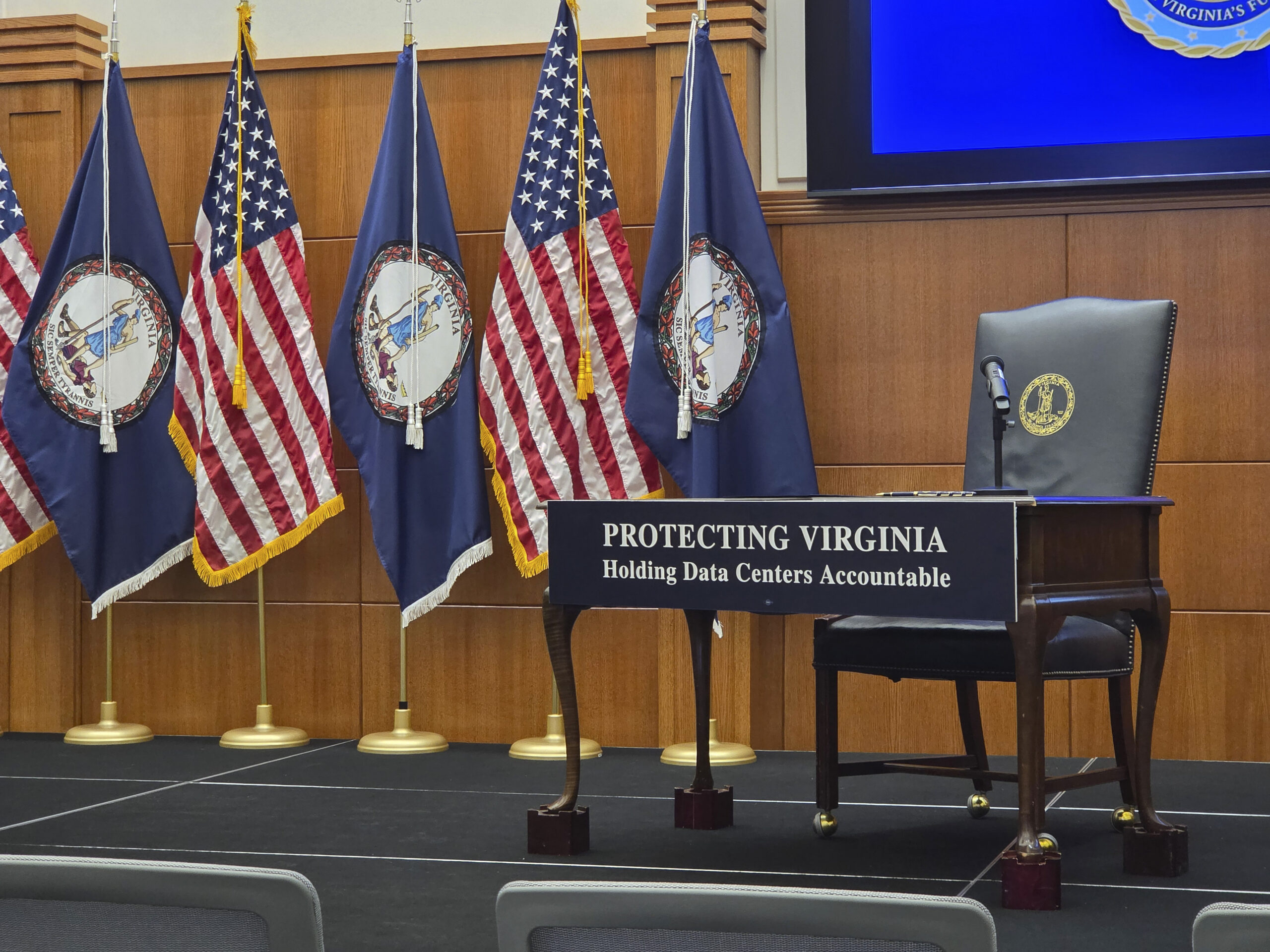
Hundreds of Virginia data centers may soon be competing with Dominion Energy Virginia and other retail electricity producers in the quarterly auctions for Regional Greenhouse Gas Initiative (RGGI) allowances. Even without the data centers bidding for them, allowances set a record price of $37.65 per ton of emissions in the most recent auction.
Bringing the data center power plants under the RGGI regime is just one of the proposals made by Governor Abigail Spanberger (D) and her staff Friday. Discouraging the large energy users from using natural gas or diesel was a central theme of Data Center Accountability Framework they released.
“If you want to build the future digital economy in our state…you will do so as a clean energy partner,” her Chief Energy Officer Josephus Allmond said. Allmond said the industry needs to “accelerate rather than delay our clean energy transition.”
He promised to close “the loophole that lets some facilities dodge our clean air rules in RGGI.”
Of the five speakers who followed Spanberger to the podium Friday, four of them talked about new constraints on the use of natural gas or diesel fuel by the industry. At the same time, the industry is under widespread pressure to use its own “behind the meter” generation take strain off the general electricity grid.
Two of the speakers she invited to her presentation Friday do not work for the state but spoke for large environmental activist groups opposed to the use of hydrocarbons. Michael Town of the League of Conservation Voters complained communities with data center power plants “have black clouds of pollution hanging over them.”
Conner Kish of the Sierra Club said the message being sent to the industry is “it is time to embrace clean energy for power, and they need to do it faster.” He called the Virginia Clean Economy Act, which was referenced by the Governor Friday, the “crown jewel of legislation, not just for Virginia but for the South.”
Another of the proposals mentioned Friday was to give permitting and interconnection preference to data centers demonstrating compliance to the Virginia Clean Energy Act more rapidly than its deadlines for eliminating hydrocarbon fuels.
“We’ll prioritize grid access for data centers that source clean energy five years faster than the Clean Economy Act and reduce emissions from backup generators by 60%,” Spanberger said. “We’re also going to limit the amount of electricity these facilities can generate from on-site natural gas – an important step that no other state has taken action on yet.”
Secretary of Natural Resources David Bulova discussed requiring data centers with generators that do not meet the most stringent air emissions standards to upgrade to the Tier Four technology. The 2026 General Assembly did order Tier Four for any new data center seeking an air emissions permit starting this year but took no action against existing facilities.
Bulova also said future applications for air emissions permits will be assessed against the cumulative impact of all such facilities in the state, not just the impact of that one facility. The Sierra Club leader praised that idea.
According to a presentation made by the Department of Environmental Quality (DEQ) to the Air Pollution Control Board during its August meeting, 200 data center air emissions permits were active at that point. Many permits covered multiple facilities of a single company. They allowed 10,260 individual generation units and a listed possible energy capacity of 26 gigawatts. That is close to another Dominion Energy’s worth of generation.
During the 2026 General Assembly, as the House of Delegates and Senate wrestled over the existing sales tax preference for the data center industry, the House’s position was to make the tax break conditional upon meeting such clean energy goals. That was not approved, but the Governor is now following other paths to get there.
Many of Spanberger’s proposals Friday will need legislation to implement, but DEQ and the air and water permitting process are part of her administration. RGGI, for example, is imposed by a state regulation and DEQ is already working on an amended RGGI regulation to take effect in 2027.
The current Virginia RGGI regulation includes an exemption for “behind the meter” generation. That is why RGGI allowances have never been required of data centers using their own natural gas and diesel generators as a primary or backup power source. A simple change can limit or remove that exemption as of 2027.
The 11-state RGGI compact sets a limit on how many allowances can be sold each year, a limit that will shrink substantially over the next three-year contract period. As Virginia was set to rejoin the allowance marketplace, an independent monitor for RGGI noted that Virginia’s return would create a greater gap between the supply of allowances and the demand for them.
“Due to Virginia’s participation starting July 1, 2026, an additional 12.6 (million) allowances (including cost containment reserve allowances) will be offered for sale in the two remaining auctions in 2026. Virginia compliance entities had 17 (million) tons of covered emissions in the last two quarters of 2025.” Potomac Economics noted in its report.
That indicated a demand for more than four million more allowances from Virginia generation firms than were available for Virginia to sell. Adding all the data center energy production into the 2027 auctions, adding scores of additional companies needing allowances to operate, without adding any more allowances, will expand that supply gap and further pressure the price.