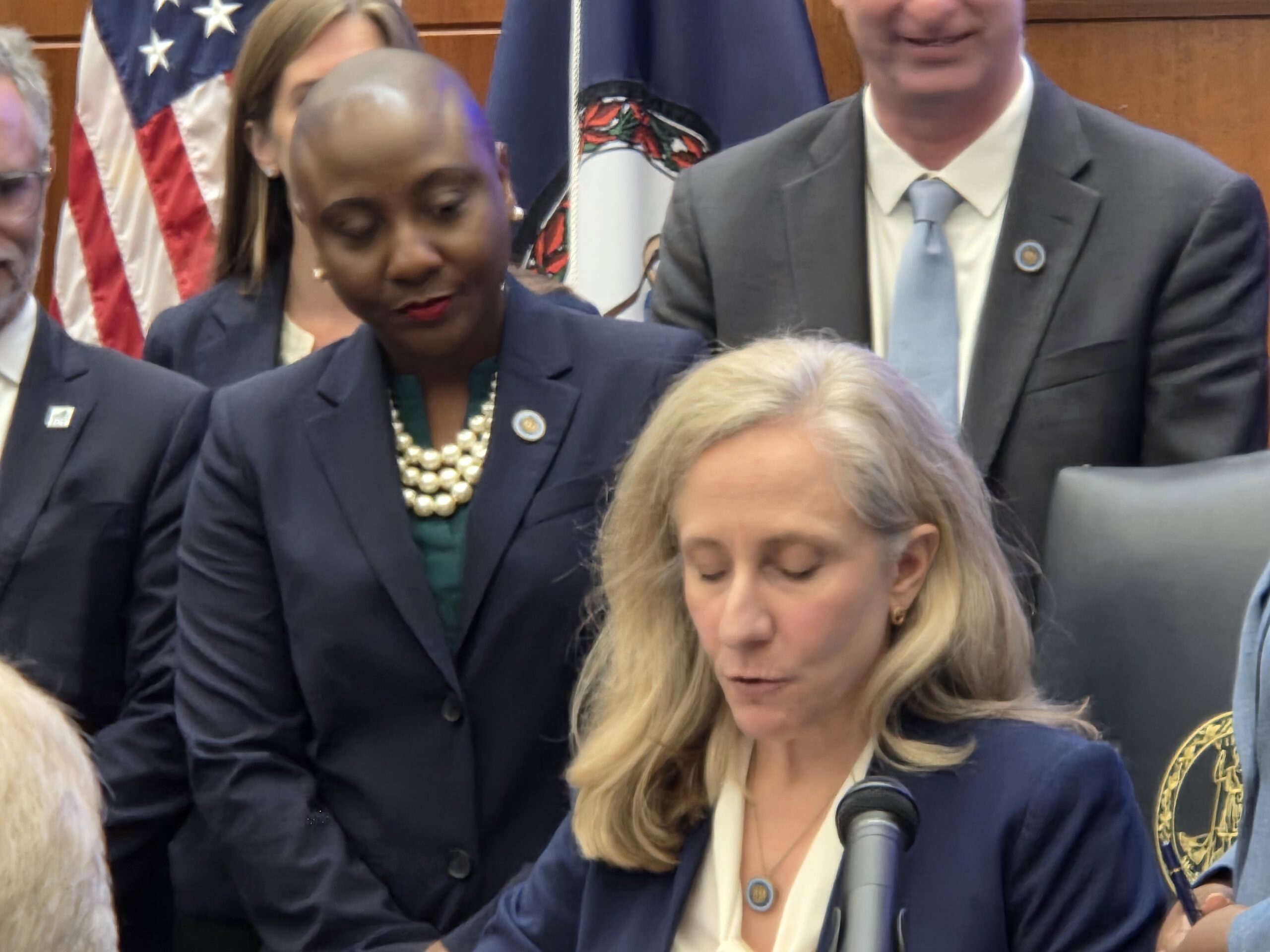
Working from the belief that “good governance is good politics,” not the inverse, Gov. Abigail Spanberger today announced and then signed Executive Order 22, which she described as the “most comprehensive data center accountability framework in America.”
The Virginia Data Center Accountability Framework that EO 22 will create rests on five pillars:
- Engage Transparently with Communities
- Protect Our Environment
- Improve Affordability for Virginians
- Advance Clean Energy and Grid Reliability
- Deliver a Better Deal for Our Workforce
“Right now,” Spanberger said in her opening remarks, citizens are “rightfully concerned about how so many of these projects have been secretive, devoid of any real transparency. They’re rightfully concerned about the long-term impact these projects have on clean air and clean water. They’re concerned about how rapidly this industry has grown with the rise of artificial intelligence. I want everyone who is feeling this way to know that I hear your concerns, I understand them, and I share them.”
Among the actions that go into place immediately are a ban on nondisclosure agreements (NDAs) throughout Virginia state government, including agencies, departments, boards, commissions, and other authorities.
“Virginia is putting a stop to the secrecy this industry so often relies on,” Spanberger said in her remarks. This means “banning non-disclosure agreements for commercial projects, because oftentimes they keep neighbors in the dark about what’s being planned in their backyards.”
Per EO 22, the ban applies to the “executive branch agencies, departments, boards, commissions, authorities, and any other employees under the Governor’s supervision.”
The order does not go so far as to ban existing agreements, however, barring “extraordinary circumstances.”
The EO also will get “rid of by-right approval” and require that developers secure “local permit approvals for any data center above 25MW,” Spanberger said.
This is being accomplished by ending the Virginia Economic Development Partnership’s (VEDP) ability to expedite permitting through the Virginia Business Ready Sites Program for any new data center project that will have a peak energy demand of 25 MW or greater.
On the energy front, Spanberger announced two significant changes.
“We’ll prioritize grid access for data centers that source clean energy five years faster than the Clean Economy Act and reduce emissions from backup generators by 60 percent,” she said. “We’re also going to limit the amount of electricity these facilities can generate from on-site natural gas – an important step that no other state has taken action on yet.”
A Community Toolkit
The Virginia Data Center Accountability Framework will be under the lead of Josephus Allmond, who serves as the state’s first Chief Energy Officer.
One of his first tasks will be to produce within four months a “Data Center Planning and Community Engagement Toolkit,” aimed at helping localities navigate negotiating and planning for data centers in their communities.
In addition to questions, information requests, and disclosure templates for proposed data-center projects, the toolkit will also provide guidance on evaluating anticipated electricity demand and water use, as well as information about backup generation.
Allmond is also tasked with creating Virginia Local Energy and Accountable Data Centers (“VA-LEAD”). Modeled on the LEED and EnergyStar programs, VA-LEAD will “distinguish responsible data center developments,” according to EO 22.
Rapid-Response AI Task Force
Beyond data centers, the EO also will address rising concerns around artificial intelligence (AI) with the forming of the Rapid-Response AI Task Force.
This group will be led by Virginia’s Chief Transformation Officer Dave Wilkinson, Counsel to the Governor Matt McGuire, and Secretary of Administration Traci DeShazor.
Key among the task force’s responsibilities will be developing policy and legislative proposals to address concerns over workforce displacement, data privacy, and cybersecurity.
In her comments, DeShazor said that “There has been a lot of conversation … about the pace of the development of this technology, and whether we are moving faster than we can responsibly manage. That is not a fringe concern.”
She acknowledged the benefits AI can bring for making services accessible but added that “we have to be honest with ourselves by acknowledging an unprecedented risk AI potentially presents for Virginians’ personal data … for the safety and security of the system we all rely on.”
Chief among her concerns are cybersecurity risks as AI rapidly develops.
“What we were securing five years ago,” she said, “is not what we will be securing five years or even five months from now.”
A key part of this work will be figuring out what the government currently is empowered to do under Virginia law, and where there are gaps.
Highest Standards
During the Q&A period, Spanberger was asked if it’s fair to call this “the most aggressive accountability” plan in the country when it has no moratorium and it is not addressing the tax incentives.
Spanberger responded by noting a number of firsts this framework provides
“We are the first in the nation to limit behind-the-meter gas generation. We are the first in the nation to conduct cumulative impacts, analysis, and require moving toward Tier Four or better clean alternatives for backup diesel generators.” And, she continued, this is a first-in-the-nation “comprehensive and specific action plan across so many categories.”
“Make no mistake about it,” Spanberger said in her opening comments: “These standards are high. And moving forward, it’s pretty simple: if you don’t want to meet Virginia’s high standards, then Virginia isn’t the place for you.”