
Another day, another poll stating that data centers – the infrastructure that makes possible everything from smartphones and Netflix streaming to online banking and high-end scientific research – are unpopular.
The most recent comes from HeatMap (Subscription Required). Over the past year, HeatMap has asked the same question to survey takers: “As you may know, data centers are facilities that house the servers that power the internet, apps, and artificial intelligence. Would you support or oppose a data center being built near where you live?”
The rapid shift in public opinion that question reveals has been described as “shocking” by Robinson Meyer, who is the publication’s founding executive editor.
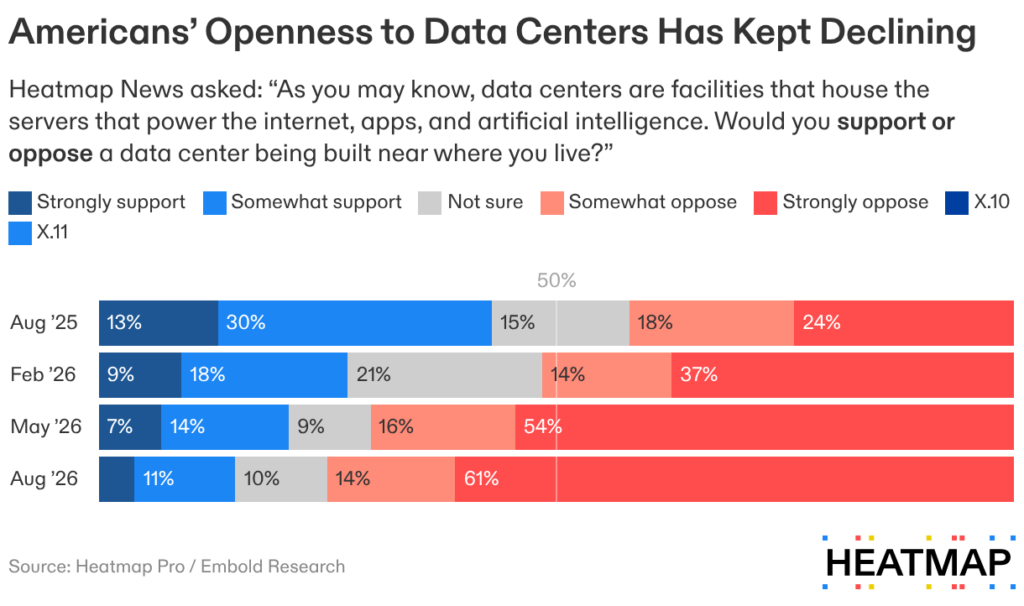
In August 2025, 43 percent of respondents “strongly” or “somewhat” supported a data center built near them. In August 2026, that percentage had collapsed to 15 percent.
As Meyer explains: “If you can think of a cohort of Americans, there’s a good chance they wouldn’t welcome a data center in their area. The shift against the facilities is represented across age, gender, income, partisan ID, and the rural-urban divide. Data centers are 43 points underwater with Republicans, 65 points underwater with independents, and 75 points underwater with Democrats.”
The findings are not a one-off. A Politico poll in July 2026 conducted by Public First found a similar trend. Forty-one percent of respondents said they wouldn’t want a data center built within three miles of their home. The same question when asked six months earlier found just 28 percent would object.
Polls by Gallup and Pew show similar trends.
There’s an element of these polls, however, that hasn’t received the same level of attention and deserves a closer look: How much do people actually know about data centers?
Data What?
When the Wilder Center at Virginia Commonwealth University released its Commonwealth Poll in July that explored Virginian’s opinions about tax exemptions for data centers, it showed an overwhelming majority who opposed the tax break – 72 percent. Given what other polls reveal about how people feel about data centers, the Commonwealth findings aren’t surprising.
However, the survey also asked how much respondents knew about data centers. “Before today,” the question began, “had you heard or read much about data centers in Virginia?”
Seventy-four percent said they had, while 25 percent said they had not. What wasn’t clear was what those respondents meant by “Much.”
I wrote Robyn McDougle, interim dean and professor in the L. Douglas Wilder School of Government and Public Affairs, and asked if VCU had done any research into what respondents meant by “much,” or if she knew of survey groups that had tried to measure how much people actually know.
“We have not done further research,” she responded. “[W]e were just wondering if the respondents had seen any news articles or advertisements related to data centers.”
I also asked her if she were “aware of any surveys that explore how deeply respondents understand the tax incentive?”
“I am not aware of any surveys that do that,” she responded.
Because respondents were left to define for themselves what constituted knowing “much” about the subject, however, the survey measures perceived familiarity rather than objective knowledge. It tells us whether people believe they have encountered information about data centers. It does not tell us what they actually know.
A similar problem shows up in the Pew research. The organization found in its polling that 75 percent of respondents said they had heard or read about data centers. Twenty-five percent said they had read or heard “a lot,” while fully 50 percent said “a little.” And 25 percent said they knew “nothing at all.”
Pew doesn’t tease out what is meant by “a lot” or “a little,” leaving it to the respondents to decide – just as the Commonwealth poll does. However, notice that in the Pew poll, 75 percent of respondents admitted to hearing or reading little or nothing, while nearly as large a percentage in the Commonwealth poll claim to have heard or read a lot about data centers.
These surveys measure how familiar people believe themselves to be with the subject. They do not test whether respondents understand things such as how data centers work, how much water they use, or what tax incentives they receive.
A person who has read some long studies about data centers, but regularly reads deeply across a range of subjects, might fairly say they know “a little.” A person who reads little, or gets most of their information from social media, may have read a couple of news stories and believe they know “a lot.”
A June 2026 poll by CBS News is among the few outlets that have picked up on the question of how much people actually know about data centers. “Most Americans,” it found, “feel they don’t know a lot about them yet.”
Indeed, 57 percent of respondents to the question “How much do you know about data centers” said “a little,” while 27 percent reported knowing nothing.”
For a topic generating increasingly strong opinions (and potentially consequential policy responses), that is a significant number of people who acknowledge knowing little or nothing about a complex industry.
A survey released the same day as the recent HeatMap survey and reported by T&D World, an industry publication covering power grids, found similarly high numbers of people who know relatively little about the industry.
“The findings,” T&D reported, “suggest that while energy utilities, developers, regulators and policymakers must work hard to build public trust in data centers, many consumers have not yet reached a firm position on the issue or are relying on incomplete or inaccurate assumptions.”
Even the HeatMap poll shows considerable numbers of people who know little about the subject. Fully 61 percent of respondents to the most-recent poll said they “strongly opposed” a data center near them. But 10 percent of respondents are “not sure.” A surprisingly high number for a topic that has been driving news cycles since the spring.
The percentage of those who are “not sure” is down from the 21 percent who responded “not sure” in February, but up slightly from the 9 percent who responded the same way in May.
Fear of the Unknown
So how much do people really know about this subject? Current polling doesn’t provide a clear answer. Relying on people to decide for themselves how well they understand any subject doesn’t yield a level of confidence that what they say reflects what they believe they know.
Thus, as policymakers in Virginia kick around ideas like a moratorium on data centers, it’s worth asking if such a stringent policy decision is really being driven by highly informed voters. A closer look at survey results reveals a far greater percentage of people who either know very little about data centers, or have lots of questions they are still seeking answers to, than activists groups who are hard-set against the industry are likely to admit.
That is consistent with what I have found in my own reporting from across Virginia. As noted in my report on the public listening session in Danville, Virginia, that Sen. Louise Lucas led, the two hour discussion covered a lot more ground than data centers. It revealed not a population dead set against a large project in the community, but rather a people asking more basic questions about how new technology is affecting the world they live in. Whether the infrastructure for that technology is in Danville or elsewhere.
“[I]t’s not the data centers that are the issue,” I concluded at the time. “It’s how we leverage the revolution they make possible and the wealth that they generate to address longstanding challenges – affordability, education, and poverty.”
Public opinion certainly matters. But if Virginia is considering something such as a moratorium on a fast-growing industry, legislators should want more than merely a measure of whether voters like or dislike data centers. They should also strive to find out what exactly people understand about them, what concerns are fueling their opposition, and which policy solutions they would support.