

Across the United States just nine states base educational funding on resource (staffing) levels, with Virginia being one. That number could drop by one if Virginia decides to adopt a student-funded model, which is currently employed by 36 states, according to the Education Commission of the States.
On Monday, the Joint Subcommittee to Study Elementary and Secondary Education funding took a step in that direction when it voted unanimously to approve a request for proposal that would hire a consultant to develop a new funding formula for public education.
The vendor selected from applicants for the RFP will “build a customizable software tool or comprehensive data model that allows policymakers to simulate fiscal impacts across all school divisions based on various policy levers and demographic shifts,” according to the presentation delivered by Virginia Department of Education Chief of Staff Holly Coy.
The scope of work approved by the Joint Subcommittee includes data collection and a baseline assessment of current funding, predictive modeling and weight optimization, a dynamic simulation tool, and reporting plus stakeholder engagement.
What Is Student-funded Funding Model?
Virginia’s current funding structure for K-12 education depends on a complicated calculus tied to the staffing needs required to meet the state’s Standard of Quality requirements.
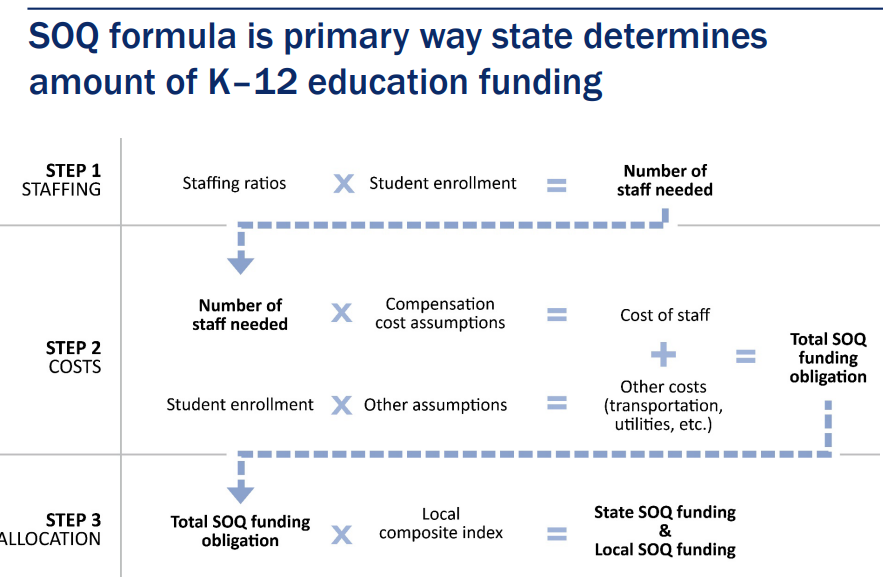
The challenge is that this approach to funding consistently underestimates the cost of educating children.
The Joint Legislative Audit and Review Commission in its 2023 report on education funding found that Virginia was sending 14 percent less money per student compared with the nation as a whole, 4 percent less than states in the South Atlantic region, and 25 percent less than West Virginia (which also uses a resource-based funding model), 18 percent less than Maryland (student based), and 5 percent less than Kentucky (student based).
In real dollars, the 2023 JLARC report found that the SOQ formula set school need at $10.7 billion, but divisions actually spent $17.3 billion.
A student-funded model bases funding on the number of students attending school, with weighting for students whose situation may require more support — English Language Learners, for example, or special education students.
Sometimes referred to as “weighted student funding,” (WSF) this “method represents a more local and decentralized approach to education spending compared with the traditional centralized staffing and funding models,” according to a recent report from the Center for American Progress, “which allocate money to LEAs and individual schools based on broader staffing, programming, and student population numbers.”
There is some evidence that weighted student funding not only flows more money where it is needed within the education system, but that it leads to better academic outcomes.
A 2020 study by the Edunomics Lab at Georgetown University looked at 19 large school districts that are funded through WSF and found that not only does more money flow to students with more needs, but student achievement overall is better.
“WSF implementation is related to positive test scores for the overall student population in those districts in both ELA and math compared to non-WSF districts in the same state,” according to the study, “even when controlling for student characteristics as well as anticipatory and phase-in effects.”
Because of how the money flows to needier students, WSF is recognized as a more equitable funding model. However, it doesn’t appear to have a significant impact on one of the more-troubling challenges in education – the achievement gap.
Per the Edunomics study: “we do not find evidence of improved achievement for Black or Hispanic students. As such, we find no narrowing of the Black/white or Hispanic/white achievement gaps that can be attributed to use of WSF.
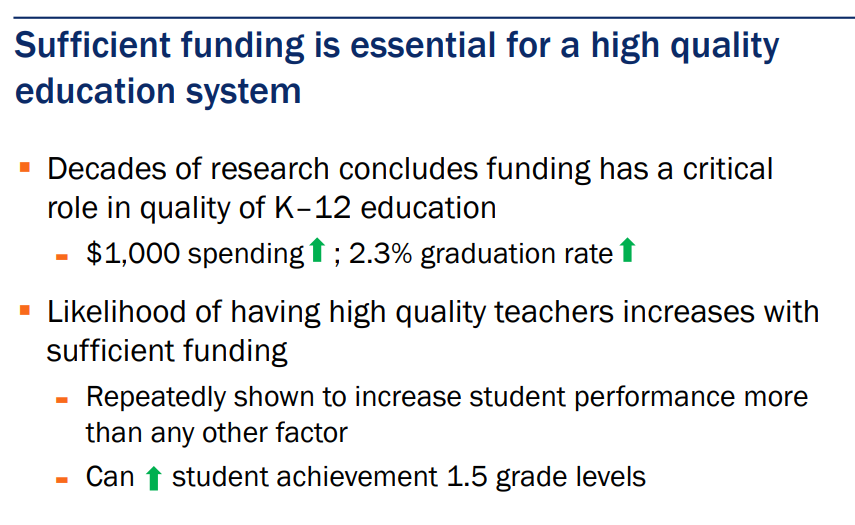
The 2023 JLARC study recognizes this when it found that sufficient funding is tied to better academic outcomes, better graduation rates, and better teacher retention. It also note, however, that money is not the sole challenge in improving education. Other factors within a school district’s control that are critical to improving outcomes are accountability for students and teachers, as well as instructional and support services.
Poverty and support at home are outside of school control, but are central to educational achievement, as well.
What Happens Next?
The Joint Subcommittee voted to approve the RFP, but expanded the potential timeframe that may be permitted to complete the work. The original draft called for the work to be completed in 6 months, but the decision was made to extend that timeframe up to 24 months to ensure that all stakeholders have an opportunity to be heard.
There are two advisory groups working alongside the Joint Subcommittee. The Technical Advisory Group is advising on what the new funding formula should achieve, recommending goals, guardrails, and value propositions. The stakeholders group will advise on the priorities and outcomes that matter most to students, families, educators, and local communities.
The Secretary of Education has already met with the two advisory groups. Coy reported that there was “clear consensus” around two principles: 1. ensuring the new formula provides consistent and sufficient funding to divisions and is responsive to student needs, and 2. the student weights and Local Composite Index were ranked as the most important policy issues in the discussion.