Whether students are succeeding or struggling is challenging if clear definitions of success have not been identified. According to the recent report “The State of the American Student 2026,” too few are engaged in establishing such a definition.
“Only 13 states,” the report that was compiled by the Center for Reinventing Public Education at Arizona State University concluded, “have a clear, specific, statewide goal for student learning that is strongly signaled in multiple sources.” Virginia has “No statewide learning goal.”
What we do have now, however, is a clear measure of how students are struggling.
The pandemic ushered in a recognized collapse in student achievement. Now, six years after the event, “Only 10.5% of students are in districts that have fully recovered to 2019 math and reading performance.”
The challenge, according to the report, is verified by performance on one national exam, NAEP (National Assessment of Educational Progress) and one international assessment, PISA (Programme for International Student Assessment).
On PISA, students scored at their lowest level in math and reading in the history of that assessment. And on NAEP, just 30 percent of fourth-graders scored Proficient or Advanced in reading, down from 32 percent in 2022. And among eighth-graders, 34 percent scored below Basic in reading — the largest percentage since NAEP began 32 years ago.
Recent news stories have highlighted that deep Red political states like Arkansas, Louisiana, and Mississippi have enjoyed substantial success in improving reading — a fact highlighted by CRPE in its report. But the problem is not one of Red states doing things right and Blue states doing things wrong. A list of the Top 10 and Bottom 10 performing states dispels that myth.
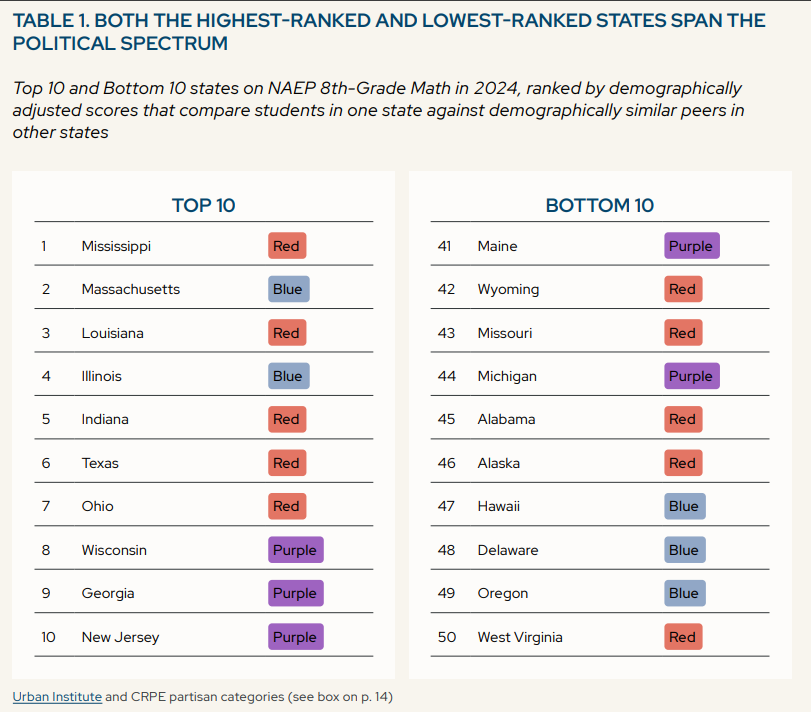
The report notes that while Red states have embraced aggressive instructional reform, they have also embraced “support for private school choice markets that face almost no public accountability?” Blue states, on the other hand, offer “ambitious rhetoric about academic improvement,” but consistently refuse to require “evidence-based instruction.”
Most important is that formulas are no guarantee of student success.
While Alabama, Louisiana, and Mississippi have won praise for growth in reading and moth, nearby Florida, which has adopted similar comprehensive instructional reforms, ranks last according to CRPE in reading recovery.
Massachusetts, on the other hand, is realizing a decline in NAEP scores, but is doing an excellent job “fostering child well-being overall—including educational outcomes,” according to CRPE.
The Story in Virginia
While CRPE finds that Virginia has no stated statewide learning goal, the state does excel in a number of areas related to education policy.
The commonwealth is recognized as having a strong teacher preparation policy rating for literacy, and a moderate rating for math. It is also recognized for being a leader in its policy guiding Artificial Intelligence deployment.
Virginia is also recognized for strong career-navigation policies.
The gold standard in career navigation according to CRPE are the 19 policies adopted by Jobs for the Future. Of these, Virginia has adopted 12, making it one of just six states that have adopted at least have of the policies. The others are Iowa, Maryland, Rhode Island, Tennessee, and Washington.
Virginia was among the first states to tackle the policy issues raised by AI when Virginia School Superintendents partnered with the Virginia Department of Education to begin training teachers in AI’s proper use.
A new state law then went into effect on July 1, 2026, that requires the Virginia Department of Education (VDOE) to create statewide guidance on using AI in K-12 settings. Further, school boards are required to adopt policies in line with that guidance.
Even with clear guidance, however, implementation across the commonwealth has been inconsistent, according to a recent report from Virginia Commonwealth University’s Metropolitan Educational Research Consortium (MERC).
“School systems are still trying to wrap their heads around” AI use, said David Naff, one of the report’s lead authors and an associate professor of research, assessment and evaluation in the School of Education, as well as the director of MERC. “There’s a lot of variability right now, and there could be some benefit from more consistent and central guidance.”
In short, while Virginia leads in some areas, there is “room for growth when it comes to establishing and implementing comprehensive policy.”
States Are More Responsible for Change
As students lag and confidence in public education lag, a fact highlighted by CRPE, a core source of support is pulling back. Under President Donald Trump, the U.S. Department of Education has pulled dollars and stopped enforcing policies aimed at improving academic achievement at the same time that it is also undercutting the tools states use to measure achievement — notably, the data required to be collected by the Center for Education Statistics.
This means that more of the burden for turning around students’ struggles is falling heavier on the states.
Virginia is in a somewhat better position than some nearby states. Under then-Gov. Glenn Youngkin, Virginia invested heavily in teacher salaries in an effort to keep teachers in-state.
Under Gov. Abigail Spanberger, the General Assembly is tackling a major overhaul of the way Virginia funds public education. Key to the change is moving Virginia from a funding formula based on staffing levels to one based on number of students. Last week the Joint Subcommittee to Study Elementary and Secondary Education funding took a step in that direction when it voted unanimously to approve a request for proposal that would hire a consultant to develop a new funding formula for public education.
The current formula has led to consistent underfunding of Virginia’s public schools. In real dollars, for example, the 2023 Joint Legislative Audit and Review Commission (JLARC) report found that the Standards of Quality formula used to tie staffing levels to funding set school need at $10.7 billion, but divisions actually spent $17.3 billion. By shifting to a student-based funding formula, the state looks to significantly narrow that gap.
Moving Forward
The CRPE study concludes with a number of suggestions for how states can move forward.
One stands out in the wake of Tuesday night’s election results. CRPE calls on state level political leaders to set aside partisanship and focus on what gets results in the classroom. “Education is increasingly partisan, and that makes improvement harder for everyone,” the report concludes.” To address this, it encourages education leaders to “align around two things: what families actually want for their students, and what the evidence says works. This means moving past ideological positions to ask hard questions about whether chosen strategies are delivering results—and being willing to abandon them if they’re not.”
The time to realize that may be now, if the Cook Political Report’s analysis of Tuesday night’s results is correct and “the partisan barrier was breached” when voters in “red, purple and blue states alike sent a clear message to Trump and the GOP-held Congress that they dislike the way they were governing the country and are willing to give Democrats the chance to steer things in a different direction.”
That direction, to have a chance to be successful, requires putting ideology aside and rigidly focusing on the data that makes clear the challenge before schools.