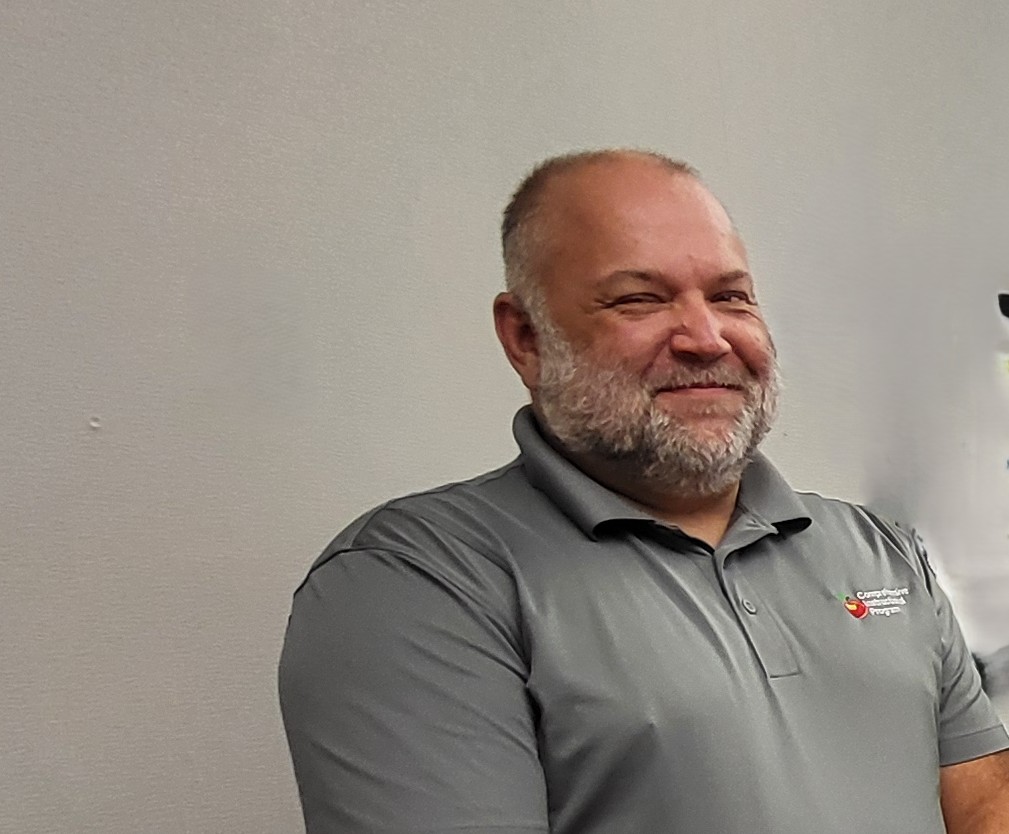
Born in Pound, Virginia, near the Kentucky border, Matt Hurt was the son of an assistant principal and later principal. His life took a similar trajectory. After studying history, he became a special education teacher working at the middle and high school levels in Wise, Virginia, before going to Roanoke City schools. In 2014, Hurt returned to Wise to lead the new Comprehensive Instructional Program (CIP). Today, CIP is in 83 school districts across Virginia. Focused exclusively on student outcomes, CIP has emerged as a powerful model for doing public education. On Thursday, Hurt sat down with the Virginia Free Press to discuss CIP, the release on Wednesday of the latest School Performance and Support Framework (SPSF) results, and why “scaling down” is a powerful tool for improving academic achievement.
Virginia Free Press: The Comprehensive Instructional Program is more than a decade old and has grown to include more than half the districts in Virginia. Can you tell us at a basic level what CIP is?
Hurt: At its most basic, CIP is a consortium of public school divisions that work together to leverage the talents and abilities and resources each district has to improve student outcomes across the consortium.
We began in Wise, Virginia, and until about five years ago were working with smaller school districts that traditionally don’t have the staff resources of larger districts. By working collaboratively we could tackle big problems by sharing expertise and resources among one another.
About five years ago, we added our first district with more than 7,000 students.
VFP: It would seem that a larger district would represent a shift in mission for CIP. How has working with larger districts affected your approach to working with public school districts?
Hurt: The larger districts have not changed our focus – we are still focused laser-like on raising academic achievement. However, bringing in larger districts has given us more perspective.
To understand how, it helps to first understand the nature of how people interact with educational organizations like ours.
In any educational organization that has made the transition from start-up to mature operation, like CIP, you find that there are folks who join and, for lack of a better term, “tag-along.” They take advantage of the offerings and learnings we bring, but they don’t engage fully with the operation. Then there are those who are fully engaged. When we hold meetings, there are people who are always there, participating fully and actively working with others in the group to come up with solutions.
It’s like a Venn diagram. The CIP has lots of circles (districts) involved, but the overlap of people who actively engage directly with CIP is smaller than the total.
By bringing in larger districts, we’ve grown the number of people who are highly engaged, thereby expanding our perspective on what does and doesn’t work.
VFP: What would you say has been CIP’s biggest success to date?
Hurt: The biggest success has been curating a very dedicated group of educators, ranging from superintendents to teachers, who are willing and able to work together to improve outcomes for students.
VFP: That sounds great. But there are a number of educational organizations that will tell you the exact same thing. What separates CIP from, say, the Virginia Education Association?
Hurt: We have one objective – improve outcomes for kids. We have to pay attention to different things that are prerequisites to making this happen, like dealing with issues related to hunger, housing, the challenges that every district faces. Groups like the VEA are advocates for those issues outside of the school building, which is a good thing. We need groups working on those issues.
Our focus isn’t tackling problems outside the school building, however. We deal with these problems inside the building.
An example would be the school climate. We know that schools that have healthier climates tend to get better student outcomes. That’s because teachers want to be there. And they are there because the leaders take care of them and build capacity for teachers to be successful.
There are outside issues that affect this, to be sure, like teacher pay. We at CIP can’t affect that debate in board of supervisors meetings, the General Assembly in Richmond, the halls of the U.S. Capitol. But we can help schools understand the problems that are impeding their developing a healthy climate and help them adjust.
The challenge here is that we don’t have great school climate data. There is the school climate survey, but it’s not particularly helpful in understanding what makes one school healthy and another school less healthy.
VFP: Let’s shift gears and talk about Wednesday’s release of the School Performance and Support Framework (SPSF) results. This is the second year for this particular framework. What are your take-aways from the findings?
Hurt: I’m still going through all the data, so I want to withhold comment on those specific results for a moment. However, I do have some thoughts on the SPSF itself.
VFP: OK, let’s talk about that, starting with the good. This framework is a major shift in how schools are rated (For more on the SPSF rating scale, read on report on Wednesday’s ratings release). What’s good about the new system?
Hurt: I appreciate how the new SPSF system is adding weight to evaluating high schools based on how well they’re doing preparing kids for future success, particularly through the Three Es measure – Enrollment, Employment, or Enlistment.
VFP: And what is less attractive about this SPSF?
Hurt: The way the system is set up is still overly complex.
The thought behind SPSF was to bring clarity to how schools are performing, and in that the new system provides interested parties with a number and a rating, they’ve succeeded.
The problem is that I’m not convinced that number or rating accurately measures what the state desires. And that’s because we have never reached consensus in the state about what we value in K-12 education.
The previous administration went through a process when designing the SPSF, but it’s not clear that that process was a-political. In other words, it reflects the political values of the administration that set it up.
Would the values be different under the current administration? I suspect they would, and we may see that as the Board of Education opens up the SPSF for evaluation and changes are introduced.
Because values change with administrations, we get wild swings in evaluations of how education is assessed.
We need to reach a set of share values about K-12 education that is arrived at in as an a-political approach as possible.
If we can do that, we will begin realizing results that can be trusted across years, regardless of the political party that is in charge in Richmond.
VFP: Can you give us an example of how politics have shaped the way Virginia assesses and evaluates K-12 education?
Hurt: I can give you several.
In 2019 and 2021, we saw decreases in SOL cut scores for math and reading respectively. Last year those scores were raised. This reflects the administrations’ different philosophies. The problem is that changing cut scores merely moved the goal posts, making it more difficult to determine if actual progress is being made.
The same thing can be said of this accountability system. The SPSF is based upon index, upon index, upon index. We are trying to use a complex calculus to measure success, and the benchmarks we choose have an air of randomness. What is the percentage we use for deciding mastery of a subject? Or for evaluating growth? Or readiness?
Consider the SPSF embracing the 3Es, which I greatly value. The problem is that how well a school is rated for delivering the 3Es is determined in the guidance office. If you set up your schedule in the right way and funnel more kids into those classes and programs, schools get points for that. So how much of the success is due to scheduling, and how much due to student achievement?
Finally, this system is set up so that high schools have a much better chance out the gate of score well than do elementary and middle schools. This is a problem that was identified in the JLARC report.
All this variability leads to situations where schools have exactly the same framework rating and wildly different outcomes, and that doesn’t sit well with me.
VFP: Do you see the situation getting any better?
Hurt: Based on the past few Board of Education meetings, it sounds like there is going to be a lot of tweaking of this system to try and level things out. While that makes sense of one level, systems should always be reviewed and strengthened, I’m skeptical this is what will happen.
The changes will be based not on agreed-upon shared values, but rather the values of the people currently in charge.
It’s in situations such as this that we see the butterfly effect, whereby little changes here lead to massive disruptions downstream. I am afraid that this is what is going to happen with this system.
At bottom, the problem is the complexity of the system that has been designed. The more complex the system, the more likely it is to fail.
If we could simplify SPFS and base it on a consensus of what Virginians value and how we measure that, we will be on a path to success.
VFP: We certainly appreciate what you are saying. However, the CIP’s success is based on its use of SOL data to identify impediments to student achievement and addressing those in the school building. How can a system that isn’t working well be the basis of CIP?
Hurt: Every successful organization uses data to a substantial degree. You have to have objectives that you are striving toward, and you have to have measures to see if you’re getting there, and you have to have adjustments for the future.
There are some measure that most people agree on, and we have measures that work. I think it is important that kids learn reading and math. Are our assessments of how well they’re doing this the best? Probably not. Are they sufficient, yes.
We don’t let the perfect be the enemy of the good. We do have data that can drive our work.
I know that you are a big football fan. Well, there’s a quote from the late Green Bay Packers coach Vince Lombardi that I keep on my desk and gets at the point we were just discussing. “Perfection is not obtainable, but if we chase perfection we can obtain excellence.”
We are chasing perfection. We won’t get there. But in pushing, we can make ourselves better.
VFP: One thing that we highlighted in our report about Wednesday’s release was the small number of districts in which every school earned the “Distinguished” designation, and that most of those were districts in the CIP. One trait all these districts share is that they are relatively small. The largest was Wise County, with 11 schools. Is it fair to say that these districts are unfairly recognized because they’re smaller and therefore less likely to have problems like those encountered in Fairfax or Arlington or Stafford or Richmond?
Hurt: You can make the argument that divisions in affluent areas have an advantage over less affluent divisions. What’s so interesting to me in the list of districts where all schools are identified as “Distinguished” is that some are in affluent communities, but many others are not.
VFP: But they are all relatively small. Is that something that we can learn from?
Hurt: Public education is a human endeavor, and it’s difficult to scale relationships. In small districts where the superintendent knows the principals, their spouses and children, and the families of students, it’s easier to develop stronger relationships, which makes everyone more accountable to one another as human beings.
So yes, scale is a problem. But rather than scaling up, the solution might be to look at scaling down.
Karin Chenoweth touches on this in her book Schools that Succeed, where success came in scaling down the administration. One example she pointed to was the Chicago Public Schools, which have significantly increased their graduation rates by taking a huge bureaucracy and decentralizing the leadership of the division.
Each school was set up with its own equivalent of a school board, which means leaders were in place to understand the problem on the ground. One can’t expect the superintendent of Chicago Public Schools to know in detail what is happening in every school in Jackson Park or south of 79th Street.
When you leave the challenge of addressing problems to the schools themselves, there is a chance for improvement.
If the big thing’s not working, why not go little?
VFP: Let’s turn back to building consensus around what we value in K-12 education. How does one do that in a state with more than 8 million people?
Hurt: We could start with gathering data from the listening sessions that the current governor embarked on shortly after taking office.
VFP: Even with that, is it realistic to believe we can reach consensus? Aren’t communities across Virginia too different from one another to reasonably be able to achieve that goal? If going small is the answer, shouldn’t we just decentralize state education and leave it to individual districts?
Hurt: I do believe consensus is possible. We just need to collect enough good information and data to realize it.
There’s another reason that we need consensus and not devolve education to individual districts.
All of these public schools are part of the Virginia education system, and they are all state funded.
Should we say it is ok for this kid in Falls Church to have a better education than that kid in Buchanan County? That’s why I don’t support differentiated expectations.