
Election Day is three weeks away, and there’s a clear shift happening in projections. Prognosticators are seeing a swelling blue tide. Turnout suggests that Democrats are highly energized. And the national picture could hardly be worse for Republicans.
But unlike recent midterms, which were — as they often are — mostly referendums on the presidential administration in office, there are challenging rip-tides at play in Virginia’s congressional races. Data centers, the war in Iran, realigning coalitions, and general voter dissatisfaction with the two-party system writ large complicate predictions.
These cross-currents, as treacherous to political prognosticators as shoals are to sailors, are interesting for more than how they will affect the coming election. They also say a great deal about where Virginians as a people are moving.
Working from the national level, to the state and congressional level, VFP explores the factors affecting Virginia’s congressional elections and what they tell us about the state of Virginia’s near-future.
The National Trends
Historically, midterms are a referendum on the sitting presidential administration. That’s bad news for Republicans everywhere.
Both the first and the second Trump administrations have been consistently unpopular in a way only one other administration has been since Gallup began polling in the Harry S Truman administration.
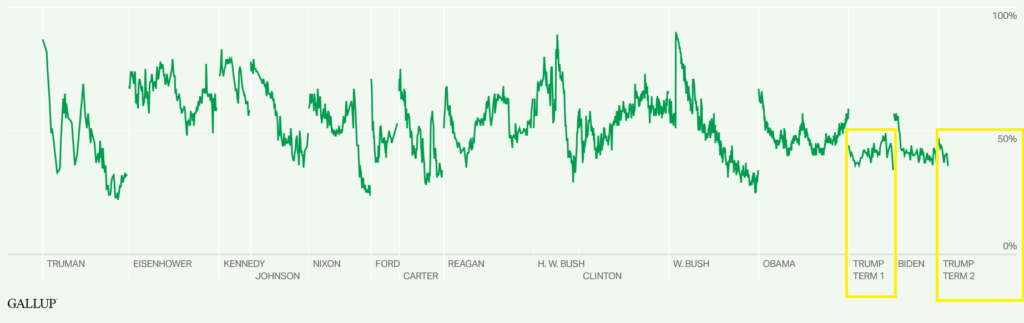
That other presidency is Democrat Joe Biden’s, who enjoyed a very brief period where slightly more than half the population supported him before his numbers went underwater and never came above.
This 10-year run from 2016 to 2026, in which the sitting president has been below 50 percent approval for the vast majority of their administrations, has no parallel in post-World War II American presidential history.
The trend has not been lost of Stephen Farnsworth, professor emeritus of political science at the University of Mary Washington.
He told the Virginia Free Press in a phone interview that what we are witnessing is “the real growth of negative partisanship. People feel much more negatively about the other party” then they feel positively about their own.
This is a break from the recent past. Farnsworth noted that during the presidency of Democrat Jimmy Carter, 30 percent of Republicans supported him when using Gallup numbers averaged over the period of his term. Republican Ronald Reagan had the support of 31 percent of Democrats. During the George W. Bush presidency, 23 percent of Democrats supported the Republican sitting behind the Resolute Desk. Even Bill Clinton enjoyed the support of 27 percent of Republicans.
That changed in 2016, when just 7 percent of Democrats supported Trump during his first term, and 3 percent of Republicans supported Democratic president Joe Biden.
This trend reflects a broader erosion of support in the presidency, and the party in power for a decade isn’t enjoying support from those in the opposing party or independents.
While much has been made of independent voters pushing Trump across the finish line in 2024, that support has all but evaporated as Hispanic voters have turned against him over immigration policies, and independents across the board are turning on him for not living up to his campaign promises to keep the U.S. out of foreign wars and to bring prices down.
What we’re seeing in this election, said Farnsworth, is “the mirror image of the Biden years, where people expected more from Democrats then they got. In 2026 the shoe is on the other foot.”
This rejection of Trump is bolstering and energizing Democrats heading into Election Day.
That alone, however, isn’t going to decide the Virginia congressional races.
The State Trends
The key to any election is turnout, and for Democrats to take full advantage of flagging national support for the president it will need to replicate the energy that brought Democrat Abigail Spanberger to the governor’s mansion in 2025.
Earlier this month Cardinal News’ Dwayne Yancey wrote about how Democrats are benefitting from early enthusiasm. While overall turnout was down slightly from 2025 when Yancey wrote the column, he noted that in Democratic localities turnout was up, and in Republican localities it was trending down.
Since then, the shift appears to be accelerating.
In early October, total early voting was down 3.7 percent, or just over 9,000 votes, compared with 2025 according to Yancey.
Since that article, the tide has shifted. As of Monday, early voting statewide is up 1,950 votes over 2025. And again, it appears to continue a strong showing in Democratic leaning communities like Fairfax County (up 3,935 votes over 2024) and Loudoun County (up 1,693 votes over 2024). Meanwhile, in purple Virginia Beach, turnout is up 3,304 votes over 2025.
And in Republican districts, turnout is trending down. Chesterfield is down 1,971 votes from 2025, and Spotsylvania County is down 1,675 votes from 2025.
Adding to the evidence that early voting is trending Democrats’ way is State Navigate’s analysis. The left-leaning pollster reports a statewide shift vs. 2025 early voting that favors the Democrats by 3.2 percent.
“Turnout is one of the big problems Republicans are facing right now,” according to Farnsworth. “If Republicans stay home out of frustration with Trump, that’s bad news for Republicans up and down the ballot.”
Compounding the problem for Republicans is that a competitive Senate race would give the GOP a reason to turn out. However, Mark Warner looks solidly in control of his race against retired Army Major General Bert Mizusawa.
The Congressional District Trends
While national and state trends certainly play into district voting, each congressional district is where the proverbial rubber meets the road. And in these districts, subtler underlying trends can make the difference.
Congressional District 1
This race between Republican incumbent Rob Wittman and Democratic challenger Shannon Taylor is rated one of the most closely contested races in Virginia this year.
Last week the Cook Political Report shifted this race from “Leans Republican” to “Toss-up.” It was one of 18 House races CPR moved in Democrats’ favor across the nation.
Among the reasons was a poll released October 1 by the Washington Post and the Schar School of Policy and Management at George Mason University showing Taylor leading Wittman by 4 percentage points. While CPR noted this was “rosier” than internal polling showed, it nonetheless it is “clear that Wittman no longer is the favorite.” Among the reasons is the spending advantage that Taylor holds over Wittman.
To be one of the most-contested races, it is notable that it is one of the few with lower early voting turnout in 2026 than in 2025. State Navigate has early voting turnout down 7.1 percent from 2025 in District 1, but projects that Democrats still hold a sizeable advantage in the partisan turnout.
It is difficult to read too much into this. It could simply be that District 1 voters who are Republican will turnout in force on Election Day. Or, it could be a reflection of sagging Republican interest in a year when then have not been going their way.
Congressional District 2
The other closely watched race in Virginia is between Republican incumbent Jen Kiggans and Democratic challenger Elaine Luria.
At the moment, this one looks to be trending in Democrats’ favor. While the Cook Political Report has this race as a Toss-up, Larry Sabato and the people at Crystal Ball shifted this race from Toss-up to Leans Democratic on September 29. Per the Crystal Ball: “Since the 2008 elections, VA-2 has also reliably sent a member of the majority party to the House. With that in mind, we are moving VA-2 from Toss-up to Leans Democratic, as we ultimately think Kiggans will have a hard time fighting against the wave against former Rep. Elaine Luria (D), who Kiggans unseated in 2022.”
There is just one poll for this race, but it was from July and had the contest a dead heat.
More telling than the polling and prognostications, however, are the veterans. Virginia District 2 has the highest military concentration in the state. Both Kiggans and Luria are veterans. Typically that would favor Kiggans, as veterans on average poll between +15 and +20 percent for Republicans.
This election, however, that vote may well be be more-evenly split.
USPollingData.com reported in March that between DOGE cuts and issues with the Veterans Administration, “Trump’s approval among veterans on military and veterans affairs specifically has declined from 58% at his second-term inauguration to approximately 44% by March 2026, according to Morning Consult tracking.”
Complicating the issue is the Iran war, which is broadly unpopular in the United States. While VFP is unaware of direct polling of veterans about the Iran war, anecdotally there is reason to suspect that military families are more divided.
This race looks to be getting away from Kiggans.
Congressional District 5
This race, pitting Republican incumbent John McGuire against Democratic challenger Tom Perriello, may well prove to be the bellwether contest not only in Virginia, but the nation as well.
Watchers say that this race — unlike that in Districts 1 and 2 — is clearly a referendum on Trump. And that strongly favors Perriello. Still, this is a very red district. Trump carried it by 12 percentage points in 2024.
But the polls show a much closer race.
The Cook Political Report still has this race rated as “Likely Republican,” while the Crystal Ball has this race “Leans Republican.”
State Navigate shows early voting up 4.8 percent over 2025, and it estimates that early voting will favor Dems by 9.8 points. That’s enough to pull Perriello without distance of McGuire.
The recent Washington Post – Schar poll has McGuire with a 6-point lead (51 to 45). However, the poll has some irregularities. According to a piece by Rich Tucker, “The Washington Post polling didn’t include the independent candidate [in its survey],” Perriello campaign manager Lily Franklin told the Daily Signal. “Tom is within one point in our internal polling, which includes the independent.”
This one could well be game-on coming down the homestretch.