

Gov. Abigail Spanberger announced that she would not be completing the final stage of the application process that would allow Virginia to take part in the Federal Scholarship Tax Credit (FSTC) that previous Gov. Glenn Youngkin had wanted to see made available to Virginia families.
The decision has drawn strong reactions. Former Lt. Gov. Bill Bolling criticized Spanberger for her decision in the pages of the Virginia Free Press. In October, the Virginia Education Association had strongly recommended that Spanberger abandon the FSTC.
What makes this decision interesting is that FSTC doesn’t fall neatly in either the pro-public-school or anti-public-school camp. It’s a hybrid policy that has enjoyed support of both conservative school choice advocates and progressive pro-public-school reformers.
To better understand the debate, our inaugural This Week in Education series answers questions about the politics, policies, and possible permutations of the FSTC.
Where Did the FSTC Come From?
The FSTC was passed as a part of the One Big Beautiful Bill in 2025.
How Does It Work?
The bill supports scholarship granting organizations (SGOs) by allowing people to write-off contributions of up to $1,700 per year for an individual or $3,400 per year for a married couple.
It’s an incentive for parents to support organizations that distribute scholarships to families. The funds can support tuition, tutoring, fees, and related education expenses. Donors are rewarded with a 100 percent dollar-for-dollar tax credit when filing annual taxes with the IRS.
SGOs can only receive funds if they meet certain IRS requirements. They must be:
- Recognized as a tax-exempt public charity under IRC Section 501(c)(3), private foundations are not eligible,
- Meet specific requirements for awarding scholarships, managing contributions, and verifying student eligibility,
- Ask to be included on a participating state’s SGO list and
- Provide information to the state needed to establish their eligibility.
Once qualified, SGOs must meet ongoing financial, recordkeeping, donor acknowledgment, and IRS reporting requirements, including registering and reporting through the FSTC SGO Portal, per the IRS website.
Is It a Voucher Program?
Sort of, but not really.
In true voucher programs, the federal or state government takes tax dollars and directs payment to a school for tuition and related expenses. Voucher programs traditionally have been created to give students who wish to leave public schools for private schools that option.
The FSTC program is funded by individual donors contributing to approved SGOs (See “How Does It Work?, above). The SGOs then distribute the funds, which can support a range of educational costs.
Donors do, however, receive a dollar-for-dollar tax credit for their gift to SGOs. In this way the federal government is incentivizing the donations. Much as it incentivizes home ownership by allowing home buyers to write off monthly mortgage costs.
Do Only Private Schools Benefit?
No. In fact, many public schools stand to benefit significantly.
Chad Aldeman in his Substack explained that the program can benefit any student.
[T]here are a growing number of initiatives that are attempting to use this opportunity to create public-focused Scholarship Granting Organizations (SGOs). Former Rhode Island state education chief and Tulsa superintendent Deb Gist is partnering with school districts and hopes to raise $100 million over the next few years.
Here in Virginia, I had been working in my spare time to help set up the Virginia Tutoring Fund. We were planning to partner with high-quality, local tutoring programs and focus on serving students in high-poverty public schools.
Does FSTC Pull Money from Public Schools?
No, mostly. But possibly in some ways.
The money for FSTC comes from individuals and businesses. It does not come out of federal coffers that would be otherwise directed for public education. (It is worth noting that federal funding of education is relatively small. Most public school funding comes from states and localities.)
However, FSTC could potentially lead to lost funds if students receive scholarships and transfer to private schools. In its position statement to the governor, the Virginia Education Association’s concerns centered around that possibility, estimating the potential for a 4 percent drop in funding for public education.
That concern comes at a time when public schools are beginning to realize a decline in public school student enrollees. The decline is driven by falling birth rates, which began in 2008 and first showed up in declined enrollments in 2014, according to the Weldon Cooper Center.
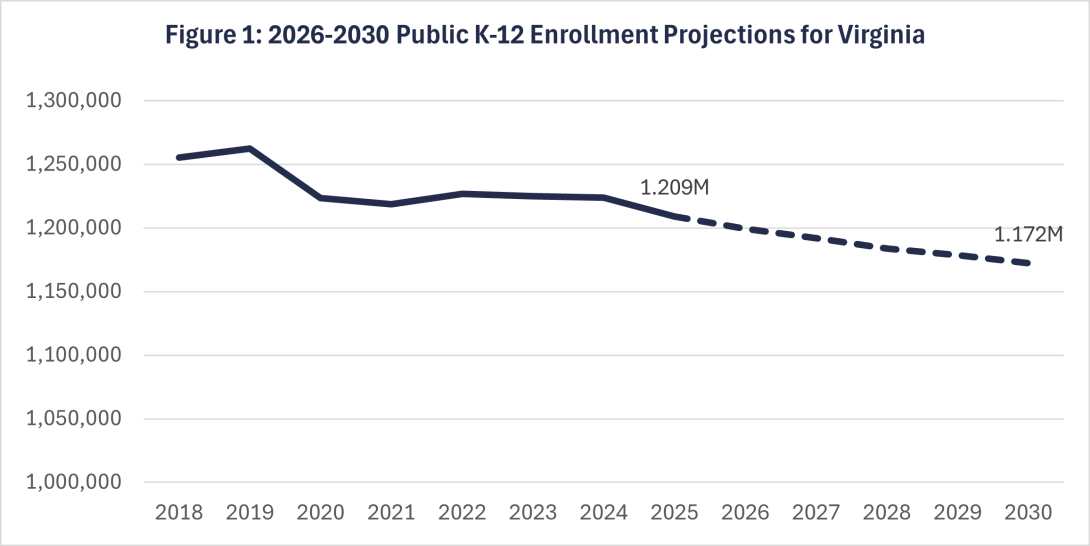
In addition to declining birth rates, more families are opting for homeschooling. Per an October 2025 story by Capital News Service, “The number of students receiving an education at home increased last school year by 4.3%, according to the Virginia Department of Education. The year before saw an almost 6% increase.”
How Many Other States Are Taking Part?
As of writing, 31 states have signed on to the FSTC.
Democrats for Education Reform maintains a tracker of states that are signing on to the FSTC. States signing on span the political spectrum, from California on the progressive end of the scale to Alabama on the conservative end.
How Much Does Virginia Stand to Lose?
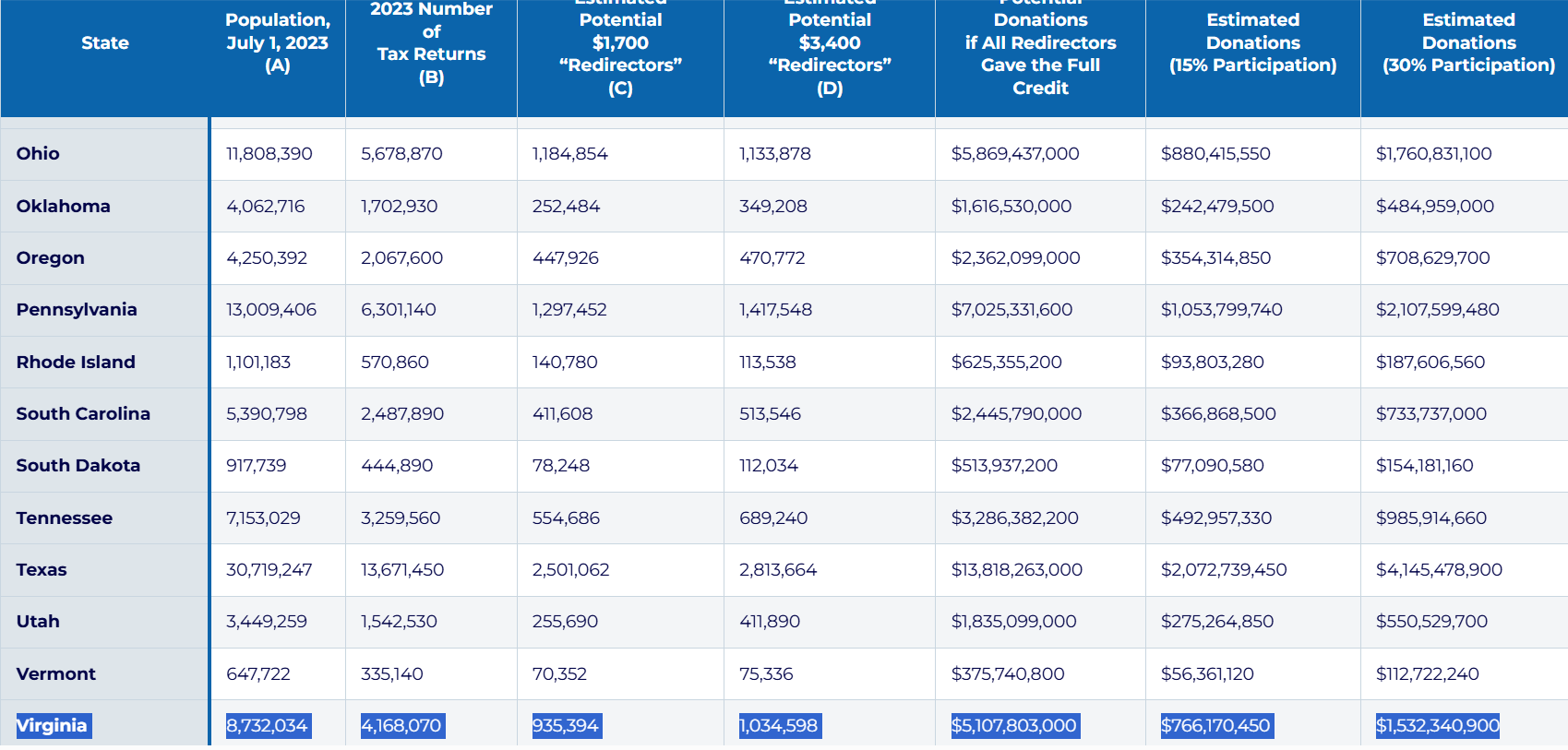
Because the amount of scholarships distributed depends upon the amount of money contributed, there is no one number to point to. However, the organization Ed Reform Now estimates that Virginia stood to realize a minimum of $766 million and a possible upper range of $1.5 billion.
Is Virginia Permanently Out of the FSTC?
No.
Gov. Spanberger has said that she will evaluate how the program plays out in other states. Enrollment occurs annually, so Virginia could choose to join next year.