
The second year under Virginia’s new School Performance and Support Framework (SPSF) brought some encouraging news. Most notably, half of schools improved their overall performance category rating over last year. Fully 99 percent of Virginia schools are now accredited, and 75 percent of schools saw a drop in chronic absenteeism.
The state also saw 16 of 49 federally identified schools removed from Comprehensive Support and Improvement (CSI) status. Schools are identified as CSI if they are among the lowest 5 percent of Title I schools in the state for academic achievement, or are a high school with a low graduation rate.
To fully appreciate the improvements, it’s important to understand what SPSF is and is not.
Understanding SPSF
Unlike previous accreditation reports prior to the 2024-2025 school year, the SPSF that was instituted during Gov. Glenn Youngkin’s tenure separates accreditation status from performance status.
Accreditation is awarded based on whether schools and districts submit and have approved all the evidence to demonstrate compliance with the state’s Standards of Accreditation, which are focused on health, safety, staffing, compliance, and planning requirements. The checklist includes items such as promotion and retention policies, graduation requirements, and leadership and staffing requirements.
To be accredited, schools must meet all the specified requirements. Again, these are unrelated to how students actually perform in the classroom.
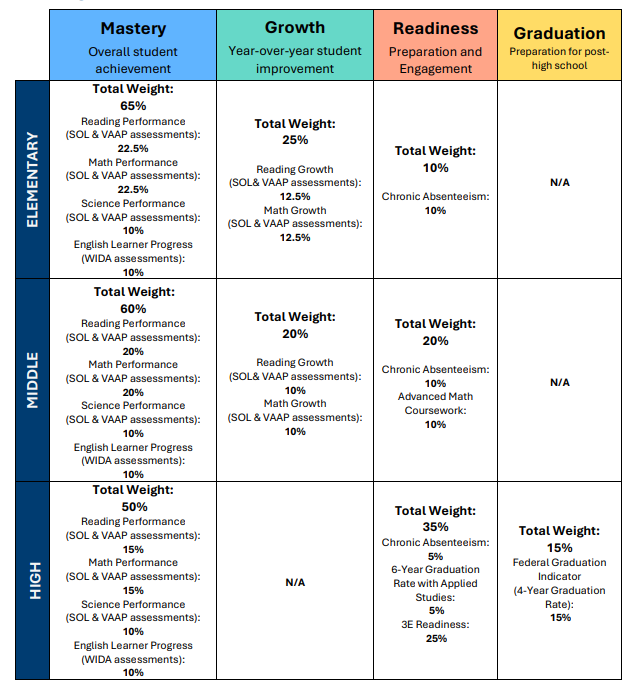
Performance status is based on measuring how schools are performing in four areas: Mastery of core subjects, Growth in core subjects, Readiness, and Graduation.
These four areas are weighted differently, or not at all, at the elementary, middle, and high school levels.
At the elementary level, the emphasis is on mastering reading, math, and science, as well we ensuring English Language Learners are making adequate progress. Also considered are growth in reading and math, and chronic absenteeism.
Middle school also emphasizes core subject mastery and absenteeism, but also rewards schools that foster students taking advanced math courses.
High school emphasizes mastery, but also graduation rate, chronic absenteeism, and 3E readiness – are students prepared to enroll in higher education, be gainfully employed, or enlist in the military.
Based on how schools rate in Mastery, Growth, Readiness, and Graduation, a performance score and category are assigned.
- Distinguished – 90+ points
- Meets Expectations – 80 – 89 points
- Approaching Expectations – 65 – 79 points
- Needs Intensive Support – Less than 65 points
Schools may earn overall scores that place them in the top three categories, but if a subgroup such as special education or minority population perform poorly, the category will drop one level.
Breaking It Down
Virginia’s shool districts are broken into eight districts. The Virginia Department of Education produced overview sheets for each district shining a light on who is doing well and who is struggling.
Region 1
Extending south and east from Hanover County, Region 1 includes Richmond City, as well as Henrico and Chesterfield counties.
Just over 61 percent of schools were designated “Distinguished” or “Meets Expectations.” Nearly 38 percent of schools earned the “Distinguished” designation.
View the full Region 1 report.
Region 2
Centered around Norfolk and running up the Eastern Shore, Region 2 includes Chesapeake and Hampton cities, Virginia Beach city, and York County.
Nearly 69 percent of schools were designated “Distinguished” or “Meets Expectations.” Fully 39 percent earned the “Distinguished” designation.
View the full Region 2 report.
Region 3
Running along Virginia’s Northern Neck, Region 3 includes two of the states 20-most-populous school districts, Spotsylvania and Stafford counties.
Nearly 60 percent of the schools in this region were designated as “Distinguished” or “Meets Expectations.” Nearly 29 percent earned the “Distinguished” designation.
View the full Region 3 report.
Region 4
Region 4 includes parts of Northern Virginia and extends as far south as Orange County.
Nearly 72 percent of the schools in this region were designated as “Distinguished” or “Meets Expectations.” Almost half (49 percent) earned the “Distinguished” designation.
Of Fairfax County’s 193 schools, 110 were recognized as “Distinguished.”
Read the full Region 4 report.
Region 5
Region 5 includes the western central part of Virginia, and extends from Rockingham County in the north to Bedford County in the south.
Nearly 67 percent of the schools in the region were designated as “Distinguished” or “Meets Expectations.” Nearly 37 percent were designated “Distinguished.”
Read the full Region 5 report.
Region 6
Stretching from Alleghany Highlands to the north to the North Carolina border, the region includes Roanoke County and Roanoke city, as well as Pittsylvania and Botetourt.
Just over 77 percent of the schools in the region were designated as “Distinguished” or “Meets Expectations.” Just over 49 percent were designated “Distinguished.”
Read the full Region 6 report.
Region 7
Nestled in the far western corner of Virginia, Region 7 is one of the smallest in the commonwealth with just 148 schools.
Nearly 87 percent of the schools in the region were designated as “Distinguished” or “Meets Expectations,” that’s the highest percentage of any region in Virginia. More than 60 percent were designated “Distinguished,” also the highest of any region in the state.
Read the full Region 7 report.
Region 8
Located in south central Virginia, Region 8 is the smallest in the commonwealth with just 51 schools.
Fully 66 percent of the schools in the region were designated as “Distinguished” or “Meets Expectations.” More than 43 percent were designated “Distinguished.”
Read the full Region 8 report.
The Standouts
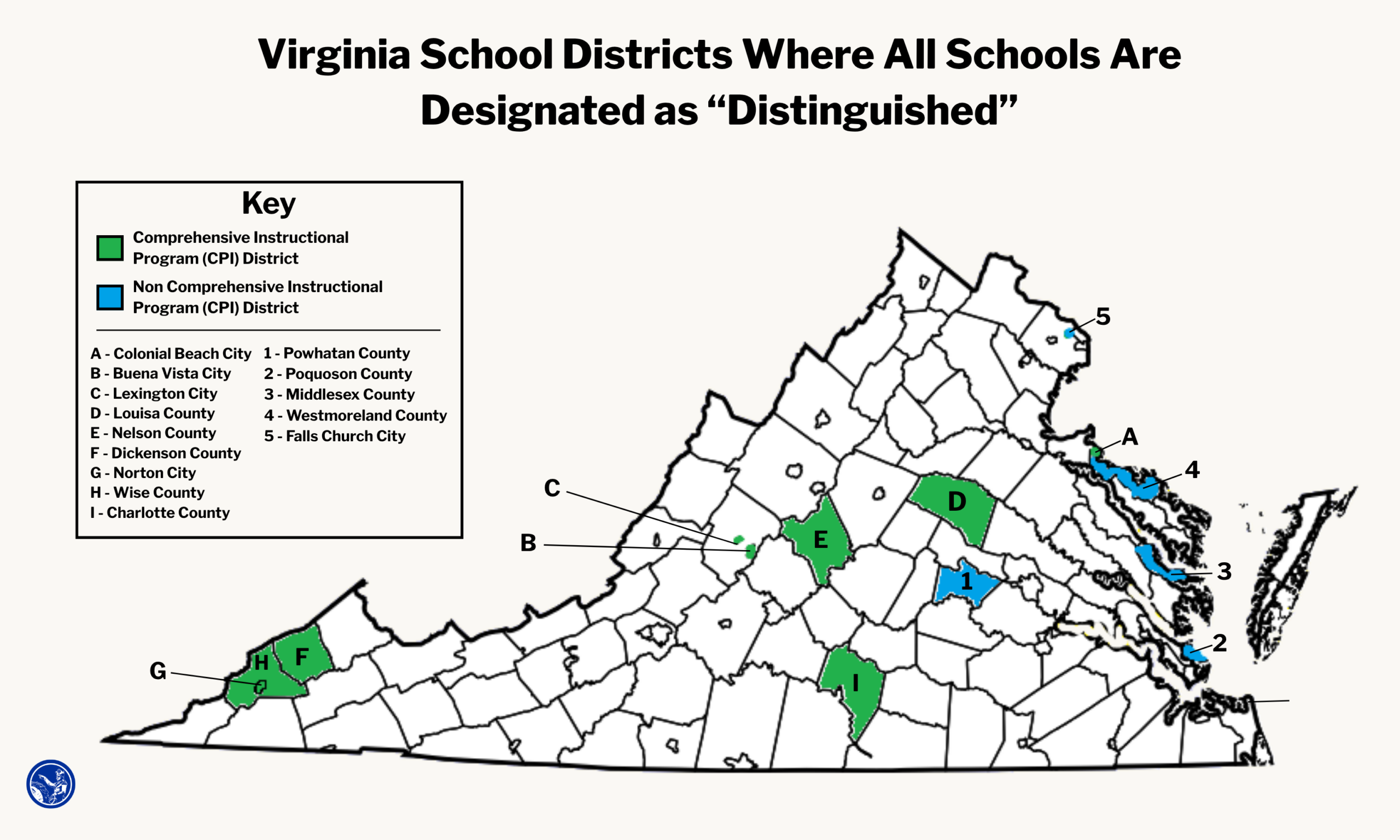
Fourteen school districts in Virginia had the distinction of every school in the district earning a “Distinguished” rating.
These districts tended to be small – Wise County with 11 schools was the largest – and clustered in the southern half of the commonwealth. The outlier is Falls Church, which has consistently earned the top SOL scores in Virginia in recent years.
Most of the districts share another trait in common – nine are members of the Comprehensive Instructional Program, or CIP.
Started in Wise, Virginia, the CIP is defined not, as the name suggests, by a set curriculum, but rather by a culture that emphasizes every student can succeed, and school leadership – from the superintendent to the classroom teacher – is focused on leveraging test information to help students achieve. The program is also marked by a commitment from the administration to supporting classroom teachers.
The CIP districts that excelled in this year’s framework have, says CIP Director Matt Hurt, “done a good job of having set their people up for success.”
How they do this varies. Colonial Beach, he said, has their chief academic officer working with teachers on a regular basis on their planning and finding ways to support them in the classroom.
In Charlotte County, Hurt says the district is led by people who “are not going to sleep until a kid gets to where they need to be.” Make sure teachers have what they need. Leadership also focuses on supporting principles as well as teachers.
(For an in-depth look at CIP and Wise County, where the program began, read the author’s piece “Wise County Outperforms Most Schools in Virginia … CIP Gets the Credit. The Reality Is Far More Complex.”)