This story was updated on November 2 at 8:39.
Polling, prognostications, and, increasingly, prediction markets play a significant role in the American election process.
However, each of these three is facing a more-challenging landscape. Polls still face skepticism owing to misses in 2016 and 2020. Prognosticators depend heavily on polling for their projections. And prediction markets are facing calls for regulation.
In advance of Election Day, the Virginia Free Press talks with leading political experts about the role prognosticators, pollsters, and prediction markets play in elections, the impacts they have on voters, and then takes a look at what three of the more-respected prognosticators, and one prediction market, believe will happen on Tuesday in Virginia and nationally.
Polling, Prognostications, and Prediction Markets
The Virginia Free Press spoke with three leading Virginia political experts concerning how voters feel about and may be influenced by polling, prognostications, and predictions markets. The three, who were interviewed separately, are:
- Stephen Farnsworth, professor emeritus of political science at the University of Mary Washington
- Richard Meagher, professor of political science and hair of the department of political science and global affairs at Randolph-Macon College
- Cayce Myers, professor of public relations and director of graduate studies at the school of communication at Virginia Tech
Can polls be trusted?
“Pollsters have a credibility problem,” Cayce Myer told VFP, adding that there are “real criticisms of polls about their accuracies and legitimacies.” The issues, however, are “not with legitimate pollsters.”
There are a number of reasons for people’s mistrust. Part of the problem rests with everyday voters. “People want to believe polling is more scientific and reliable than it is,” Stephen Farnsworth told VFP. “At best it’s an approximation of where people are at a given point in time.”
Those approximations are becoming more difficult to discern. “We know less about how reliable polls are right now than we have at any point in the past 20 years,” Farnsworth said. Noting that two decades ago phone calls were answered, improving pollsters’ chances of getting people to respond, Farnsworth said “Now things are different.”
That large numbers of people refuse to engage with polls creates distortions. For example, Farnsworth said, “we know that Republicans are less willing to talk than Democrats are, and we try to correct for that. The mechanism for fixing it involves some sort of guess work.”
Still, for all their flaws, “There’s nothing particularly better than polling for predictions,” Farnsworth said. “It’s just not as reliable as it was.”
Does polling affect voters?
Polling is important to candidates because it can provide a window into how messages should be shaped and where resources should be deployed. It is also important for fundraising — without sound polling numbers, dollars to drive campaigns can dry up.
But to what extent does polling affect voters behaviors?
Richard Meagher told VFP that he was “not aware of any strong data any one way or the other” that indicated if polling data moved voters.
In tight races, he noted, “polls get a little noisy because there are competing narratives among campaigns.” However, in a wave election, such as the one that is predicted for Tuesday, polls “do become a part of the narrative,” Meagher said. “When you get these wave elections, the polling can help create this cascading effect. Three months ago, people would have said Wittman is going to win. It doesn’t seem that way anymore” because voters can see Trump’s falling numbers at the same time they see the generic ballot growing more in favor of Democrats.
When that happens, “The general mood of the story or campaign becomes more cemented.”
Still, Meagher said, it’s difficult to tease out “how much polling affects people. … We really don’t know the reasons people vote, why they don’t.” So yes, polling is “probably part of the equation, but it’s hard to tell the exact amount.”
For Cayce Myer, polling’s “impact is niche,” he told VFP. “It’s more of a demotivator than a motivator.” If people think a race is a foregone conclusion, they are more likely to sit out.
Some of that was evident in 2025, when Republican voters stayed home in large numbers as it became increasingly evident that their candidate for governor, Winsome Earle-Sears, was swimming upstream.
Farnsworth said that polling could affect “casual voters” who “might be inclined to look at the prevailing winds and act accordingly.”
How many of these “casual” or “pole-sitting” voters there may be is up for debate. While some scholars like Omar Ali argue that independents are a rising force in American politics, many political scientists contend truly independent voters’ numbers are small.
“In 2026,” Myer said, “it’s hard to imagine people in this environment who are agnostic” on the core issues dividing the parties. Moreover, he notes, “there is a lot more difference between [Democrats and Republicans] than has been in the past,” said Myer. “Just compare the 1970s to today.”
Even if polling can solidify narratives in wave elections or move casual voters in tight races, there are some things that polling is unlikely to affect.
What polls can’t overcome, Farnsworth said, are the realities voters face. “When people look at higher prices at the pump,” he said, “that can’t be spun away. Same for grocery bills. Polling doesn’t create victories or defeats, but in close races it may encourage some on-the-fence voters to show up.”
What about the rise of prediction markets and their impact?
As the public’s opinion of polling has slid, prediction markets like Kalshi and Polymarket are gaining in popularity. These prediction markets, Cayce said, “have an impact on voters.” A lot of voters don’t really understand how those things are created. If they did, he added, “they might feel differently.”
Prediction markets, Cayce said, are fundamentally different from polls. “They operate like betting markets and can be influenced by factors that are very slight, like who is betting.” Consequently, prediction markets are not “reflective of someone’s opinion,” but rather “someone’s opinion of what they think the outcome might be.”
The appeal, he said, is that the results are real-time, and they’re much easier to understand than polling. Saying a candidate has a 93 percent chance of winning, as prediction markets do, is inherently easier to comprehend than saying a candidate is leading 51 percent to 49 percent in a poll taken two weeks ago and includes only likely voters and carries a margin of error of +/- 3.5 percent.
While prediction markets are popular, they are not without concerns.
A report released two weeks ago by the Brennan Center for Justice argues that prediction markets are influencing voters, and significantly.
The center did a study in which voters were given a series of pairs of hypothetical congressional candidates as well as given information about each (race, age, party, and previous occupation, for example). In addition, they were also shown their chances of winning according to NBC News polling and Kalshi.
“The results,” according to the study, “show that prediction market odds shift voters’ expectations substantially: The higher a candidate’s odds of winning on Kalshi, the more likely they were to be selected as the projected winner. Voters were 10 percentage points more likely to say a candidate with 67 percent odds on Kalshi would win, compared to a candidate with 50 percent odds. For a candidate whose Kalshi odds were at 84 percent, their perceived electability rose by 20 percentage points.”
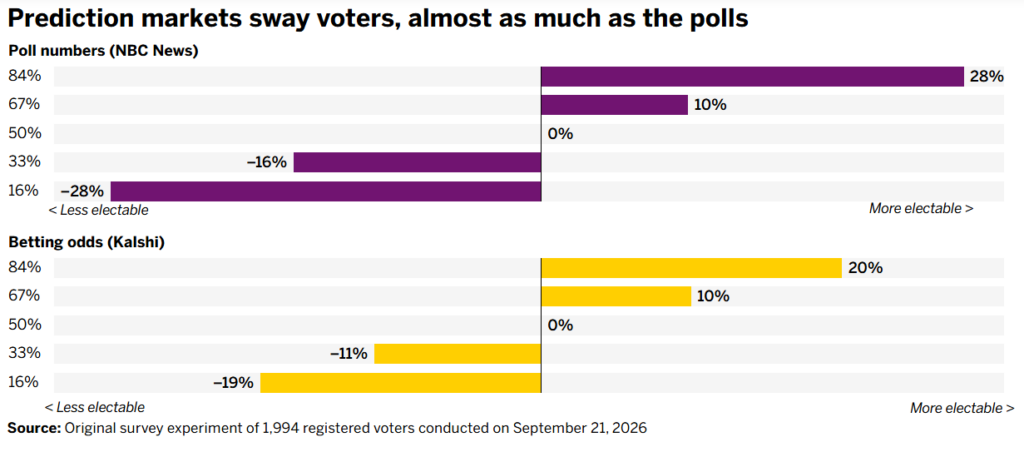
The concern with these findings, according to the report, are most acute for small-volume prediction markets in down-ballot contests where there is little or no polling, and the odds are “vulnerable to attempts at …. manipulation.”
“A lot of Americans argue this shouldn’t be part of our political environment,” Myer said.
The study confirms Myer’s observation, as it showed that people remain highly skeptical of prediction markets.
It will take legislators a while, however, to catch up to this fast-moving environment, so expect prediction markets to have a role in elections in the years ahead.
Do prognosticators move voters?
Prognosticators have become major players in predicting elections. Typically built upon the back of recognized polls, prognosticators mix a vast range of polling data with reporting and experience to rate the way elections are tipping. But do they move voters?
“What the prognosticators do is shape public attention on races to pay attention to and races to ignore,” said Farnsworth. “Their greatest impact may be on donors. This is why donors are putting money into Texas and not Virginia, for example.”
However, prognosticators, he argues, are not typically drawing the attention of regular voters. “People following the Cook Report and related groups” he said, “are not undecided about who they will vote for or how they feel about the political parties.”
Who Will Win in Virginia on Tuesday?
This weekend’s news serves as a reminder how difficult projecting election outcomes can be.
On Saturday, Chaz Nuttycombe, who runs State Navigate, sent an email saying that it appears that pollsters in an effort to adjust their findings to capture Trump voters are now undershooting Democratic voters. Per the email:
-
Recall bias in polling has likely resulted in the industry overrepresenting Trump voters in surveys due to a disproportionate number no longer claiming they supported him in 2024. They’re largely concentrated in groups Trump made large gains with in 2024: lower propensity, younger, non-white, politically disaffected voters who are unhappy with his job performance.
-
Our estimate is that this probably results in a 2-point error in favor of Democrats in a standard generic ballot poll: a more conservative estimate based solely on data from Verasight points to a 1-point error in favor of Democrats.
If correct, the Democratic wave could swell and outpace projections.
Then on Sunday, there was a dramatic shakeup in the closely watched Michigan U.S. Senate race between Democratic Socialist Abdul El-Sayed and Republican Mike Rogers. Rep. Haley Stevens, who lost a bitter primary contest with El-Sayed for the nomination, announced that she was backing the Republican Rogers. The announcement has sent shockwaves through Michigan, gotten Stevens cast from the Michigan Democratic Party, and could have significant ramifications for the Democrats’ chance to win the Senate back.
How much it will affect the outcome will be determined on Tuesday. Before the announcement, some polls and Kalshi had been showing El-Sayed opening up a pronounced lead over Rogers, though the Cook Political Report has kept the race rated a toss-up.
In short — elections remain in the hands of the voters.
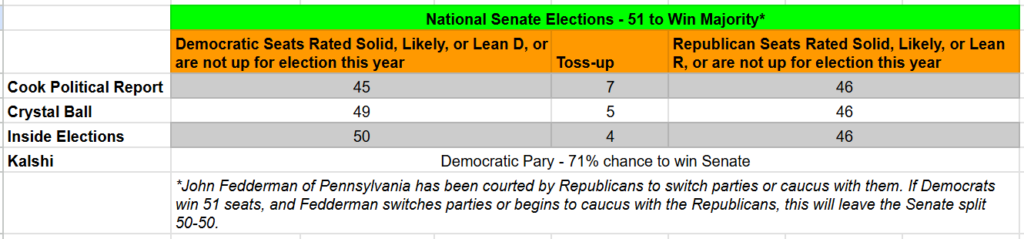
How well are the prognosticators and prediction markets capturing what voters will decide? The VFP has compiled what prognosticators the Cook Political Report, Crystal Ball, and Inside Elections are projecting for each of the 11 Virginia congressional races, the race to control the U.S. House, and the race to control the U.S. Senate. We are also providing Kalshi’s odds for each of these.
We will follow-up later this week to evaluate how each did in reading the election tea leaves.
Virginia Congressional Races

Race to Control the U.S. House

Race to Control the U.S. Senate