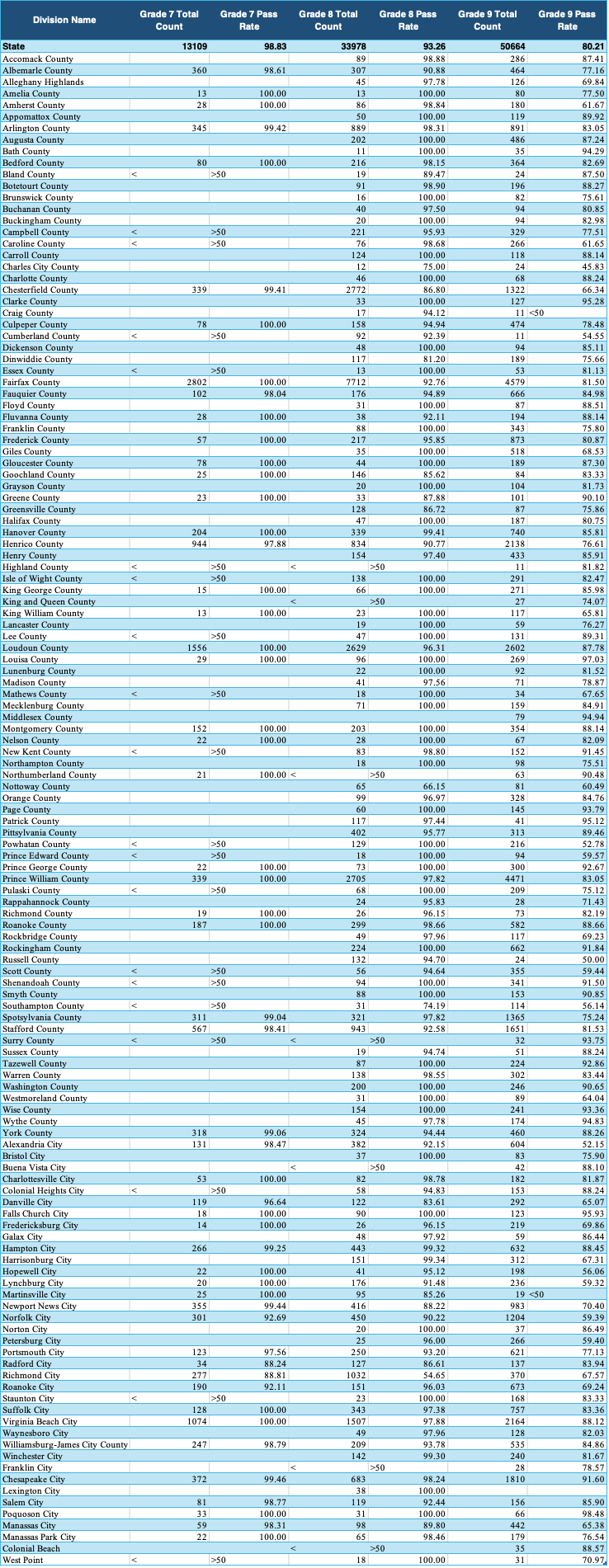

Update: An earlier version of this article omitted a table. That table has been added and is viewable at the end of this piece.
Should you accelerate your child in middle school math? That question has been on more Virginia parents’ minds lately, as divisions across the state are pushing, at the request of the Virginia State Board of Education and the legislature, to enroll more 7th and 8th graders in Algebra.
On one hand, research suggests that advanced math courses are good for students and can lead to higher achievement and a greater likelihood of attending college. There is a risk, however, that students advanced too quickly will struggle with challenging material.
Historically, Virginia schools have likely been too cautious deciding which students deserve the chance to enroll in advanced math classes. In 2024, for example, slightly more than 11,000 7th graders took the state’s Algebra exam. Nearly all of them (98.8 percent) earned a passing score.
That’s an exceptionally high success rate, and it suggests there might be still more students who could succeed in Algebra if given the opportunity.
Thanks in part to policy changes from the State Board and the legislature, that’s exactly what’s happening. Over the past two years, Virginia schools have increased the number of 7th grade Algebra students by 18 percent, with essentially no change in pass rates.
Are these just the super elite students? Not necessarily.
There’s a similar trend going on in 8th grade, where the number of those students taking Algebra has risen 6 percent over the past two years, and success rates have also remained high.
Last year, almost 34,000 8th graders across Virginia took Algebra, and more than 90 percent of them passed the state test. (See the Table below to find the numbers and pass rates in your division.)
The challenge for educators is to nudge students who are ready for advanced math classes, without pushing students who are not yet ready into classes where they won’t be successful.
A recent study from NWEA, a company that works with districts to foster student growth through evidence-based assessment and learning solutions, followed 55,000 students nationally and compared their prior math achievement with how they subsequently performed in Algebra. They found that students with stronger math skills performed better in Algebra when they took the course earlier rather than waiting until 9th grade.
Which students are ready? Schools have traditionally relied on teacher recommendations, parent requests, and local placement rules to decide who gets into advanced math.
Too many capable students, however, were being overlooked. So, in 2025, the General Assembly passed what’s called an “automatic enrollment” law for advanced math. Students in grades five through eight who score in the top quartile statewide on their state math test now must be given the chance to take an advanced math course the following year, assuming their school offers one. Parents can opt their children out if they like.
Virginia is making another important change at the same time. For years, the state has had what education officials have called an “honesty gap” between the relatively high share of students deemed proficient on Virginia’s SOL tests and their much lower performance on more rigorous national exams. As Jim Cowen wrote in Forbes last year, Virginia has begun confronting that gap by raising its academic expectations through higher cut scores – the minimum required to pass the state exam.
Those new cut scores are not yet reflected in the 2025-26 Algebra results, but they will take effect in coming years. Once they do, Virginia will be simultaneously pushing more students into advanced math and raising the bar for what counts as success.
That’s the right combination, and it will mean schools will have to use the data they already have to give more students access to advanced coursework when they are ready for it, while making sure “ready” actually means something. As a student demonstrates that he or she is ready for more advanced math, the default should be to move that student ahead.
Virginia schools are already moving in this direction, though some districts have moved faster than others. Over the past two years, Fairfax County increased the number of 7th and 8th grade Algebra I test takers from 8,595 to 10,514, a 22 percent increase. Prince William’s numbers rose 49 percent, while Stafford’s rose 84 percent.
Looking only at Algebra I actually understates the amount of acceleration happening across Virginia, because students who take Algebra in 7th grade can then move on to Geometry or Algebra II in 8th grade. Last year, about 76 percent of Fairfax 8th graders had taken one or more advanced math courses. The figure was 65 percent in Loudoun and 88 percent in Richmond.
There is still plenty of work to do. The automatic enrollment rule can help schools find the students who are already ready for Algebra. But it can’t make more students ready. In fact, the NWEA researchers found that students with weaker math skills struggled in Algebra regardless of when they took it. Waiting another year didn’t appreciably improve their performance. Those students simply need stronger math instruction and additional help well before they reach Algebra.
Virginia is doing the right thing by accelerating students who are capable of tackling advanced math classes in middle school. The state’s experience shows that schools can open Algebra to more middle schoolers while maintaining very high success rates. Its new automatic enrollment policy should help it expand those opportunities even more.
Table: 2025–26 Virginia Algebra I Results, by Grade and School Division