When the New York Times reviewed Janine M. Benyus’ then-new 1997 book, Biomimicry: Innovation Inspired by Nature, it highlighted a tension that is familiar to people today.
We owe our growth – both demographic and economic – and our ability to feed and sustain both to the “plundering of energy-rich fossils.” Those concerned with “global ecology,” however, fear that the path is unsustainable and the only way back is to “turn to nature.”
“[L]ike many middle-class intellectual polarizations,” the reviewer Dorion Sagan wrote, “the debate between ecological conservatives and economic liberals is too much about taking sides and preaching to the converted and too little about listening to other views.”
In biomimicry, the two sides have found a bridge that they are using to move forward. And that bridge is finding a home in the current debate over data centers and land use.
Solving Human Design Problems with Nature
Simply put, biomimicry is “The discipline of learning from nature to solve human design challenges,” according to Kaitlin Chuzi, the director of global land strategy at Microsoft who holds both a professional certification in biomimicry and an M.S. degree from Arizona State University in the field.
It is an idea that has been gaining momentum with a number of industries across the country.
Qualcomm, Boeing, and Interface are just some of the companies that are adopting biomimicry to solve design challenges.
Biomimicry is less a set of rules and more a philosophical approach to design problems. “We take the whole location into consideration,” Chuzi said. “And that’s what makes biomimicry different from .. conservation or ecological restoration” where the goal is to create biodiversity.
There are two major types of biomimicry.
One is “form” biomimicry, in which a design is “based on the form, the structure of the visual elements of something natural,” Chuzi said. An example of this is the common injection needle, which is modeled after the mosquito’s proboscis.
“Ecosystem” biomimicry is what is being deployed in data center building. It looks to benefits that naturally accrue to humans in healthy ecosystems and incorporates them into building projects. Things like noise abatement, visual screening, air quality improvement, soil health, and water quality control “are all benefits that naturally, healthy … ecosystems give to humans,” Chuzi said. “They’re things that we can quantify, and then we can make sure that that same level of functionality and ecosystem service production is replicated on our campuses.”
Biomimicry in the Data Center World
Microsoft is bringing this ecosystem biomimicry approach to its data center campuses.
Chuzi, who spoke with the Virginia Free Press via an online interview, said “there are certain things that are particularly important to the local ecosystem, the local habitat, and we can look to healthy intact ecosystems in order to pull what is working … onto our data center campuses to help those thrive as well.”
One example can be found in Mecklenburg, Virginia, said Chuzi. Originally, Microsoft was looking at a 600-acre development. Recognizing the importance of the community’s rural character and the prominent role that greenery and rivers play in the region, the project was scaled back so that there’s now “230 acres of permanently protected rural landscape,” as well as over 16,000 linear feet of restored stream in the region.”
It’s an example, she said, of what’s possible when “you plan well and when you take the local ecosystem into consideration as early in the design process as possible.”
Another example comes from Noord-Holland, where Chuzi was during her interview with VFP.
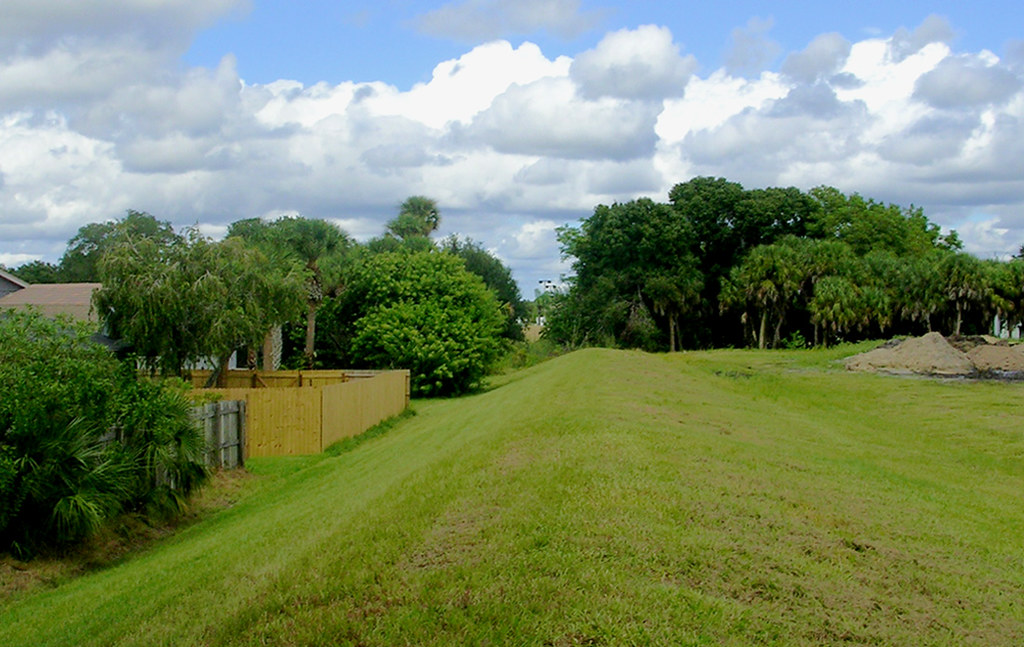
Visible through the window behind Chuzi was a small berm. That berm, Chuzi said, “is a perfect example” of ecosystem biomimicry.
It’s a vegetated berm that serves as a lunch place for employees. But it also has a more practical purpose – it absorbs water so that the site can effectively “manage these significant downpours that we get here in the Netherlands,” Chuzi said.
Other tactics taken at the 5,017 square-meter data center in Middenmeer included planting 150 trees that will help shield the facility from the view of motorists traveling along a nearby highway. Also 2,300 square meters of shrubs, brushes and ground covers that are common throughout Noord-Holland’s landscape have been planted.
“We expect the native plants we chose will mirror a healthy, resilient ecosystem and support biodiversity, improve stormwater control, and prevent erosion while reflecting the natural beauty of Noord-Holland,” Chuzi said.
Biomimicry also has a role to play when data centers are being built in an urban area. While trees and berms make sense in more-rural settings, they are less practical in space-constrained urban areas.
The solutions in those environments, Chuzi said, are likely to include “engineered solutions,” like a green wall or a different facade on the building.
Now, Microsoft is expanding its application of biomimicry principles. “All of our data center campuses in the U.S. going forward,” Chuzi told VFP, are “going to be evaluating these ecosystem enhancements based off some of the learning that we had in Mecklenburg and Noord-Holland and other regions.”
Moderation
Biomimicry is not without its critics. Architect Kamila Buraczynski has argued that there are limitations in applying biomimicry to architecture. Those limits “become clear,” she wrote, “through the stark contrast of nature and man as well as the unified ways in which nature works versus the individualistic methods humans tend to pursue.”
Others have criticized biomimicry for “fatal ambiguity,” leading to a situation where rather than protecting nature a new “human dominated nature” emerges.
At a moment in the burst of rapid data center growth and development, however, the biomimicry movement has an important trait on its side, which was captured in the New York Times review of Benyus’ book.
A book like Benyus’, the reviewer wrote, is a “valuable reminder that in the long run moderation pays.”