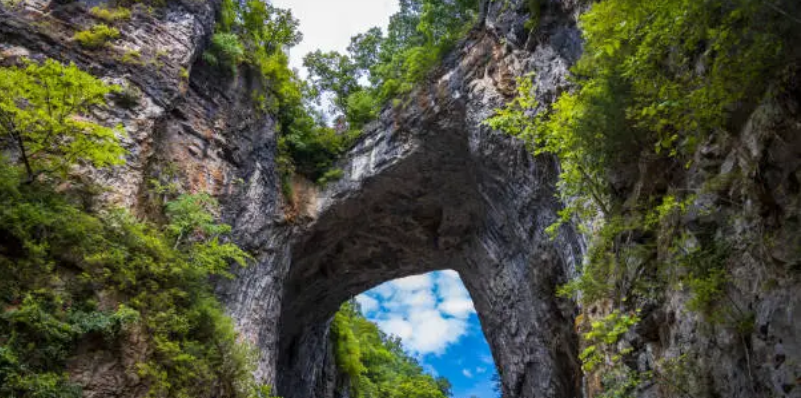
I spent part of this weekend at Natural Bridge, near Lexington, for a meeting of the Republican Party of Virginia’s State Central Committee. I’d been there before, but this visit gave me some time to really think about the history surrounding one of Virginia’s best-known landmarks.
Natural Bridge is enormous. The limestone arch rises 215 feet above Cedar Creek. Photographs show its shape, but not its scale. You really have to stand beneath it and look up.
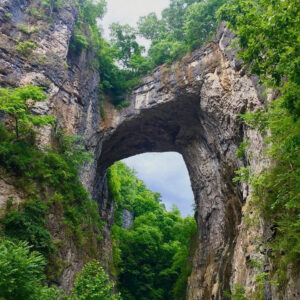
The Monacan tribe knew the site long before the first European settlers reached the area. They considered it sacred ground. By the middle of the 18th century, explorers and surveyors were moving through this part of western Virginia as the colony expanded toward the mountains and beyond.
George Washington allegedly visited Natural Bridge around 1750, when he was still a young surveyor. Initials said to be his were carved high on one of the stone walls. Historians have debated the details, but Washington was certainly surveying western lands during that period, decades before he commanded the Continental Army.
Thomas Jefferson first saw Natural Bridge as a young man. In 1774, he acquired the bridge and 157 surrounding acres through a land patent issued in the name of King George III.
Two years later, Jefferson wrote the Declaration of Independence and helped end the king’s authority over the American colonies.
Jefferson never lost his affection for the place. In Notes on the State of Virginia, he called Natural Bridge “the most sublime of nature’s works.”
He considered building a small retreat nearby and returned several times during his life. In 1815, he wrote that he viewed the bridge “in some degree as a public trust” and would not allow it to be damaged or hidden from view.
That was a remarkably early statement about preservation. Jefferson owned the property, but he knew Natural Bridge belonged to the country and to the future.
The history continued beyond the bridge itself. Nearby Saltpeter Cave, supplied material used to make gunpowder. The Great Wagon Road carried settlers through the Valley as the young nation moved westward.
Natural Bridge became one of America’s earliest tourist destinations, drawing presidents, statesmen and travelers who wanted to see the place Jefferson had praised.
Virginia eventually made it a state park in 2016. Jefferson’s “public trust” is now truly open to the public.
During America’s 250th, this was a good time to be here. We spend a lot of time debating the Founders, usually through the politics of our day. Natural Bridge brings them back to human scale.
Washington came here as a young surveyor. Jefferson came as a curious young Virginian, years before either man knew the role he would play in history.
They stood beneath the same stone arch that visitors stand beneath today.
There is something poignant about that continuity. Governments change, generations die off and political arguments come and go. Natural Bridge remains where it has always been, part of the land and part of Virginia’s story.