
Updated October 5, 2026
If any congressional district captures the dynamic nature of Virginia’s demography and politics it’s the 7th.
In 2014, then-House Majority Leader Eric Cantor, who had held his seat since 2000, was upset in the primaries by Dave Brat, a victory for the Tea Party. Cantor resigned his seat shortly thereafter to move into the private sector, leaving the 7th vacant until Brat took office in January 2015.
The district was not done with surprises, however. Historically anchored by the western Richmond suburbs, in 2018 Abigail Spanberger rose to defeat Brat from the seat as part of a Blue Wave that swept the nation during Trump’s first term.
She won the seat twice more. In 2020, she bested conservative Nick Frietas by just over 8,000 votes. After redistricting moved the seat towards Northern Virginia, Prince William County Supervisor Yesli Vega lost in 2022 by over 12,000 votes. Spanberger’s three victories earned her a reputation for winning close races, and launched her successful run for the governor’s mansion.
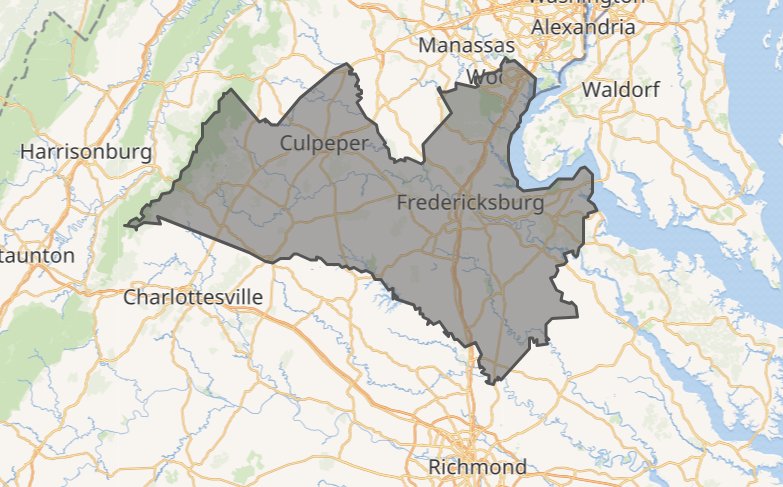
The district’s dynamism is due both to redistricting and to demographic shifts. Prior to redistricting, the western Richmond suburbs anchored the district. Since January 2023, Fredericksburg has become the geographic center of the 7th that stretches north to include parts of Prince William County, which accounts for 32 percent of the 7th’s total population.
Stafford County (20 percent) and Spotsylvania County (19.3 percent) are the other two large population centers. Both have long been among the fastest growing counties in Virginia, and both are on the cusp of becoming majority-minority counties.
Platforms
INCUMBENT: Eugene Vindman (D-VA)
CHALLENGER: Doug Ollivant (R)
CHALLENGER: Alaha Ahrar (Independent)
CHALLENGER: Taner Lopez (Libertarian)
State of the Race as of August 24th
Cook Political Report: Soft Democratic
UVA Sabato Crystal Ball: Hard Democratic
270 to Win: Soft Democratic
270 to Win Consensus: Soft Democratic
VPAP: Toss Up
Eugene Vindman is looking to return to Congress by running on a pro-affordability platform grounded in fighting for families. Standing on the opportunities afforded his family following their escape from the former Soviet Union, Vindman is advocating cutting taxes for working families while lowering costs, addressing health care pricing, and making data centers pay their fair share. As a veteran, he is also leaning into ensuring the military is appropriately outfitted to carry out their missions, and that once service members return to civilian life they have the resources they require to adjust.
Doug Ollivant is grounding his race in increasing energy output by adopting an all-of-the-above approach that includes renewables, natural gas, and small modular nuclear reactors, among others. He is also advocating for regenerative agriculture and creating more ways for farmers to sell their products directly to consumers so that all eat better. On the housing side, Ollivant is about cutting regulations to speed the production of new housing and grow supply.
Two additional candidates are in the mix. Alaha Ahrar is an independent running on a platform emphasizing human rights and social justice. Born in Afghanistan, she attended Mary Washington University and earned a master’s at George Mason University. Today she is CEO of the Kindness Sharing Project.
Taner Lopez is running as a libertarian advocating for “re-independence,” by which he means standing up to “foreign countries, lobbies, billionaires, big corporations, and private interest groups” that he argues have taken over the political system.
What to Watch: The Wave
Editor’s Note: On October 5, Republican candidate Doug Ollivant announced that he had been diagnosed with cancer, but that he would stay in the race. In a text-message exchange with the Virginia Free Press, Ollivant wrote: “I am deeply grateful for the support and encouragement. This is not the path anyone expected, but it turns out I have two contests now. For my family and for the district, I am going to fight hard and win both.”
While Democrats have held the 7th for four consecutive terms, the district was tightly contested each time. There are three waves that could well determine the winner in 2026.
The Anti-Trump Wave: Spanberger rode a wave of anti-Trump sentiment in 2018 to first win the 7th Congressional District seat. Now into his second term, Trump’s popularity is even lower than it was in 2018, according to poll tracking conducted by the Economist. Anti-Trump sentiment was an important factor in Spanberger’s initial 2018 victory. Whether that dynamic will again be decisive in the redrawn 7th remains one of the central questions of 2026. If Vindman can generate that energy, he stands a good chance to win owing in no small part to the significant cash advantage he holds. (Vindman has $6.5 million on hand, per the July Federal Elections Commission, against just over $65,000 for Ollivant.)
The DSA Wave: Democrats across the country are reeling from stunning losses to Democratic Socialists in the primaries. One of those Democrats is Eugene Vindman’s brother Alexander, who lost the Democratic nomination for U.S. Senate from Florida to DSA candidate Angie Nixon. While DSA candidates have had much less success in Virginia, DSA-aligned voters in the 7th District could be swayed to take their votes to either Ahrar or Lopez. In a tight race, that could favor Ollivant.
Money Fatigue Wave: Yes, Vindman has a mound of cash for this election. But so, too, did his brother. With the cost of living escalating and frustration rising with the monied class, voters may end up turning on well-financed candidates. Still, money matters. Ollivant will have to raise considerably more in short order to compete with Vindman. As the race heats up, will the money drive voters to the polls, or lead them to stay home?