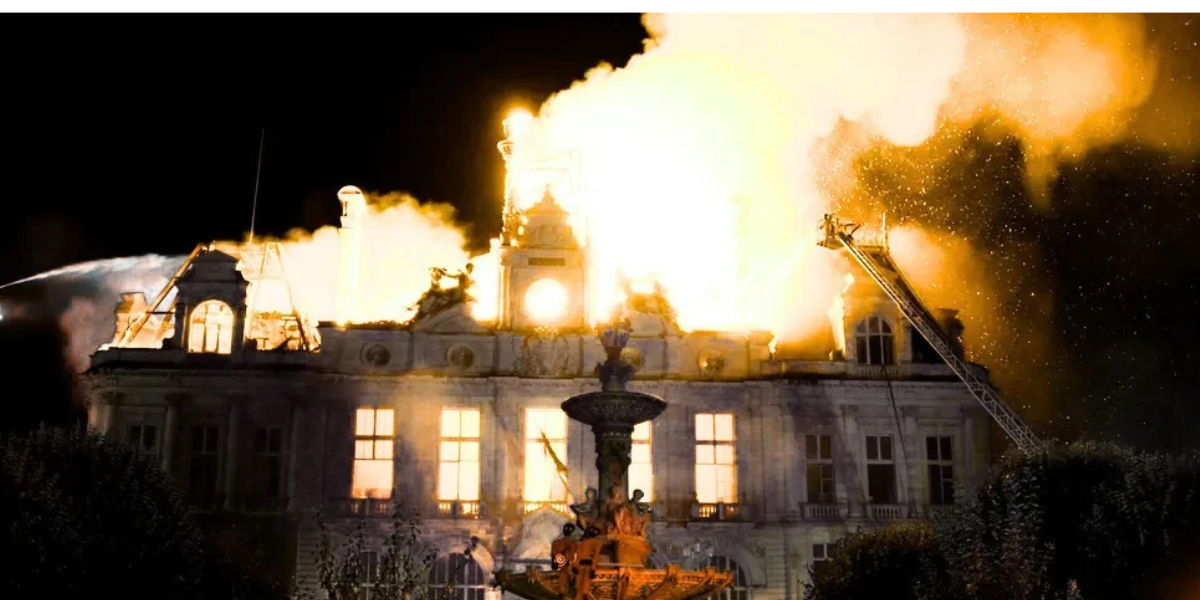
There is nothing ennobling about watching another human being die.
Hollywood has turned death into a sudden pop as hero continues to empty rounds long after the clip should have been emptied. Or worse, in our secular age, seems terribly obsessed with the occult and horror for its own sake. Unlike the veterans at the bar who actually went into combat, the folks who love death have never seen it up close.
Set aside those who applauded the assassination of Charlie Kirk who are now suddenly horrified by the possibility of live streaming of Nidal Hasan’s execution.
Is it hypocritical? Of course it is.
Set aside further whether or not Nidal Hasan deserves the penalty of death, not just for the violation of his constitutional oath, not just for the violation of his Hippocratic Oath, not just for murdering 13 — one of whom was pregnant —and wounding a further 32. Hasan took the side of America’s enemies.
That having been said, there is nothing ennobling about executing Hasan via live stream. You know who else does that? The Islamic State.
I cannot claim to understand the enthusiasm for watching people die. When I do think of examples, I think of the images of people clapping as the Twin Towers came down on September 11th, 2001. Or the people who cheered the near assassination of President Trump in Butler, Pennsylvania.
Or the people who celebrated the ‘Kirkiversary’ last month. Or the folks who think this sentiment is perfectly acceptable civil discourse:

Now clearly, there is an ocean of difference between Charlie Kirk and Nidal Hasan, between an assassination of an innocent man and the death penalty being laid upon a man who committed cold and premeditated murder of American soldiers. Kirk never deserved what he got. Hasan has it coming.
Yet the point more broadly is whether we as Americans are becoming a society that celebrates the macabre. The death penalty is not supposed to be vengeance, yet neither is it a spectacle we should celebrate like so many Romans packed into the Colosseum.
In a culture where the culture of death has finally infiltrated its way into our moral vocabulary as Americans.
What do public spectacles of death achieve? Simple answer there. They condition society and the public to the idea that death is the final argument.
More to the point, the death penalty does not serve as a deterrence but rather as a lowering of the bar. Execution as public spectacle is not the best of America. One might beg to differ that such implements as the electric chair send a message — and it does:
So our virtues
Lie in the interpretation of the time:
And power, unto itself most commendable,
Hath not a tomb so evident as a chair
To extol what it hath done.
One fire drives out one fire; one nail, one nail;
Rights by rights falter, strengths by strengths do fail.— William Shakespeare, Coriolanus (1608)
It sends a message that violence can triumph over reason and invites us to join Hasan in the spectacle of that violence.
Someone stooped — and in doing so, accepted Hasan’s terms.
The Death Penalty and the Ends of Justice
Of the four types of justice, none of these are satisfied with the execution — public or private — of Nidal Hasan:
- Restorative justice.
- Defense of society.
- Deterrence.
- Rehabilitation.
St. Thomas Aquinas would equate the death penalty imposed by the state as akin to removing a diseased limb from the body. Yet the test here is between a question of prudential judgment by the government and the dignity of the human person. I won’t bore you with too many of the details other than to say that while the death penalty may be a matter of prudential judgment, the intrinsic value and dignity of the human person is not a matter for judgment. Whether it is abortion, euthanasia, or the death penalty, the option is and always will be for life.
“It is clear that, for the [purposes of punishment] to be achieved, the nature and extent of the punishment must be carefully evaluated and decided upon, and [the state] ought not go to the extreme of executing the offender except in cases of absolute necessity: in other words, when it would not be possible otherwise to defend society. Today however, as a result of steady improvements in the organization of the penal system, such cases are very rare, if not practically non-existent.”
— Pope John Paul II, Evangelium Vitae 56 (emphasis original)
What has changed over the last few decades is a shift from the impermissibility of the death penalty e.g. where there remains a possibility that has been removed by means of improving incarceration methods, to the word inadmissibility as understood by Pope Francis.
The idea that the state must impose the death penalty is not a Catholic one, but a Kantian one. Violation of the categorical imperative (or absolute) invokes and imposes yet another categorical imperative, one that cannot be violated whatsoever.
An eye for an eye, so it goes.
In the Catholic tradition, the purpose of the death penalty is not an end unto itself, but rather a means of protecting the common good and the commonwealth.
Let us keep in mind that “not even a murderer loses his personal dignity, and God himself pledges to guarantee this”. The firm rejection of the death penalty shows to what extent it is possible to recognize the inalienable dignity of every human being and to accept that he or she has a place in this universe. If I do not deny that dignity to the worst of criminals, I will not deny it to anyone. I will give everyone the possibility of sharing this planet with me, despite all our differences.
— Pope Francis, Fratelli Tutti, 269
Like many Catholic thinkers, I disagree that the death penalty is inadmissible, yet strongly agree that it is impermissible. That sounds to some ears like a distinction without a difference, yet the distinction is this: if impermissible, it means that our civilizational progress has put the option for violence beyond use. If impermissible, then the defense of human life by means of self-defense was somehow inherently flawed, which is neither the tradition of Christianity nor the West.
The Spectacle of Violence
Satiating the public appetite for bloodlust is a very Roman approach to justice in the bread-and-circuses motif. It says something about us as Americans. Is that really the kind of people we are?
For some, the answer is a full-throated yes.
One has to wonder whether or not a culture that celebrates death, embraces violence, which spits upon innocence only to embrace horror, cruelty, and even the outright demonic is worthy of the name of civilization.
The Islamic State live streams their executions. Too many people cheer the idea of violence and conservatives are right to recoil when we see such instances on the left. Yet does it help us — is it ennobling to ourselves or the things we claim to hold true and dear — when we join in the cult of death for its own sake?
We know which side Nidal Hasan chose.
I’m not there.