
Worries that a coming demographic cliff will drastically reduce college and university enrollment in Virginia doesn’t appear to be a significant concern. In testimony before the Senate Finance Committee on Tuesday, the State Council for Higher Education in Virginia (SCHEV) said that it doesn’t anticipate “a rapid decline.”
Virginia’s higher-education sector, however, is not without challenges — the state is on the leading edge of declining enrollment as the pool of students begins to wane, nearby states are actively recruiting Virginia students by offering financial incentives and nonacademic benefits like major sports, and the gender imbalance continues to be an issue.
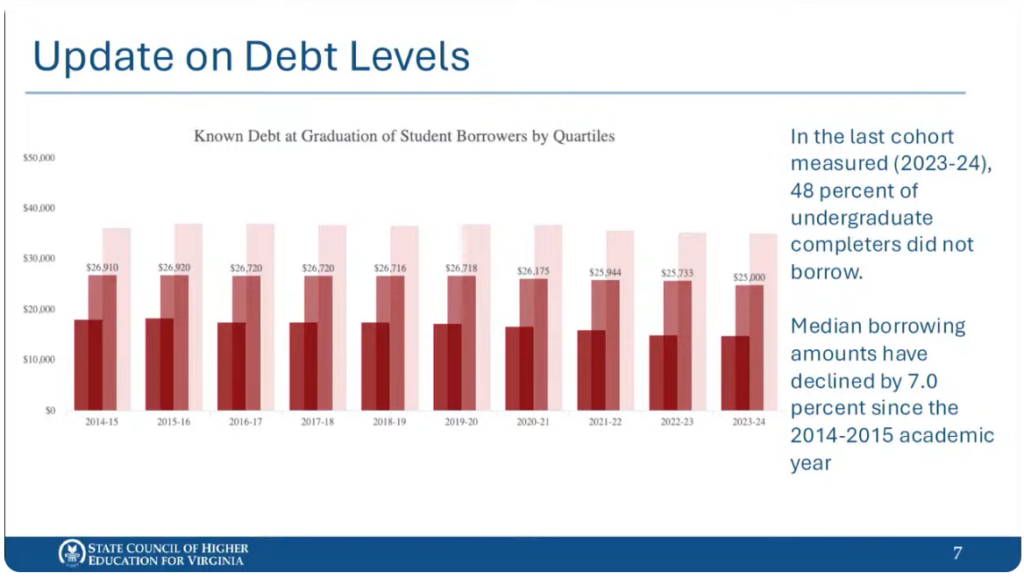
And there was good news in SCHEV’s report — student borrowing and debt are both on the decline.
Demographic Slide
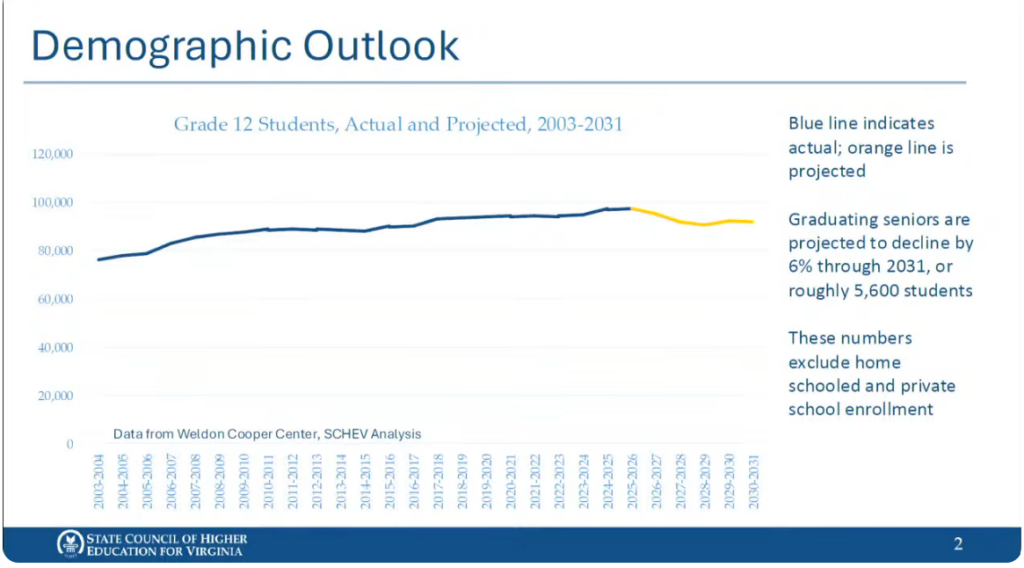
While 12th-grade public school enrollment is declining in Virginia, the drop-off isn’t nearly as steep as in some other states.
Between now and 2031, the number of Grade 12 students in Virginia is projected to fall by 6 percent, or some 5,600 students. These numbers, however, are exclusive of homeschooled and private-school students. That’s notable because since COVID the number of homeschooled students has been on the rise in Virginia.
Since 2019, the percentage of homeschooled students has climbed 49.5 percent, to 66,117 students in 2026, according to the Home Educators Association of Virginia.
Depending on the number of homeschooled students who decide to pursue a university degree, those students could help offset college and university enrollment declines among public-school students.
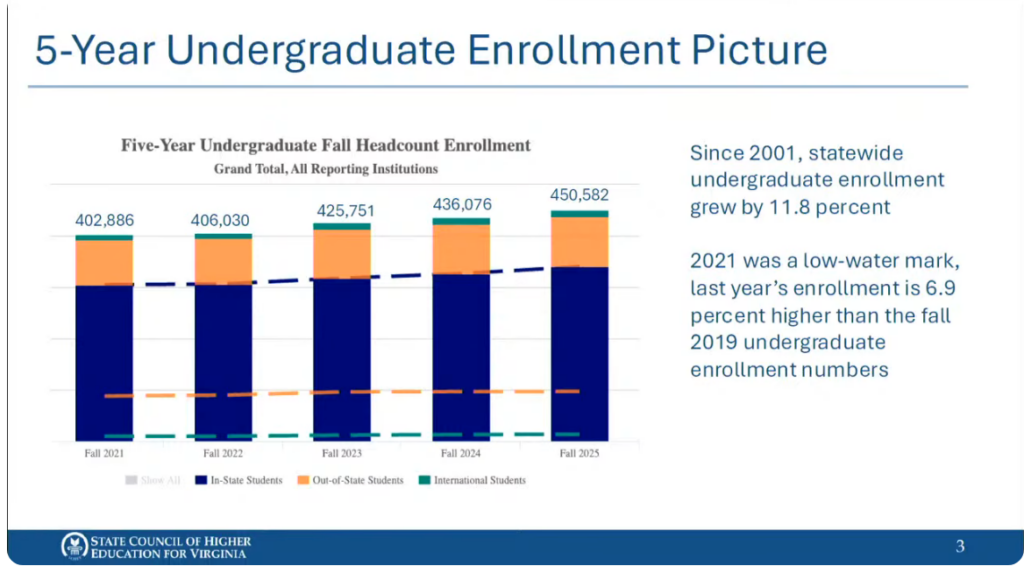
Following five years of enrollment gains, SCHEV projects that college and university enrollment among undergraduate and graduate students in 2026 will be down 1.4 percent from 2025. Though concerning, SCHEV stressed that overall enrollment growth in Virginia’s public colleges and universities between 2019 and 2025 was up 6.9 percent.
SCHEV stated that higher education is facing a couple of headwinds other than shifting demographics. Those challenges include “a public narrative around higher education that it may not be necessary, not worth the cost.”
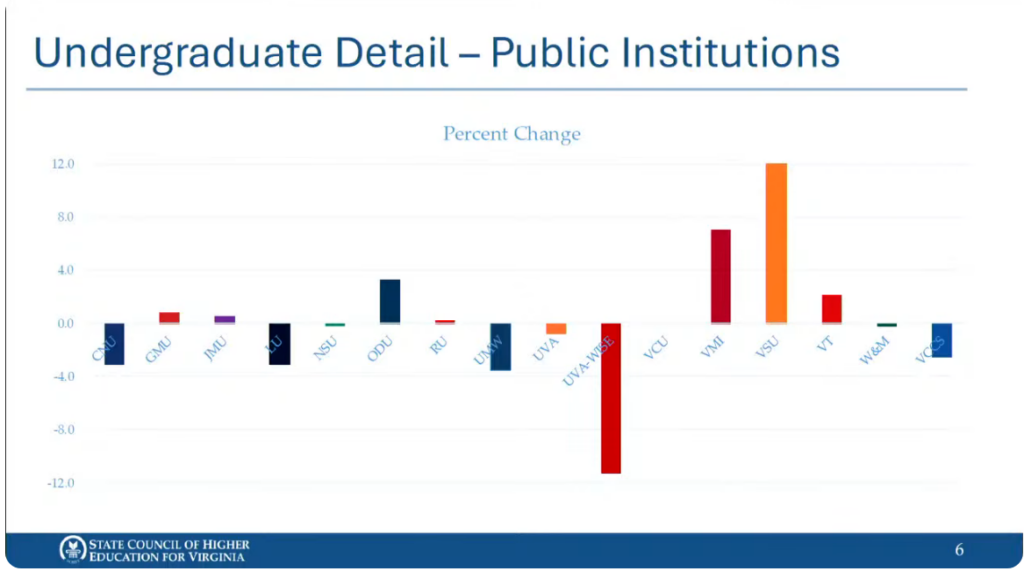
The enrollment decline is not affecting all schools equally. Virginia State University, Virginia Military Institute, and Virginia Tech are seeing enrollments rise. The University of Virginia at Wise is realizing the sharpest decline in enrollment.
Declines in international student enrollment in graduate programs is a contributing factor to the overall decline in Virginia enrollment. The total international student population in Virginia based on last year’s data is down 13.1% for graduate programs. The loss is not evenly distributed across the commonwealth’s universities. George Mason University and Virginia Tech collectively have been hit the hardest and are down about 1,000 students (30% down at GMU, and 11% down at VT), according to SCHEV.
Greater Competition
One group of students that is on the rise are out-of-state students. SCHEV’s data shows their number up 2.6 percent from 2025. While Virginia is doing well attracting out-of-state talent, the competition for these students is fierce. And increasingly, Virginia students find themselves being recruited by out-of-state universities. .
“Tennessee, North Carolina, and now Maryland and other states are advertising in-state tuition for Virginia students,” SCHEV told the Senate Finance Committee. One school that is affected by this, according to SCHEV, is the University of Virginia at Wise which has been “an anchor” for southwest Virginia, but is facing competition from nearby Tennessee for students.
In addition to the financial incentives, Chris Peace, president of the Council of Independent Colleges in Virginia, told the Virginia Free Press via email that southeastern schools with a prominent sports culture are also a draw for Virginia families. “Tennessee has followed Alabama and Auburn in attracting families who prefer that experience to in-state regional institutions. Kentucky is following suit. South Carolina led before Alabama expanded its efforts.”
West Virginia University is also growing in popularity with Virginia students for the same reason.
“Overall,” Peace concludes, “Tennessee poses the greatest competitive concern for Virginia students, followed by Kentucky and WVU.
Gender Gaps Persist
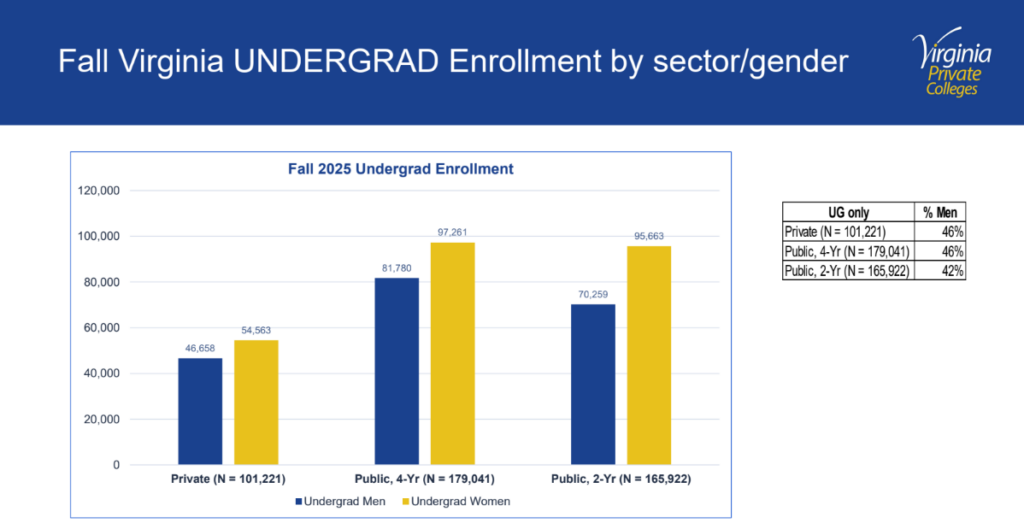
Women continue to outpace men in university enrollment. SCHEV projects 314,906 women enrolled in 2026, down 1 percent from 2025. The projection for men is 240,899, down 1.8 percent from the previous year.
Peace said that the gender imbalance in higher education is “a long-term structural trend, not a recent development.” Citing information from the National Center for Education Statistics (NCES), he said that of the 16.39 million undergraduate students enrolled nationwide in the fall of 2024, including at community colleges and other two-year institutions, women made up 57 percent of the total (9.35 million students).
“The national gender imbalance is visible across the entire four-year college sector,” he said, “including public, private nonprofit, and for-profit institutions. The female share of enrollment has stayed within a fairly narrow range of 56% to 57% across all four-year colleges.”
Here in Virginia, the gap also shows up across the range of educational institutions. In a slide prepared for VFP, the imbalance is clear across private and public four-year institutions, as well as public two-year institutions.