
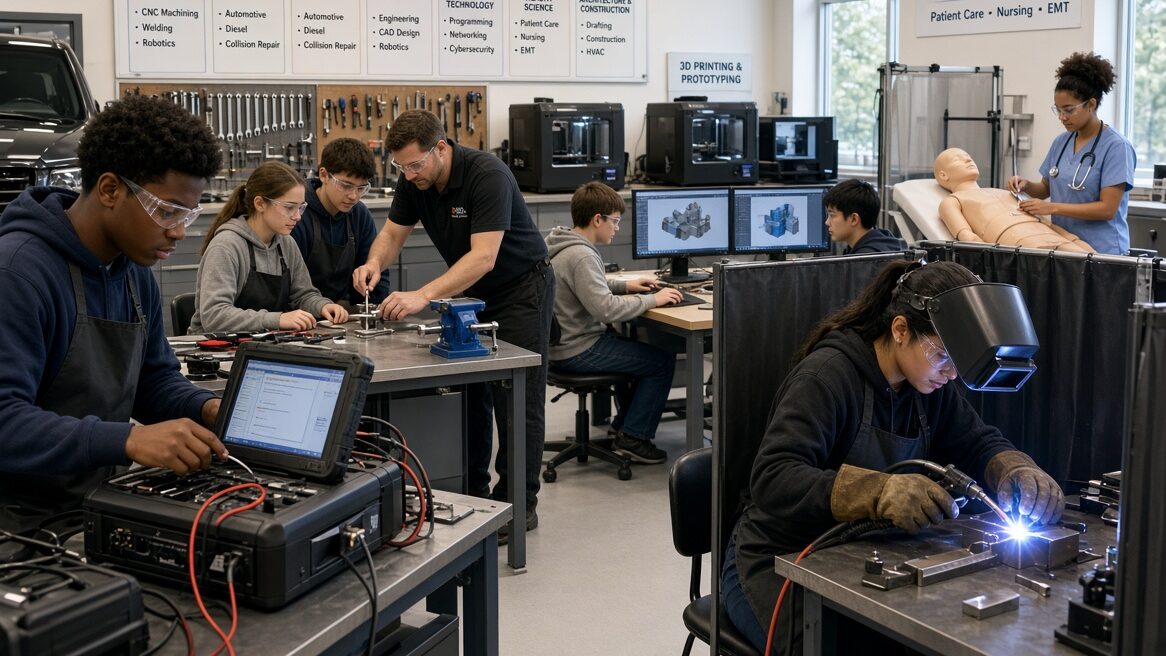
Career and workforce readiness is a key priority for federal education policy. The federal career and technical education (CTE) program was saved from the gutting of the Education Department by being one of the first to be moved to the Labor Department. The program is tasked with aligning CTE programs to local workforce demands, advancing skilled trades, and expanding apprenticeship programs and other work-based learning opportunities. As a result, there is growing attention to CTE policies and practices by states and localities across the country.
With this additional attention on CTE, it is critical for Virginia policymakers to incentivize integrating AI skills and tools into CTE curriculum, and that CTE remains an inclusive space for all learners.
Integrating AI into CTE Programs
With the current attention on SB394, which requires school boards to develop AI policies that are aligned to Virginia’s Department of Education guidance, leadership must consider the uses of AI beyond the typical classroom setting such as in CTE programs.
There are many ways that AI can be meaningfully integrated into CTE programs to ensure that Virginia students are best prepared for the changing workforce demands due to advances in AI. For example, AI-enabled tools are common in manufacturing, agriculture, carpentry, and medical professions. Lesson plans or course modules can be developed to focus on AI skills specific to the different CTE pathways, as well as general AI literacy skills to build foundational knowledge to prepare students to be competitive in the evolving workforce.
Inclusive CTE Opportunities
Virginia was one of three states in the U.S. to fold to the Trump administration’s demands to exclude undocumented students from CTE programs. In August 2025, school leaders across the state were instructed by the then-Superintendent of Public Instruction to sign an attestation that their districts would not allow undocumented students to participate in CTE programs if they wished to continue to receive Perkins funding to support CTE programs. Only seven divisions in the state refused to sign and at least one of those divisions lost its Perkins funding.
It is important to note that the state has now walked back this policy since the change of state administration. However, CTE is now seen as a space deserving of only U.S. citizens, and division leaders must navigate the politically charged tactics of the federal government to maintain funding for CTE programming.
While the state no longer requires division leaders to exclude certain students, the threat of the federal government imposing exclusionary and racist policies remains and school divisions must be prepared to respond in the best interest of all students.
The Benefits of CTE for All Students
The landmark Supreme Court decision in Plyer v. Doe guarantees free and public education for all students regardless of their citizenship status. This makes it particularly chilling that the federal government and the state of Virginia at one point were willing to exclude certain students from CTE programs in public schools.
However, beyond legal matters, there are many benefits to promoting CTE as an inclusive space for all students. School engagement is particularly low in high school. CTE improves engagement by making learning more relevant to students’ career interests and by incorporating hands-on learning. This can be motivating for students and increase their engagement through graduation.
For students who were not born in the U.S. and who are learning English, CTE courses are a great way to connect with native English speakers through hands-on projects, which provide an opportunity for students to practice their English in meaningful ways. It is also motivational to students to be able to apply emerging English skills with career skills. CTE offers a bridge to connect English learner students to the larger community and to build workforce skills that can help to integrate them into U.S. society and fill needed skills in the local workforce.
Beyond the benefits to English learners, other students in CTE courses benefit from a diverse student body that is reflective of the diversity seen in career environments. It makes the learning environment richer when there is diversity of backgrounds and experiences to learn from.
How Can Virginia Support CTE Programs?
We risk losing the benefits of an educated and workforce-ready society if we allow education to become politicized and exclude certain students. Therefore, Virginia must prioritize student interests first and foremost.
Virginia should define what it values in CTE – prioritizing student learning and inclusion and building a career-ready workforce that is adaptable to the rapid developments in emerging technologies. These are goals that all Virginians can support.
We also should prioritize holding on to our state’s status as a leader in AI. To do so, the state must invest in preparing the next generation to be career ready in an evolving AI landscape. This requires investment, coordination, and flexibility for divisions to innovate and expand their CTE programming and to be inclusive to all students.
BETH DAVIS is a Postdoctoral Fellow at EdPolicyForward: The Center for Education Policy at George Mason University.