
Earning a Virginia high school diploma generally requires students to do two things: pass their required classes and independently demonstrate proficiency in core subjects such as English, Math, Social Studies and Science. Students typically demonstrate that proficiency through state Standards of Learning (SOL) standardized tests, although Virginia allows other ways to qualify.
Nationally, graduation exams have steadily fallen out of favor. At their peak in the mid-2000s, 27 states required students to pass an exam to graduate. Today, only about six retain such requirements, and New York is phasing out its Regents exams as a graduation requirement.
Opponents argue that students who successfully complete their coursework should not be denied a diploma because of their test performance. Supporters argue that course grades alone do not provide a consistent statewide measure of what graduates know.
A proposal to eliminate this requirement is expected to return to the Virginia General Assembly in 2027, placing Gov. Abigail Spanberger at the center of a fundamental question: What independent evidence of academic readiness should a Virginia high school diploma require, if any?
Testing Flexibility and High Graduation Rates in Virginia
Virginia does not require students to pass a single, comprehensive exit exam. Instead, students earn verified credits by demonstrating proficiency in specific subjects, generally through standardized End-of-Course SOL exams, alongside completing their coursework.
The state also provides alternatives to passing those exams, including approved substitute tests, locally awarded verified credits under specified conditions, locally scored alternative assessments in certain subjects, and credit accommodations for students with disabilities.
Virginia has already reduced the number of verified credits required for graduation:
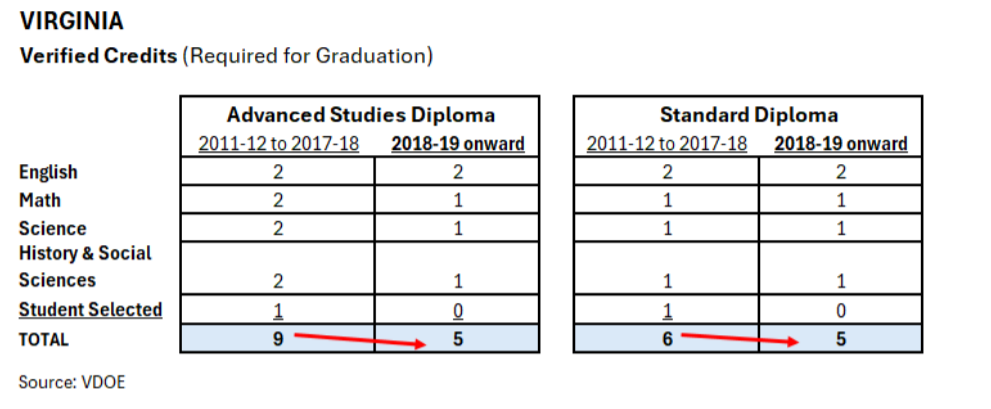
Virginia’s system already combines flexibility with a statewide proficiency requirement. The question is whether further flexibility should eliminate the requirement for independent evidence of academic proficiency altogether.
The state’s graduation outcomes provide additional context. Virginia’s four-year graduation rate was 92.7% in 2024–25, compared with approximately 87.4% nationally among the 45 states and Washington, D.C., reporting comparable data. An August 2026 U.S. News comparison ranked Virginia as having the third highest graduation rate among the reported states. In 2022–23, Virginia’s four-year graduation rate for Black students was 86.1%, compared with 81% nationally.
These figures do not establish that testing causes higher graduation rates, nor do graduation rates alone establish academic readiness. But that combination sharpens the practical question lawmakers should answer: What specific problem would eliminating the statewide assessment graduation floor solve, and how would a replacement better prepare students for post-high school opportunities?
What Virginia Lawmakers Proposed
The issue surfaced during Virginia’s 2026 legislative session through SB 147, introduced by Sen. Stella Pekarsky (D–Fairfax County), and a companion bill sponsored by Del. Sam Rasoul (D–Roanoke), chair of the House Education Committee. The proposals would have created an alternative graduation pathway without requiring students to achieve a minimum score on any assessment.
The House Education Committee approved its bill 18–3. In the Senate, a subcommittee substantially narrowed the proposal to a study by the Spanberger administration. That subcommittee’s chair, Sen. Schuyler VanValkenburg (D–Henrico County), is a high school social studies teacher and a vocal defender of retaining the graduation testing requirement.
The narrower legislation passed the House 87–11 but was continued until the 2027 session by the Senate Finance and Appropriations Committee.
What Other States Can—and Cannot—Tell Us
Virginia’s school rating system recognizes multiple post-secondary pathways, including college credit, military readiness, and preparation for technical careers. Virginia’s high school rating framework, however, accommodates diverse pathways while retaining a separate expectation of academic proficiency.
Experiences in other states illustrate the risks when alternative credentials substitute for demonstrated academic achievement for graduation. A 2026 Thomas B. Fordham Institute study of Ohio found that economically disadvantaged students were more likely to earn lower-value credentials in lieu of meeting Ohio’s testing standards.
In Pennsylvania, a 2026 Chalkbeat investigation questioned whether some credentials used to meet graduation requirements there demonstrated meaningful academic achievement or job preparation. Examples included a two-hour online course in ladder safety. The reporting also raised concerns about the disproportionate use of such credentials in high-poverty schools.
A Connecticut lawsuit illustrates a related concern. A high school honors graduate sued her former district, alleging that she had graduated unable to read or write. Her allegations underscore the stakes of ensuring that course completion and a diploma reflect meaningful learning.
What New York’s Experience Could Mean for Virginia
New York offers a preview of the debate Gov. Spanberger may face. In September 2026, its Board of Regents moved to eliminate statewide Regents standardized exams as a graduation requirement, drawing national criticism. The controversy intensified when Regent Felicia Thomas-Williams invoked the analogy that a fish should not be judged by its ability to climb a tree—a comparison critics argued wrongly suggests that expecting students to demonstrate a minimum level of academic knowledge in core subjects is inherently unfair.
Civil-rights advocates warned that eliminating a common statewide academic benchmark could allow standards to vary across districts and make it harder to identify whether underserved students are prepared for college and careers. Democratic Gov. Kathy Hochul also expressed concern about the lack of clarity surrounding replacement standards.
New York’s governance structure limits the governor’s direct authority over education policy. Virginia’s process is different: Gov. Spanberger will be directly involved in addressing any proposed change in the graduation testing requirement, whether legislatively or by regulation.
Spanberger has publicly committed to academic excellence and high standards. If lawmakers revisit graduation testing in 2027, she will have an opportunity to apply those commitments to an important policy question: Should a Virginia diploma continue to require a minimum score on the applicable SOL assessments, with the flexibility the current system allows, or should the requirement be eliminated altogether?