
In recent years, CNBC’s Top States for Doing Business rankings have received a lot of attention from both Democratic and Republican governors. And for good reason. The state has finished lower than third just once since 2019.
The CNBC rankings paint the business health of a state in broad strokes, looking not only at a state’s economy, workforce, and infrastructure, but also cost-of-living, education, and quality of life.
Area Development (AD) magazine is not as widely known as CNBC, but its annual rankings of the best states in the nation for business take a narrower, more-nuanced look at the factors companies heavily weigh when considering a state – site selection, facility planning, and workforce development.
Its findings, released on Monday, highlighted that there are “several viable paths to competitiveness – and a narrowing tolerance for weak links.”
For the 13th consecutive year, Georgia finished No. 1 in the rankings. The state, AD noted, “does not lead every measure, but it rarely falls far behind. Its workforce, training, infrastructure, utilities and public agencies function as parts of the same operating proposition. That consistency gives companies confidence that advantages promised during site selection will still be there during permitting, construction and hiring.”
Virginia’s Strengths, Weak Links
In announcing Monday’s ranking release, the governor’s office celebrated the commonwealth being ranked “No. 1 in the nation for its workforce training program,” the Virginia Talent Accelerator Program that was launched in 2019.
“The Virginia Talent Accelerator Program,” per the press release, “gives businesses a powerful reason to choose the Commonwealth by delivering customized training that prepares Virginians to succeed from day one. This No. 1 ranking reflects our commitment to helping more Virginians step into good jobs and ensuring employers have the durable, skilled talent they need to grow.”
Overall, however, Virginia did not fare as well in the composite rating. It ranked 8th in the nation for best state to do business, between No. 7 Alabama and No. 9 Louisiana. This placed it in AD’s second tier.
Rounding out the Top 5 were Texas, Tennessee, North Carolina, and Ohio.
Referencing the second tier of states (Nos. 6 – 10), AD wrote: “[S]tates distinguish themselves through more concentrated advantages. Michigan’s engineering base, water position and resilience profile remain powerful. South Carolina excels in project execution. Alabama combines competitive labor and operating costs with strong government performance. Virginia leads workforce training and also appears across talent, site readiness and regulatory measures.”
The Rankings’ Structure
To better appreciate AD’s finding that businesses have a “narrowing tolerance for weak links,” A fuller understanding of what the study ranks is necessary.
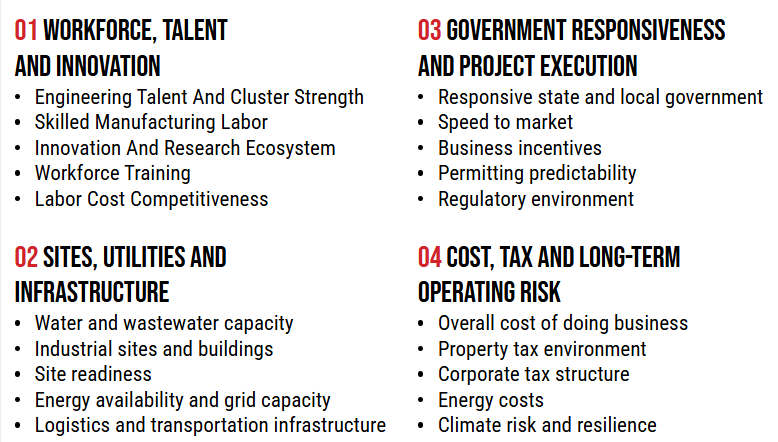
The rankings are based on four broad categories: 1. Workforce, talent, and innovation, 2. Sites, utilities, and infrastructure, 3. Government responsiveness and project execution, and 4. Cost, tax, long-term operating risk.
Each of the four areas have five subcategories, which are identified below.
Where Virginia Is Doing Well
Workforce, Talent, and Innovation
“Workforce,” AD writers, has become a catch-all term for a range of questions that companies looking to site a business explore. Among the factors considered are whether it can hire sufficient people at launch, are there a sufficient number of engineers and technical managers, is there a training system available for when processes change, and can the business carry the labor costs at scale?
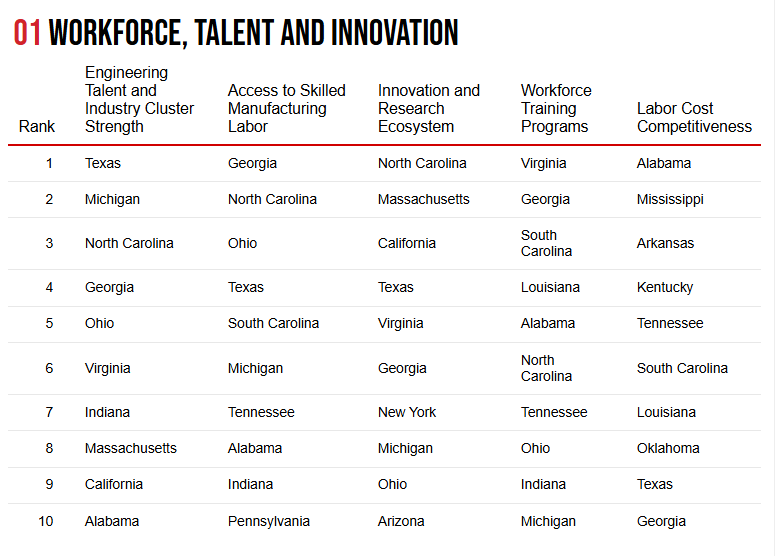
Virginia was at the top of the list for workforce training, and made strong showings in both the engineering talent and industry cluster strength subcategory, and the innovation and research ecosystem subcategory. It did not receive a Top 10 ranking the remaining two categories.
Sites, Utilities, and Infrastructure
This category is one that is undergoing a significant shift. And that shift is due in part to the rising importance of digital infrastructure.
The AD rankings noted that while acreage and access to highways remain important, companies today are asking a different set of questions, including: is there enough power and can it be delivered on schedule, is water capacity in place or being planned for, and can a site support construction?
“Site readiness has really overtaken talent as a priority,” said Monty Turner, Senior Vice President at Colliers to the editors of the AD rankings. “I’m thinking not only about the availability of sites or buildings, but the infrastructure to support them — including water and wastewater capacity.”
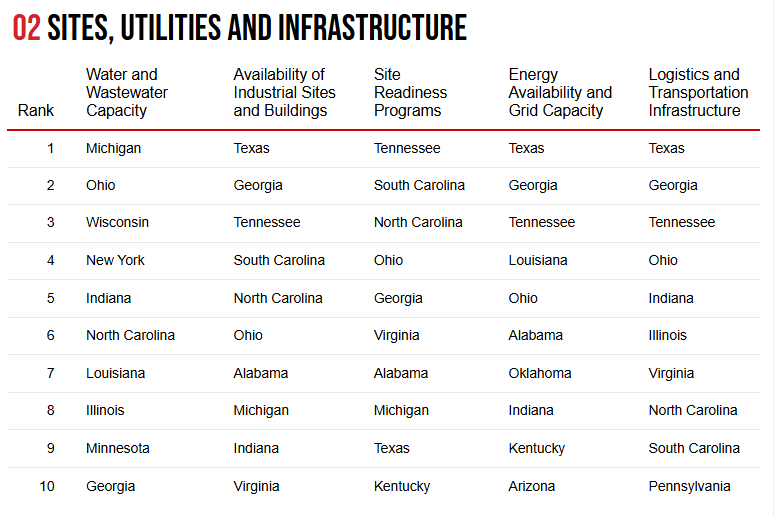
The rising importance of site readiness is an area where Virginia is holding steady, but arguably has work to do. The commonwealth ranked in the Top 10 in three areas: Availability of industrial sites and buildings (No. 10), site readiness programs (No. 6), and logistics and transportation infrastructure (No. 7). It did not crack the Top 5 in any of these.
 Where Virginia Is Lagging
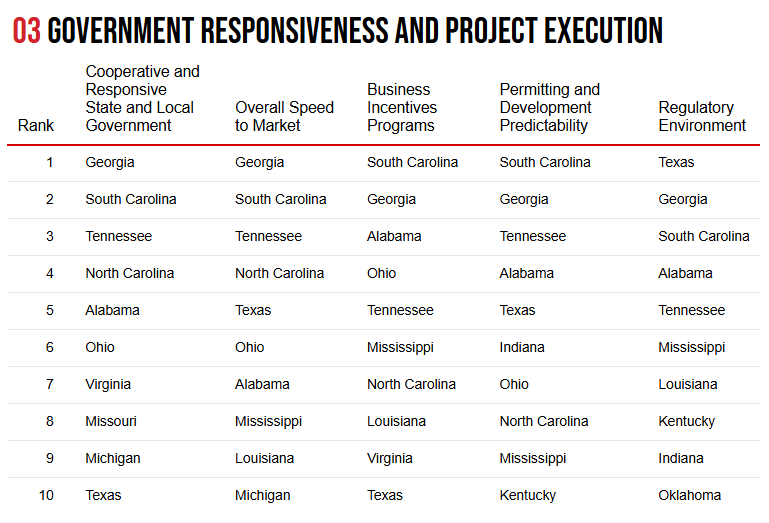
While there is good news to be had in the first two categories, the commonwealth is struggling in the remaining two, according to AD rankings.
Government Responsiveness and Project Execution
Traditionally viewed as a “soft factor,” government responsiveness and project execution are growing in importance.
Sven Gerzer with Principal at Parker Poe Consulting’s Location Solutions, told AD that “Clients pick up quickly on whether things work smoothly in a community…. When the state and local teams have worked things out before a project comes in, you can see it. They are prepared, and the process runs smoothly.”
Virginia received a Top 10 ranking in just two of the five subcategories: Cooperative and responsive state and local government (No. 7), and business incentive programs (No. 9).
The 2025 rankings were structured differently, but of the 15 categories that study ranked, “Cooperative state and local government” had Virginia ranked 7th. In 2024 the state ranked 8th.
While the 2026 ranking does not reflect a drastic shift in perception, this will be a category to monitor in 2027, as the state tightens government oversight of data center development and localities continue to push back on siting data centers in their communities.
Cost, Tax, and Long-term Operating Risk
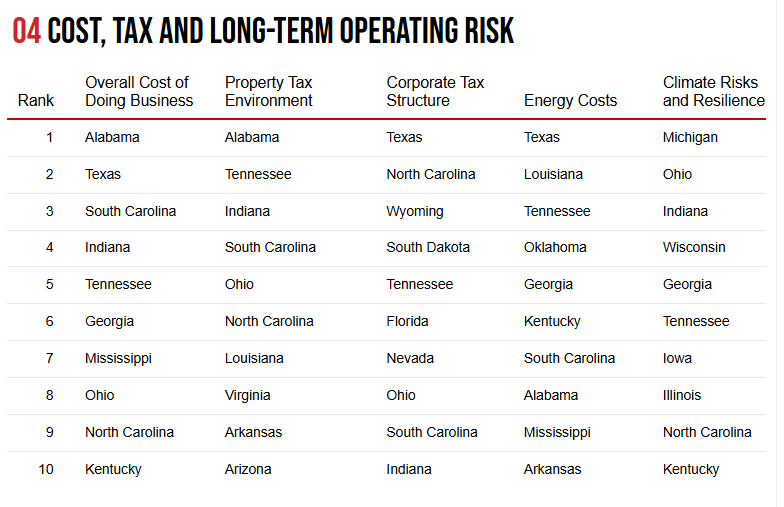
The fourth category is where Virginia ranked poorest. It earned a Top 10 rank in just one subcategory, property tax environment (No. 8).
This category is one that AD describes as “more fragmented” than the other three. This is because costs are not as straight-forward as start-up expenses, or tax rates. The probability of natural disasters and the risk of exploding costs down the road factor into companies’ siting planning.
Robby Burgan, State and Local Tax Managing Director at Crowe, told AD “What never gets skewed is the cost of doing business…. If your power costs twice as much in New York as it does in Alabama, that is going to be a significant obstacle because you are comparing power to power. The same is true of water and other utilities. Those operating costs are what companies are looking at.”
A Dynamic Environment
Business environments are ever-shifting, but the AD rankings highlight two areas of note.
The first is anti-growth sentiment, which has been prominent across the country especially as it relates to data centers. And it’s especially notable in Virginia.
While Gov. Spanberger made the decision not to bow to those demanding a moratorium on data center development, her Executive Order 22 does raise the bar on such projects. How the AD factors — or doesn’t factor — that into their rankings for 2027 will be worth watching.
Second, while the South continues to dominate the listings, there is a growing awareness that the playing field is leveling.
In some sense, the South is becoming a victim of its own success, as labor markets in the region tighten, shovel-ready sites decline as companies occupy them, and infrastructure strains tighten.
The Midwest in particular is poised to benefit, as the costs of doing business — once almost always less in the South — are leveling out across the country.
“Midwestern states,” AD magazine writes, “are converting long-standing industrial assets — engineering talent, water, transportation networks and manufacturing clusters — into a renewed location proposition.”
This does not mean that growth is about to make a regional shift from the South to the Midwest. It does mean that siting decisions are likely to become more “project-specific,” according to AD. The state with the right mix of measures that fit a particular project will have an advantage over states with fewer matches.
Strengthening offerings across a range of areas that appeal to business, in other words, and not being too focused on any one, will be important as states work to grow their economic development in the coming years.